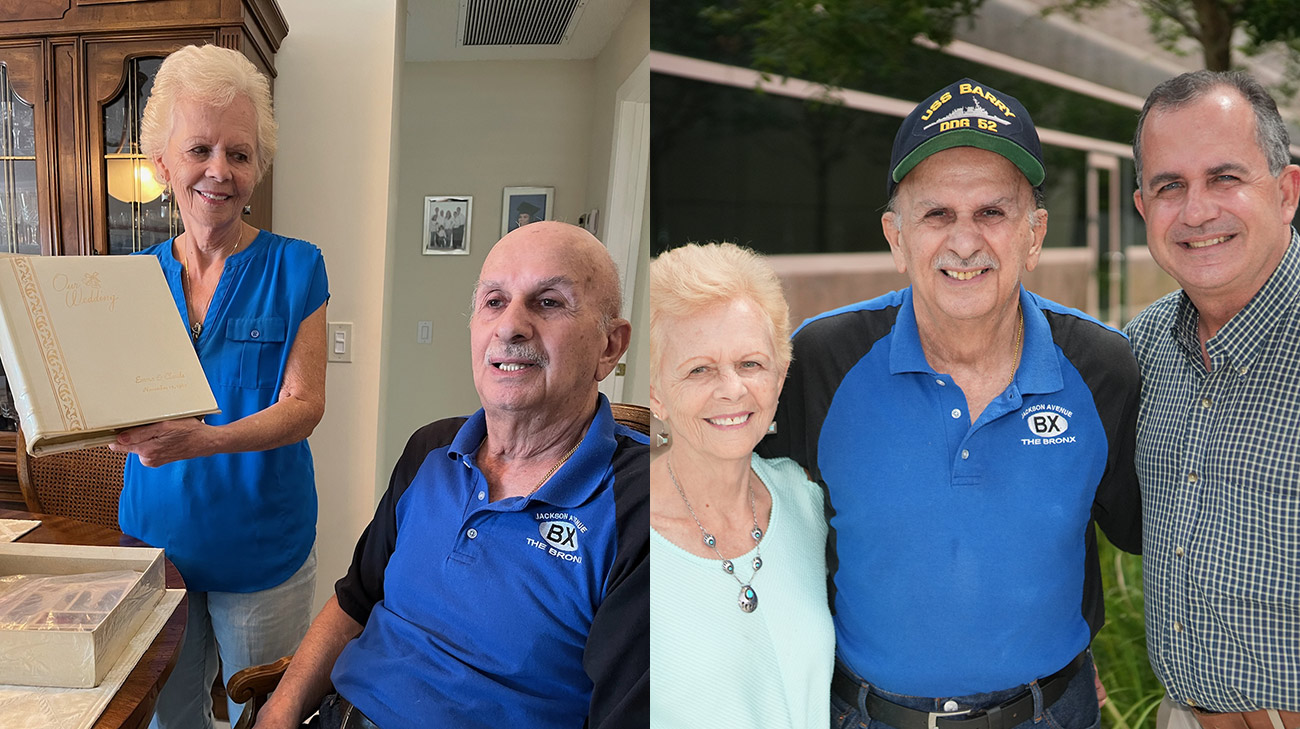
When Emma Noriega learned her husband, Claude, had stage III bladder cancer, she was fearful she might lose him.
At 84 years old, Claude not only survived the cancer, but has been able to return to a normal life.
“I’m so happy we have more time together,” Emma says. “Each day is a gift.”
Claude credits his strong, loving family, and a team of “excellent doctors and nurses” for pulling him through the cancer diagnosis and treatment. “I feel fantastic,” he says.
His Cleveland Clinic Florida physicians, Rafael Arteta-Bulos, MD, hematologist/oncologist, Alberto Pieretti, MD, urologic oncologist, and Christopher Fleming, MD, radiation oncologist, were extremely pleased with the outcome, particularly due to Claude’s age and advanced stage bladder cancer.
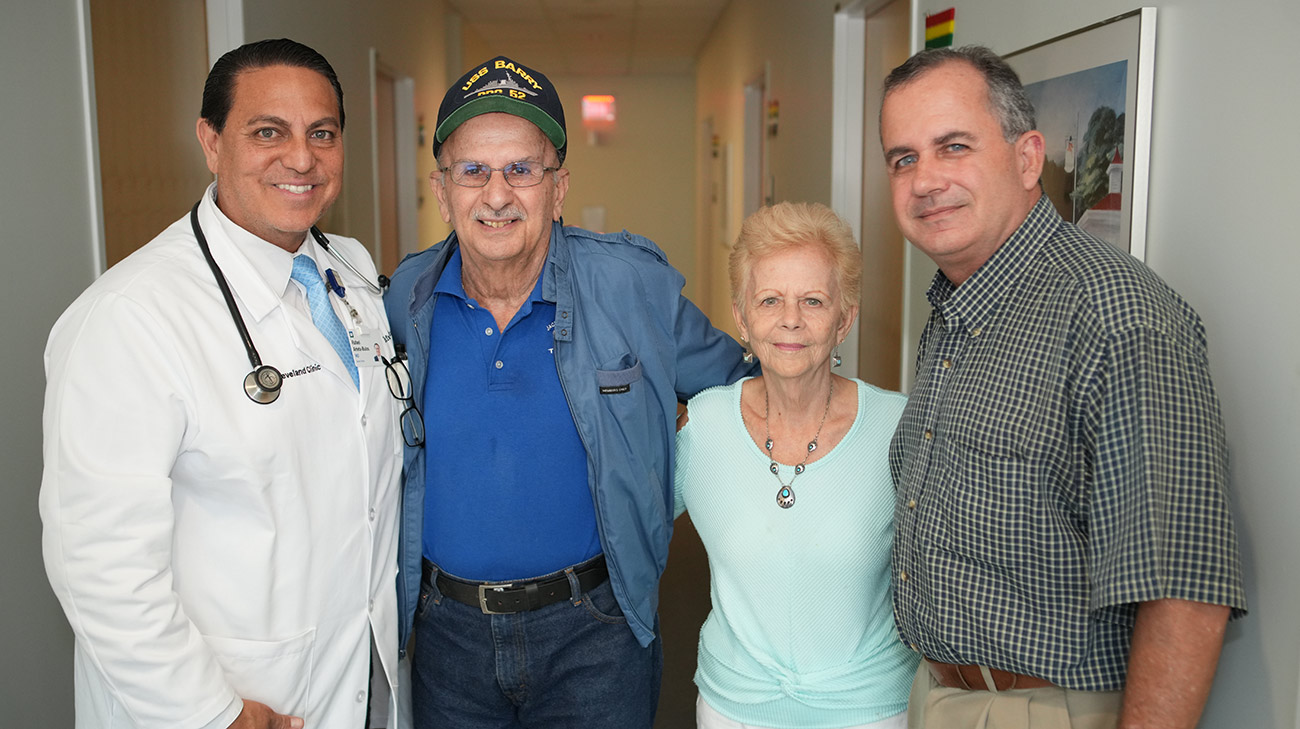
“When I met Mr. Noriega, he had advanced bladder cancer with a tumor obstructing one of his kidneys and lymph node involvement,” Dr. Arteta says “He was not a candidate for surgery, so our first line of treatment was systemic chemotherapy.”
When the cancer did not respond to the chemotherapy as they had hoped, Drs. Arteta, Pieretti and Fleming reviewed Claude’s options with both him and his family. Their decision was to treat Claude with immunotherapy and a new drug, an antibody drug conjugate, designed to target and kill tumor cells while sparing healthy cells.
“The chemo took a lot out of my dad,” says Carl Noriega, one of Claude’s three sons. “With immunotherapy and the newer drug, he got his life back. It made a huge difference for my father.”
The Noriega family will never forget the day Dr. Pieretti told them Claude was cancer-free. “He said, ‘the tumor is gone,’’ Carl says. “That changed everything.”
“This modern approach has dramatically changed the outcome for patients like Mr. Noriega,” says Dr. Pieretti, who specializes in genitourinary cancers. “He achieved a complete response, and we were able to preserve his bladder and offer him a better quality of life and life expectancy.”
The Noriega family has long counted on Cleveland Clinic Weston Hospital for their health care needs; they could not be more pleased with the care Claude received during his cancer treatment. “When my father was diagnosed, we wanted to be sure he received the best care possible,” Carl says.
“At Cleveland Clinic we are fortunate to be able to offer our patients the best, and latest, treatment options,” Dr. Pieretti says.
Throughout his treatment, Claude felt the support and caring of two families: that of his wife, sons, and his sons’ families, and that of his care team. “The doctors and nurses treated me like I was part of their family,” he says. “I felt at home with them.”
Now cancer-free, Claude looks ahead to special family events, like his and Emma’s 60th wedding anniversary in 2025.
For Emma’s part, she says, “I’m making sure he takes good care of himself!”
Photos courtesy of Emma and Claude Noriega
Patient Stories
Cleveland Clinic Team Helps Florida Patient Breathe Easier After Complex Lung Surgery
Oct 21, 2026

Teen Athlete Returns to Sports After Two Head Injuries Trigger Yearlong Headache
Oct 19, 2026