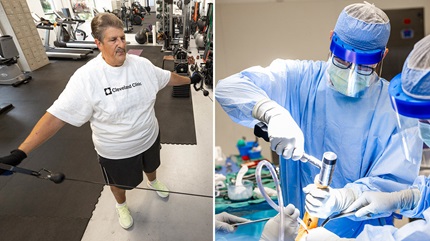
Brent Boyle was coaching a little-league softball tournament and woke up with a tingling and numbness in his fingers and toes.
"I just kind of brushed it off, as it will go away as I get through the day and get moving. When I woke up the next morning, my entire body was numb. I couldn't hardly pick my head up off the pillow. I couldn't really talk. Even my respiratory was slowing down [sic]," says Brent.
That's when he told his wife that they needed to go to the hospital.
Brent was transported two hours to the Cleveland Clinic, after his local hospital decided they were not adequately equipped to treat him.
"I know when they took him into the ICU that... I saw him struggle. So I didn't know," says Brent's wife Jody.
"He was completely quadriplegic. He could not move any of his arms or legs, and he was so weak from a respiratory standpoint that he had to be intubated and placed on a breathing machine. It's very crucial during the time that patients are so incapacitated that they need to be mobilized. They need to keep moving, there are all kinds of medical complications that can occur just from being in bed."
Diagnosed with Guillain-Barre Syndrome, an auto-immune process that attacks the peripheral nerves and the nerve coverings.
"He was completely quadriplegic. He could not move any of his arms or legs, and he was so weak from a respiratory standpoint that he had to be intubated and placed on a breathing machine. It's very crucial during the time that patients are so incapacitated that they need to be mobilized. They need to keep moving, there are all kinds of medical complications that can occur just from being in bed," says Dr. Edward Manno, a neuro intensivist at the Cleveland Clinic Cerebrovascular Center.
As Brent's condition stabilized enough for him to be safely mobilized, a team of caregivers got him out of bed and moving using bedside safe patient handling equipment.
"We know that for every day that you're in bed, it's three days of rehabilitation, because you decondition that quickly," says Kate Klein, CNP of Pulmonary Medicine at the Cleveland Clinic.
Due in part to the early functional mobility provided by the Cleveland Clinic to Brent, he was discharged only five days after starting the mobility program.
"It's probably one of the largest rewards that you can have when working in this profession. I can think of no better case than this," Dr. Manno says.
Related Institutes: Neurological InstitutePatient Stories
Cleveland Clinic Team Helps Florida Patient Breathe Easier After Complex Lung Surgery
Oct 21, 2026

Teen Athlete Returns to Sports After Two Head Injuries Trigger Yearlong Headache
Oct 19, 2026