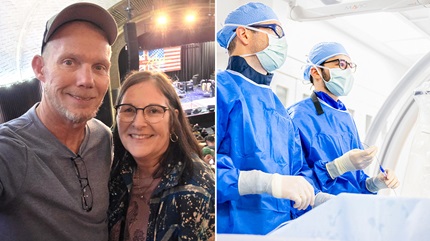
In early 2019, Kathleen Shaffer was diagnosed with right breast cancer. She had a lumpectomy and two lymph nodes removed in March followed by chemotherapy, then radiation.
Just when she thought cancer was behind her and she could move on with her life, she developed pain and swelling underneath her breast and arm. Her doctor told her she had acquired (secondary) lymphedema.
The lymphatic system is the third vascular system besides arteries and veins. Lymphedema develops when the lymphatic system is underdeveloped (primary) or injured (secondary). As a result, lymphatic fluid collects in body parts causing pain, loss of function and disfigurement. In the U.S., cancer treatment is the most common cause of this damage, affecting 1 in 1,000 people, most often women who have been treated for breast cancer.
Upon diagnosis, Kathleen began lymphedema therapy which requires lifelong commitment of compression bandaging, garments and lifestyle modification. In search of less demanding treatment alternatives, she found Dr. Wei Chen, co-director of the Center for Lymphedema Research and Reconstruction at Cleveland Clinic.
Until recently, lymphedema was considered an untreatable and incurable condition. Modern advances in reconstructive microsurgery and supermicrosurgery have changed that. There are just a dozen surgeons across the country trained to perform these procedures and Dr. Chen is one of them.
“The mainstay of lymph surgery – lymph node transfer – was created in 1990. With supermicrosurgery, we came up with lymph vessel transfer, or lymph node transfer 2.0. Using supermicrosurgery we can work with lymph vessels as small as 0.1 millimeters, allowing us to transfer functioning lymph vessels while completely preserving lymph nodes,” says Dr. Chen.
Kathleen had her first appointment with Dr. Chen in March 2020. After learning she also had swelling in her legs for years, in addition to arm swelling that started following cancer treatment, Dr. Chen suspected primary lymphatic insufficiency exacerbated by lymphatic injury caused by cancer treatment. This diagnosis was confirmed when an indocyanine green (ICG) lymphography test demonstrated compromised lymphatic system not just in her arm, but in both of her legs as well.
“Primary lymphatic insufficiency is commonly undetected due to a pervasive underappreciation of this disease. This results in suboptimal treatment because it cannot be treated effectively without an accurate diagnosis,” says Dr. Chen.
After completing a thorough diagnostic workup, Kathleen was presented with treatment options including lymph vessel transfer.
“It was a full day. Dr. Chen explained all my options. He’s very confident, but also compassionate. I chose the most drastic option that would have the most impact. He knew what the end result would be, and what I would need to do to get there. I was willing to go though some discomfort to be healthy for myself and my family, to be able to do what I want to do,” says Kathleen.
On October 22, 2020, Dr. Chen performed lymph vessel transfer surgery on Kathleen, harvesting a piece of lymph vessel from under her left armpit and transferring it to her right arm. “Her result was phenomenal. One day after surgery, the pain and swelling in her breast was gone and the swelling in her arm and legs were significantly improved,” says Dr. Chen.
10 months after surgery, Kathleen was free of all lymphedema symptoms. She no longer experienced pain and swelling in her arm, breast or legs. She also stopped wearing compression garments. A bioimpedance spectroscopy and ICG study confirmed absence of swelling and significant improvement in lymph drainage.
“Kathleen’s case is unique in that the reconstructive surgery performed to treat lymphedema of her right arm exerted therapeutic effects on not just her arm, but on her breast and legs,” says Dr. Chen. “It’s important for those who are currently suffering with lymphedema to know that effective treatments do exist, and that we can beat lymphedema.”
Related Institutes: Dermatology & Plastic Surgery Institute, Cleveland Clinic Cancer CenterPatient Stories
Exercise Medicine Program Helps Man Prepare for Surgery and Reclaim an Active Life
Oct 9, 2026

‘Cornstarch Keeps My Son Alive’: Boy Eats Raw Cornstarch Daily To Manage Rare Metabolic Disorder
Oct 8, 2026