



Akinesia is when your body struggles to start moving, even though your brain tells it to. It’s often linked to Parkinson’s and related conditions. You might feel frozen mid-step or stuck in place. With the right care, you can manage these symptoms.
Advertisement
Cleveland Clinic is a non-profit academic medical center. Advertising on our site helps support our mission. We do not endorse non-Cleveland Clinic products or services. Policy
Akinesia is a loss or near loss of movement. It happens when your body has trouble starting a movement or doesn’t move at all. You might feel “frozen” mid-step or struggle just to get going.
Advertisement
Cleveland Clinic is a non-profit academic medical center. Advertising on our site helps support our mission. We do not endorse non-Cleveland Clinic products or services. Policy
Akinesia is different from bradykinesia. This is moving more slowly than usual. While both can happen in Parkinson’s disease and similar conditions, akinesia refers specifically to difficulty starting or producing movement — not just moving slowly.
Treatment options are available. Your care team can help you manage it and the underlying cause.
With this symptom, your brain tells your muscles to move — but they don’t always get the message. That disconnect can make everyday tasks feel hard or impossible. Depending on how severe it is, you might have:
Feeling stuck or unable to move can be frightening. You might feel anxious or panicked during freezing episodes.
In rare and severe cases of Parkinson’s disease or related Parkinsonian syndromes, you may develop an akinetic crisis (also called an akinesia crisis). During this emergency, symptoms may suddenly get much worse. You might experience:
Advertisement
Akinesia may affect a developing fetus. Fetal akinesia is when a fetus doesn’t move or moves less than expected. You may notice fewer kicks or feel that something isn’t quite right during pregnancy.
In many cases, fetal akinesia links a genetic disorder that affects how nerves and muscles develop or work. These changes can make it harder — or sometimes impossible — for a fetus to move before birth.
Fetal akinesia can be part of a condition called fetal akinesia deformation sequence (FADS). FADS is a serious disorder that affects how a fetus’s body develops during pregnancy. In some cases, it can lead to stillbirth. Babies born with FADS may have underdeveloped lungs or small lower jaws.
These are difficult realities to face. Your care team will be with you every step of the way to help guide testing, answer questions and provide support.
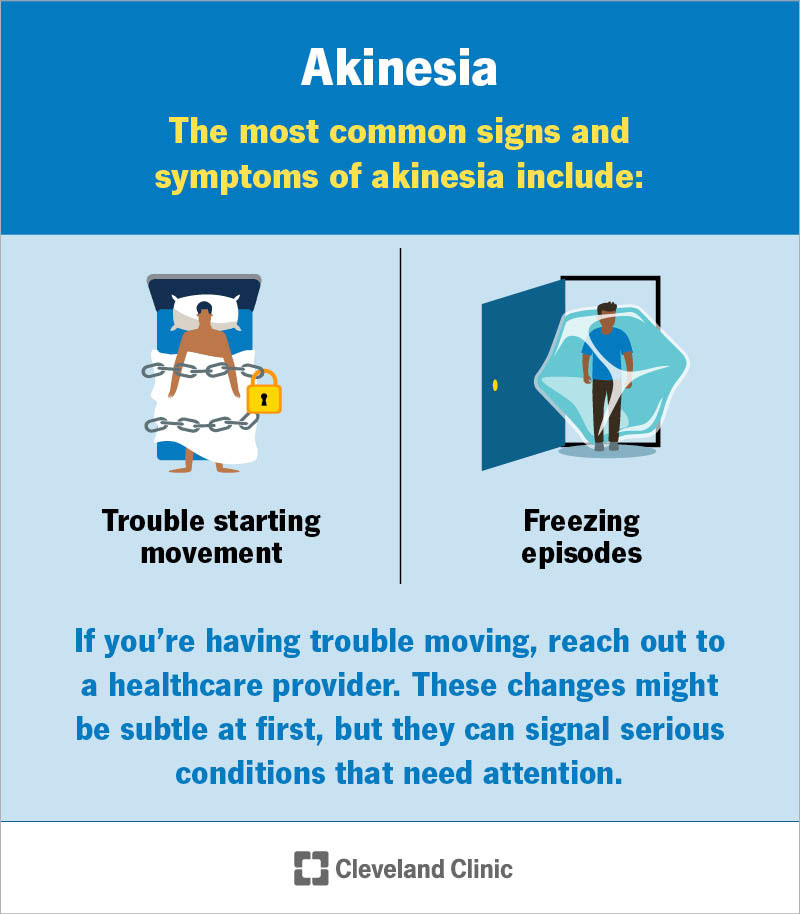
Image content: This image is available to view online.
View image online (https://my.clevelandclinic.org/-/scassets/images/org/health/articles/akinesia)
Akinesia happens when something affects the parts of your brain that control movement — especially areas like your basal ganglia and frontal lobes. These changes interfere with your brain’s ability to initiate or carry out movement.
Healthcare providers often group the causes into three main categories.
These are the most common causes of akinesia. They affect how your brain uses dopamine. This is a chemical that helps control movement. Conditions may include:
Rarely, akinesia may appear as part of a condition called pure akinesia with gait freezing. This is often considered part of the progressive supranuclear palsy (PSP) spectrum.
Sometimes, akinesia develops because of another condition or injury that affects movement centers in your brain. Examples include:
Certain dementias that affect your frontal lobes or movement circuits can also lead to this symptom. Frontotemporal dementia is one example.
There’s no cure for akinesia, but there are ways to manage it. Treatment varies based on the cause, but often includes a combination of the following:
Advertisement
Without treatment, this symptom may cause many serious and sometimes life-threatening problems, like:
If you’re having trouble moving, reach out to a healthcare provider. These changes might be subtle at first, but they can signal serious conditions that need attention, like Parkinson’s or other brain and nerve problems.
If you suddenly can’t move at all, have trouble swallowing or feel very confused, seek medical help immediately. This can be an emergency.
Akinesia may feel like your body is holding you back — even when your mind is ready to move. Whether it’s difficulty getting started or suddenly feeling frozen mid-step, these moments can be frustrating, frightening and hard to explain.
But you’re not without options. Treatment and therapy can make a real difference, especially when they’re tailored to the condition causing symptoms. The sooner you connect with a care team, the sooner you can begin finding ways to move more freely and safely again.
Advertisement



Sign up for our Health Essentials emails for expert guidance on nutrition, fitness, sleep, skin care and more.
Learn more about the Health Library and our editorial process.
Cleveland Clinic’s health articles are based on evidence-backed information and review by medical professionals to ensure accuracy, reliability and up-to-date clinical standards.
Cleveland Clinic’s health articles are based on evidence-backed information and review by medical professionals to ensure accuracy, reliability and up-to-date clinical standards.
Parkinson’s disease, essential tremor and dystonia are common movement disorders. And Cleveland Clinic has the expert care and support you need to manage them.
