



Mini gastric bypass (one anastomosis) is a weight loss procedure. A surgeon creates a smaller, narrower stomach and connects it to your small intestine. It differs from traditional gastric bypass by using one intestinal connection. Both surgeries reduce stomach size and limit calorie absorption. A mini gastric bypass is less complex.
Advertisement
Cleveland Clinic is a non-profit academic medical center. Advertising on our site helps support our mission. We do not endorse non-Cleveland Clinic products or services. Policy
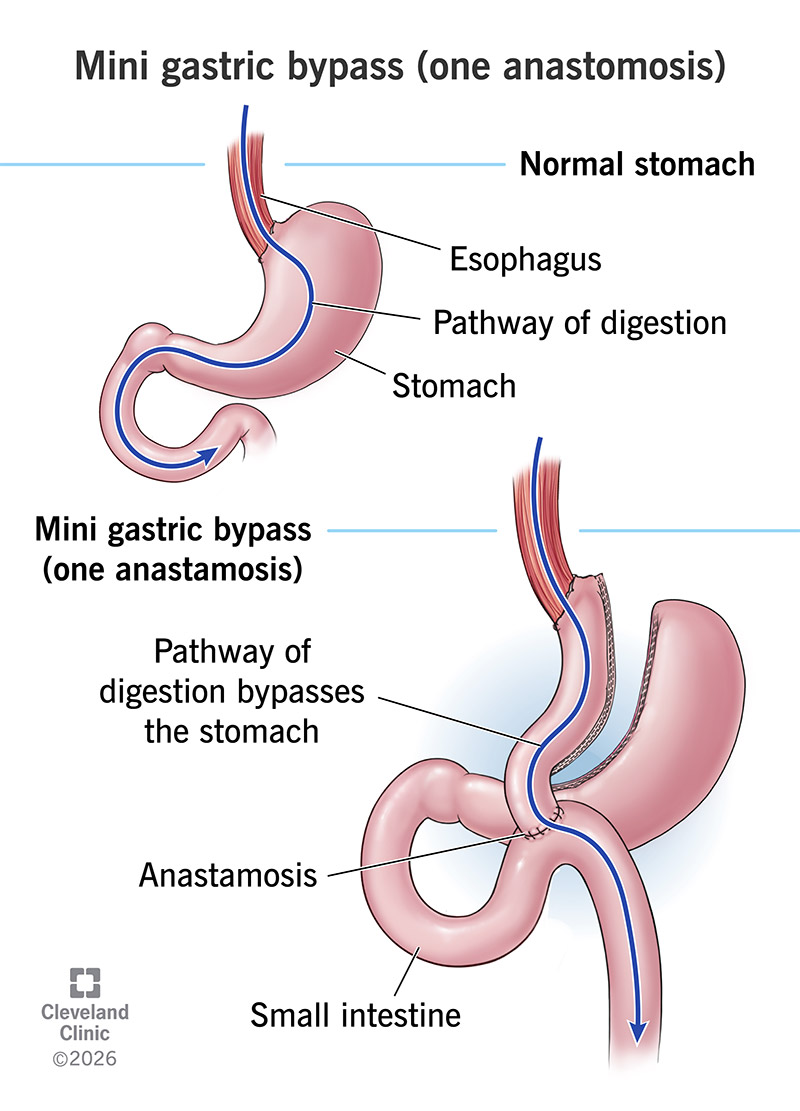
Image content: This image is available to view online.
View image online (https://my.clevelandclinic.org/-/scassets/images/org/health/articles/mini-gastric-bypass.jpg)
A mini gastric bypass (MGB) is a type of weight loss surgery. It involves a surgeon making your stomach narrower and connecting it in a loop to the middle of your small intestine.
Advertisement
Cleveland Clinic is a non-profit academic medical center. Advertising on our site helps support our mission. We do not endorse non-Cleveland Clinic products or services. Policy
A smaller stomach limits how much food you can eat. The intestinal loop connection allows food to skip the first part of your intestine. This decreases how many calories and nutrients your body digests and absorbs.
MGB is different from traditional gastric bypass surgery (also called Roux-en-Y) because of how your stomach and small intestine connect. The traditional method makes your stomach smaller and reroutes your stomach and small intestine using two connection points. With a mini gastric bypass, there is just one connection point. This makes the surgery less complex.
This procedure is sometimes called one anastomosis or omega loop bypass.
A mini gastric bypass works in these ways:
These effects can lead to significant weight loss for people with Class III obesity and/or obesity-related health conditions.
Advertisement
Your healthcare provider will give you specific instructions on how to prepare. You may have to go to appointments to make sure you understand the procedure and recovery process.
Other things you may expect include:
A mini gastric bypass uses minimally invasive techniques, like laparoscopic or robotic surgery. These methods use small cuts, which help you recover faster.
You can expect the following to happen during the procedure:
It takes about two hours. You’ll need to spend one to two days in the hospital afterward.
The main advantage is that it’s effective for weight loss. Losing weight can help with many health conditions, like Type 2 diabetes, high cholesterol, high blood pressure and sleep apnea.
Some of the advantages of a mini gastric bypass compared to a traditional gastric bypass are:
Some of the main risks and disadvantages are:
You’ll need a few weeks to recover after the procedure. Your healthcare provider can let you know what to expect. You may need to avoid strenuous activity for up to six weeks. It may take up to 12 weeks to go back to a typical diet.
Your provider will monitor you — usually for the rest of your life — to make sure the surgery is working as expected. They’ll check for vitamin and mineral deficiencies. They’ll work with you to adjust your diet and supplements to help you stay healthy.
Advertisement
It’s one of the more effective bariatric surgeries for weight loss. One study showed that people with a mini bypass had up to 73% excess weight loss compared to 60% for traditional bypass after five years. Your results may be different. Talk to your healthcare provider about what you can expect based on your health history.
Contact your provider if you have any of the following after surgery:
You’ll need several follow-up appointments with your provider to make sure the surgery was successful and that you’re getting the nutrients you need. It’s important that you don’t miss or skip these appointments.
Mini gastric bypass is one solution your provider may suggest for Class III obesity and other health conditions. If you’ve tried other methods to lose weight and haven’t seen the results you hoped for, mini bypass may be an option. When coupled with a healthy diet and regular exercise, it can offer life-changing weight loss results. Talk with a healthcare provider to decide if mini gastric bypass is right for you. Together, you can review the benefits, risks and long-term care needed to help you maintain a healthier weight.
Advertisement



Sign up for our Health Essentials emails for expert guidance on nutrition, fitness, sleep, skin care and more.
Learn more about the Health Library and our editorial process.
Cleveland Clinic’s health articles are based on evidence-backed information and review by medical professionals to ensure accuracy, reliability and up-to-date clinical standards.
Cleveland Clinic’s health articles are based on evidence-backed information and review by medical professionals to ensure accuracy, reliability and up-to-date clinical standards.
If you have obesity and losing weight is an uphill battle, Cleveland Clinic experts can help you decide if bariatric surgery is an option.
