



A bullectomy is a surgery to remove pockets of trapped air that are compressing your lung tissue. This procedure may help you breathe better. Surgeons often use a minimally invasive approach for this procedure. You’ll need a hospital stay and follow-up visits afterward.
Advertisement
Cleveland Clinic is a non-profit academic medical center. Advertising on our site helps support our mission. We do not endorse non-Cleveland Clinic products or services. Policy
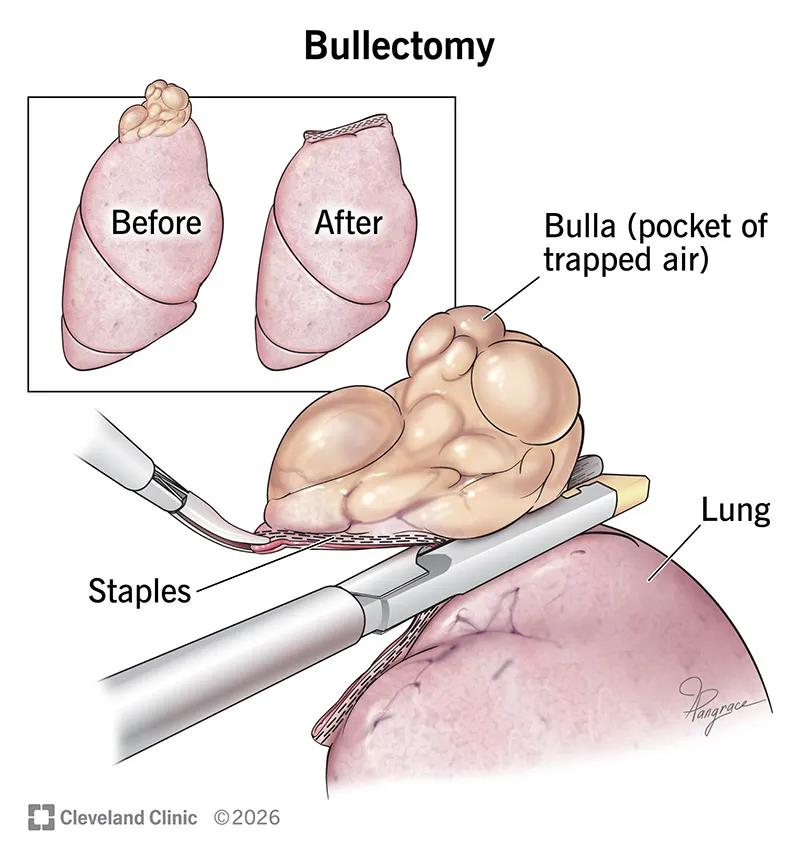
Image content: This image is available to view online.
View image online (https://assets.clevelandclinic.org/transform/4f02ff3a-f090-487f-acb4-2e37c945003a/Bullectomy-Illustration-25-HVI-7460558)
A bullectomy is a surgical procedure to remove one or more bulla(e) from your lungs. A bulla is a pocket of trapped air in your working lung tissue. It comes out of damaged tissue when you have bullous emphysema.
Advertisement
Cleveland Clinic is a non-profit academic medical center. Advertising on our site helps support our mission. We do not endorse non-Cleveland Clinic products or services. Policy
Why it’s done:
You’ll likely need a chest X-ray and CT scan that can show where the bullae are and their size. Imaging can also show a collapsed lung. You may also need to do:
For the best results, your healthcare team may suggest you do these things before surgery:
A surgeon may access your chest through a large cut (thoracotomy) or several small cuts (minimally invasive approach). The minimally invasive approaches can take place through VATS (video-assisted thoracic surgery) or robotic surgery. In robotic surgery, your surgeon has complete control of the robotic instruments.
Your surgical care team will:
Advertisement
The median time for this procedure is 90 minutes to over two hours. That means half of cases are below that range and half are above it.
A bullectomy procedure can help your lungs work better for many years afterward. You may find you can walk longer distances or climb more stairs than you could before surgery. You might have better results from the procedure if you only had one bulla or if the bullae were all in one area.
Occasionally, a surgeon can perform the same procedure on the other lung if bullae are present on both sides. This is often many months after the original surgery to allow for appropriate healing.
Your surgeon will do their best to prevent complications. But some are common. Complications may include:
In rare cases, some people can die from lung failure.
You’ll receive medicine for pain and supplemental oxygen. You may have a chest tube to drain fluid. A provider will usually remove it before you go home. Your healthcare team will ask you to get out of bed as soon as you can on the day of your bullectomy surgery. You can expect to start physical therapy the day after surgery.
If you had a collapsed lung, your provider will do a chest X-ray to make sure your lung expanded well.
Length of stay after surgery is usually more than one day. It’s often at least three days.
You can expect to have follow-up visits with your healthcare provider. You may have a chest X-ray within the first few weeks after surgery.
Contact your provider if you have shortness of breath or chest pain after surgery.
When you can’t catch your breath, it’s hard to think about anything else. A bullectomy procedure may bring relief. Ask your healthcare provider any questions you have about this surgery. Other treatment options exist, but their results may not last as long.
Advertisement



Sign up for our Health Essentials emails for expert guidance on nutrition, fitness, sleep, skin care and more.
Learn more about the Health Library and our editorial process.
Cleveland Clinic’s health articles are based on evidence-backed information and review by medical professionals to ensure accuracy, reliability and up-to-date clinical standards.
Cleveland Clinic’s health articles are based on evidence-backed information and review by medical professionals to ensure accuracy, reliability and up-to-date clinical standards.