



Exercise is a great way to stay healthy. But it can affect your health if you’re burning so many calories that your body doesn’t have enough energy to function properly. RED-S can affect anyone at any age. A healthcare provider or registered dietitian will help you create an eating plan that meets your nutrition and performance goals.
Advertisement
Cleveland Clinic is a non-profit academic medical center. Advertising on our site helps support our mission. We do not endorse non-Cleveland Clinic products or services. Policy
Relative energy deficiency in sport (RED-S) is a health condition that can happen when you burn more calories from exercising than you take in. It can hurt your body if it goes on for a long time.
Advertisement
Cleveland Clinic is a non-profit academic medical center. Advertising on our site helps support our mission. We do not endorse non-Cleveland Clinic products or services. Policy
Calories in the food you eat every day are the energy your body needs to perform — not just for your sports and workouts, but to stay alive. You need energy for your organs to work properly.
RED-S used to be called the female athlete triad. But healthcare providers have changed its name to recognize that it can affect anyone, even if it’s more common in female athletes.
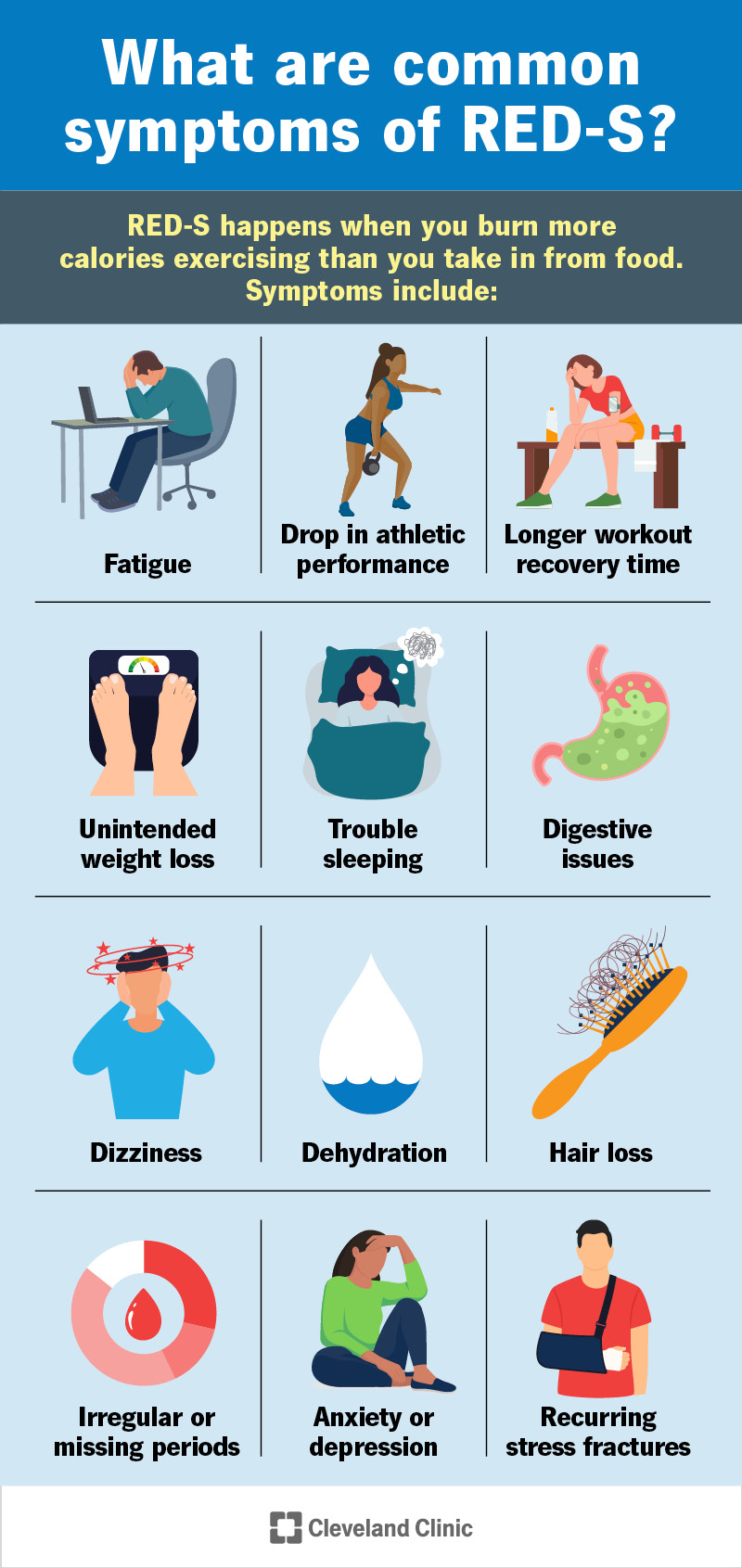
Image content: This image is available to view online.
View image online (https://my.clevelandclinic.org/-/scassets/images/org/health/articles/red-s-infographic)
Burning more calories than you take in every once in a while isn’t harmful. But RED-S sets in when it happens too often. Your body is using more energy than it’s getting from food. The sustained calorie deficit will start to affect your health. This can lead to lots of symptoms, including:
Relative energy deficiency in sport can also cause issues that aren’t as easy notice, including:
Advertisement
Burning more calories than you consume too often can lead to RED-S. It can happen to anyone, but it’s most common in athletes and people who are very active.
Your body turns the food you eat into energy that fuels your body. It needs energy to keep your heart pumping, lungs breathing and brain functioning. That’s why you burn calories constantly, even when you’re sleeping or sitting still.
Working out, playing sports or doing any physical activity increases how many calories you use. RED-S happens when you aren’t getting enough calories to make up for the ones you've burned. That’s what its name means:
Nutrition is a complex science that affects everyone differently. But in the simplest terms, you need to take in calories from food and drinks to balance out how many you’re burning while you exercise. If you do a lot of intense workouts or train all the time, you might be using more calories than you realize.
Some people intentionally eat fewer calories than they need. But even if you’re trying to lose weight, your body still needs enough energy to function. You shouldn’t skip meals or withhold food from yourself to lose weight. A healthcare provider or dietitian can help you set a healthy calorie target.
Having an eating disorder can also lead to RED-S. Having an eating disorder isn’t a sign of weakness or that you don’t have enough willpower. It’s a health condition with complex causes. Talk to a healthcare provider or someone else you trust if it feels like eating, exercising or thinking about food is causing you extra stress or hurting you.
A healthcare provider will diagnose RED-S with a physical exam and by asking about your health and nutrition. Tell your provider if you’ve noticed any symptoms and when they started. Explain how you train, which sports you play and how active you are in general.
Your provider will examine your body if you have pain or any injuries. They might ask about what kinds of food you eat most often and how much you’re eating. They’re not trying to trick you or make you feel bad. There’s no right or wrong answer. They just want to understand why you might not be getting enough calories. Tell them if you’re having any negative thoughts about food or your body.
Advertisement
Your provider might suggest some tests to check for injuries or signs of other issues in your body. You might need:
Balancing how many calories you take in compared to how many you burn is the most important part of managing RED-S.
There’s no one-size-fits-all solution that works for everyone. Your healthcare provider may suggest that you work with a registered dietitian. They’ll help you come up with an eating plan that meets your needs. Your dietitian will help you maximize your performance while getting the right nutrition.
You might need to take a break from exercise, training or playing sports to help your body leave the unsafe calorie deficit. If you feel like it’s impossible for you to stop exercising, you might want to meet with a mental health specialist.
It can be tricky to diagnose RED-S. This condition can cause lots of symptoms that might not seem related. Noticing that something feels off is usually the first sign. You know your body better than anyone. See a healthcare provider if you feel like your athletic performance is dipping or if you have any symptoms — especially if you feel like you’re having a tough time managing what you eat.
Advertisement
You should be able to resume training or working out once you’re getting a safe number of calories. Even if you need to take a break to rest while your body adjusts, you should be able to get back to your sport after a while. Your healthcare provider will let you know when it’s safe for you to resume playing or training again.
RED-S can be a serious condition. But it’s manageable. Athletes and active people sometimes feel like they’re failing by asking for help. That’s not the case. RED-S is a health condition, not a sign that you’re cutting corners on your training. Getting the right amount of nutrition will help you feel better. It'll also make sure your body is able to keep up with you. Your performance and stamina should recover over time.
If you’re a competitive person, you’re probably used to pushing your limits. But “no pain, no gain” doesn’t apply to nutrition and your health. If you’re not getting the right amount of calories, it can start to affect your body and health. It might feel like taking a break to manage RED-S is annoying. But it’s worth it. And it’s what’s best for your body and performance over the long term. You’ll perform your best when you’re feeling your best.
Advertisement
Never feel silly about asking for help or talking to your healthcare providers about anything. Nutrition is a complex part of your training regimen, and it’s OK to ask questions about it. Think of your providers as key members of your training staff. They want you to feel and perform as best as possible, just like you do.



Sign up for our Health Essentials emails for expert guidance on nutrition, fitness, sleep, skin care and more.
Learn more about the Health Library and our editorial process.
Cleveland Clinic’s health articles are based on evidence-backed information and review by medical professionals to ensure accuracy, reliability and up-to-date clinical standards.
Cleveland Clinic’s health articles are based on evidence-backed information and review by medical professionals to ensure accuracy, reliability and up-to-date clinical standards.