



Poland syndrome is a rare condition present at birth. It mainly affects the chest muscles on one side of your child’s body. The muscles don’t form properly, so their chest can look uneven. The condition can also affect the hand, ribs or breast tissue on the same side. Most children have mild symptoms and don’t need treatment.
Advertisement
Cleveland Clinic is a non-profit academic medical center. Advertising on our site helps support our mission. We do not endorse non-Cleveland Clinic products or services. Policy
Poland syndrome is a rare condition that affects the chest muscles on one side of your child’s body. Typically, their pectoralis (pec) muscles are underdeveloped or missing. This can make their chest look lopsided and sunken in on one side.
Advertisement
Cleveland Clinic is a non-profit academic medical center. Advertising on our site helps support our mission. We do not endorse non-Cleveland Clinic products or services. Policy
In addition, your child may have differences in their hand on the same side of their body. The condition can also affect their arm, shoulder and other chest wall muscles of the same side. They may have underdeveloped breast and nipple tissue and/or missing or fused ribs or rib cage cartilage as well.
Other names for the condition include Poland sequence and Poland anomaly. It may cause physical differences, but it doesn’t affect your child’s cognitive (thinking) abilities. Depending on your child’s situation, they may not need treatment.
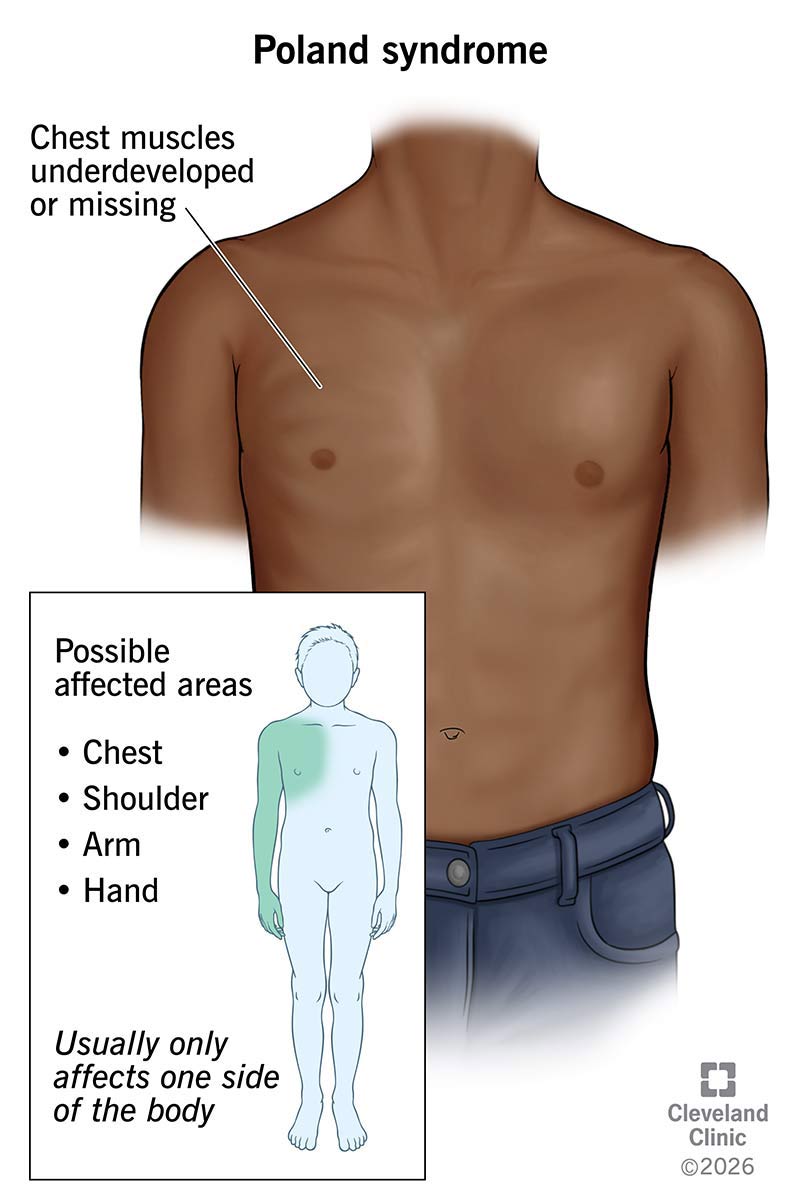
Image content: This image is available to view online.
View image online (https://my.clevelandclinic.org/-/scassets/images/org/health/articles/poland-syndrome.jpg)
Poland syndrome causes physical differences that are present at birth (congenital). The condition almost always affects only one side of your child’s body. It happens on the right side about twice as often as the left. The most common sign is a chest that looks uneven. One side is caved in because your child’s chest muscles didn’t fully form.
Poland syndrome signs may include one or more of the following on the affected side:
Your child may also have arm or hand differences on the same side. These can include:
Advertisement
In rare cases, Poland syndrome may affect your child’s internal organs. These can include an underdeveloped lung or kidney on one side. If their Poland syndrome is left-sided, they may also have a condition called dextrocardia. This is when their heart sits on the right side of their chest. Also, Poland syndrome can be associated with Moebius syndrome.
Researchers don’t know the exact cause of Poland syndrome. But they have a few theories, including:
Most likely, the condition occurs due to a blood flow problem during fetal development. Researchers believe a temporary disruption of blood flow to one side of the developing chest and arm happens at about the sixth week of development. This is when the subclavian artery is forming.
The subclavian artery supplies blood to the chest wall and upper arm. If blood flow is reduced at this stage, the tissues that become the chest muscles and arm may not develop fully. The blood flow theory is the most widely accepted.
Another theory is that exposure to teratogens during fetal development causes the condition. Teratogens are substances that can cross the placenta and lead to issues like birth defects.
Examples of teratogens include:
Most cases of Poland syndrome happen randomly, with no biological family history. Very rarely, the condition appears in generations of families. This suggests that genetics might play a role. But scientists haven’t identified a specific gene related to the condition.
The exact cause of Poland syndrome is still unknown. So, there are only a few recognized factors that may increase the risk. These include:
Your baby’s healthcare provider may be able to diagnose Poland syndrome at birth if signs are severe. Hand and arm differences can make the condition more obvious when your child is younger.
But you may not notice any signs of Poland syndrome until your child hits puberty. The difference between the two sides of your child’s chest may become more noticeable during this time. This is especially true for females. They may see a difference in their breast development.
Advertisement
Your child’s healthcare provider will perform a physical exam. They’ll carefully examine your child’s physical features. They’ll also ask you about any other signs or symptoms.
They may also request imaging tests to confirm the diagnosis. Imaging may include:
Treatment for Poland syndrome depends on your child’s signs and symptoms. Providers also factor in how the condition affects your child’s daily life. Some children don’t need treatment at all. Some don’t need it right away but may later. If your child has a hand difference, a hand surgeon may operate during early childhood. Surgery can improve function and appearance early on.
Reconstructive surgery is the most common treatment. It helps improve the look and function of your child’s chest.
Chest reconstruction may include:
Boys may have chest surgery as early as age 13. Girls usually wait until breast development is complete. Surgery done too early can increase the chance of uneven results later.
If one breast is smaller or doesn’t fully develop, options for breast reconstruction may include:
Advertisement
Some people choose nipple and areola tattooing to help improve symmetry.
Other treatment options may include:
No. Surgery isn’t always necessary. Many people with Poland syndrome have mild symptoms and don’t need any medical treatment. They may choose not to have surgery if the condition doesn’t affect their comfort, daily activities or confidence.
Your child’s provider may recommend surgery if:
Most people with Poland syndrome have a normal life expectancy. The condition usually doesn’t affect functioning, movement or overall health. Your child’s long-term outlook depends on the severity of their symptoms. It also depends on whether they have surgery to correct chest or hand differences. When surgery is needed, results are usually good. Overall, the prognosis for Poland syndrome is very good. Most children go on to lead typical lives.
Advertisement
Poland syndrome can lead to visible differences. But most children have excellent long-term outcomes. Your child will receive personalized treatment because no two cases are the same. Your child may not need surgery. If they do need treatment, you can count on your child’s providers. They’ll take steps to make treatment as safe and effective as possible. Your child’s care team will help guide your family through every step.



Sign up for our Health Essentials emails for expert guidance on nutrition, fitness, sleep, skin care and more.
Learn more about the Health Library and our editorial process.
Cleveland Clinic’s health articles are based on evidence-backed information and review by medical professionals to ensure accuracy, reliability and up-to-date clinical standards.
Cleveland Clinic’s health articles are based on evidence-backed information and review by medical professionals to ensure accuracy, reliability and up-to-date clinical standards.
As your child grows, you need healthcare providers by your side to guide you through each step. Cleveland Clinic Children’s is there with care you can trust.
