



A parastomal hernia is the most common complication after ostomy surgery. It happens when tissue pushes through weakened abdominal muscles near your stoma, creating a bulge. Some hernias are mild. But others can affect comfort, pouch fit and daily life. Knowing the symptoms and treatment options can help you know when to seek care.
Advertisement
Cleveland Clinic is a non-profit academic medical center. Advertising on our site helps support our mission. We do not endorse non-Cleveland Clinic products or services. Policy
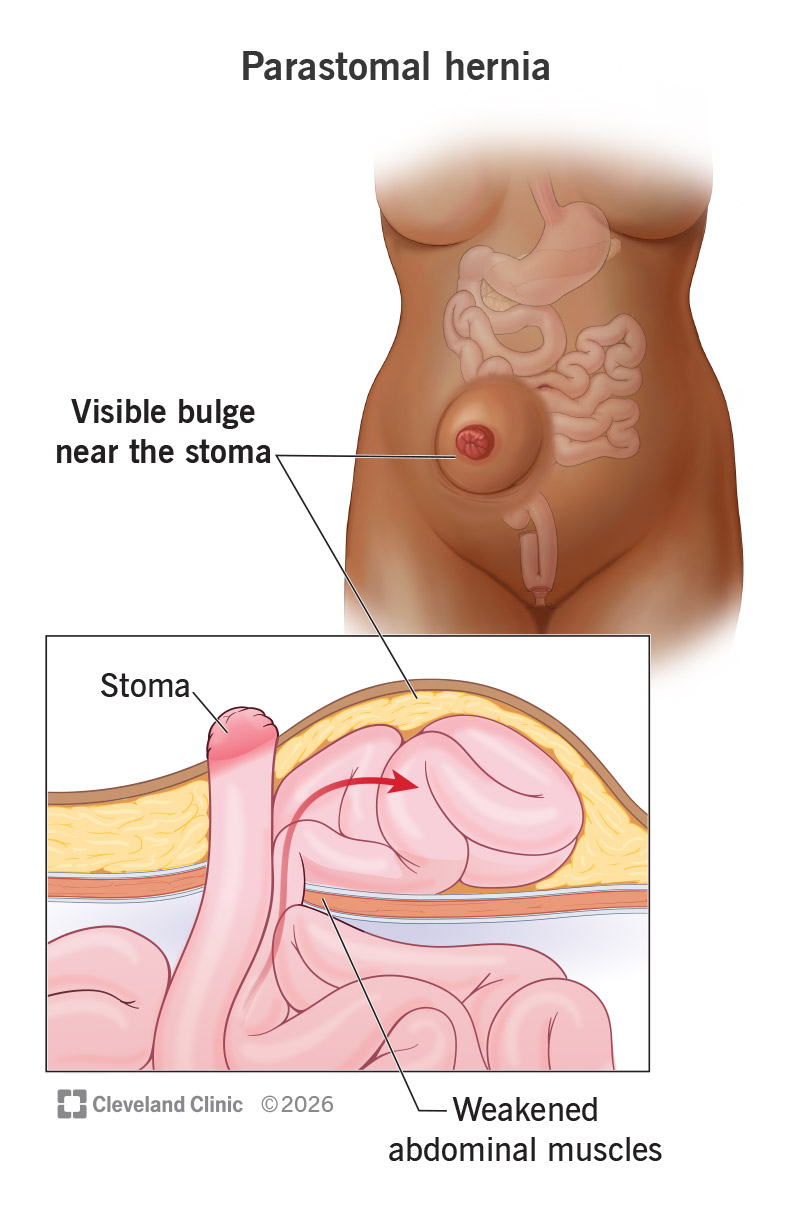
Image content: This image is available to view online.
View image online (https://my.clevelandclinic.org/-/scassets/Images/org/health/articles/parastomal-hernia.jpg)
A parastomal hernia happens when tissue pushes through weak abdominal (belly) muscles near your stoma. It’s a type of incisional hernia. That means it occurs at the site of abdominal surgery. To create a stoma, a hole must be made in your abdominal wall for a loop of intestine to pass through. Over time, that hole can become wider. That allows other loops of intestine or fat to push through and cause a bulge.
Advertisement
Cleveland Clinic is a non-profit academic medical center. Advertising on our site helps support our mission. We do not endorse non-Cleveland Clinic products or services. Policy
Parastomal hernias are one of the most common complications after ostomy surgery. Studies suggest that up to half of all people develop one after the procedure.
Some parastomal hernias are small and don’t cause problems. But others can affect comfort, pouch fit and quality of life. They can cause a visible bulge around your stoma. They may make it harder to manage your ostomy bag.
Some parastomal hernias don’t cause symptoms. Others can range from mild to more disruptive. Common symptoms include:
A parastomal hernia can develop because you need an opening in your abdominal wall to create a stoma. That opening creates a natural weak point in your muscle. Over time, pressure inside your belly can push tissue through that weakened area, creating a bulge. Muscle strength at the stoma site can’t fully withstand the internal pressure.
Anything that increases pressure inside your belly can lead to it, including:
Advertisement
Certain factors make you more likely to develop a parastomal hernia. These include:
Many parastomal hernias remain mild. Most people with the condition live with it for a while before they notice symptoms. But in some cases, symptoms start to develop, and complications can happen. These include:
Strangulation is a medical emergency. It’s rare but serious. It can cause:
If you have signs of strangulation, seek immediate medical care.
Your healthcare provider will ask you about your symptoms and do a physical exam. They can usually diagnose the condition based on these factors.
But if you have symptoms of a blockage or another complication, they may order a CT scan. Imaging can help rule out other conditions or show if there’s anything else affecting the hernia.
If your provider is planning surgery, they may want a CT scan. This is to see the location of the stoma in relation to the hernia defect.
Treatment depends on your symptoms and their severity. Most people don’t have symptoms. If you do have symptoms, they’re usually mild. Management of a parastomal hernia in these cases involves nonsurgical methods. For a more severe case, you may need surgery.
Nonsurgical options may include:
Parastomal hernia support belts may help reduce bulging. They may also improve the fit of the stoma. But comfort and proper fit are important. Not everyone tolerates support belts well. Your healthcare provider or ostomy nurse can help you figure out whether a belt may work for you.
Your provider may recommend hernia repair surgery if you have ongoing pain, a bowel blockage or frequent stoma problems. There are several surgical approaches. The right option depends on your anatomy, your overall health and your surgeon’s preference. The main options include:
Advertisement
Recovery time depends on the type of surgery and your overall health. Full recovery may take four to eight weeks or more. Your provider may recommend:
Even after repair, the hernia can return. Following your provider’s instructions carefully after surgery may help reduce the risk of it coming back.
Contact your provider if you notice:
Severe pain with less waste or color change could signal a strangulated hernia. You need immediate medical attention.
Parastomal hernias are common after ostomy surgery. Many develop within the first year. Some remain mild. But others can affect comfort, pouch fit and daily activities.
The good news is that many cases are manageable without surgery. Work closely with your healthcare providers, including an ostomy nurse, to find strategies that support comfort, independence and quality of life.
If symptoms worsen or complications develop, surgical options are available. The best approach depends on your overall health, symptoms and personal goals.
Advertisement
There’s no guaranteed way to prevent a parastomal hernia. But certain steps may reduce your risk.
Before surgery:
After surgery:
The chances of developing a parastomal hernia go down if you understand how to take care of the stoma. Also, it’s important to listen to your provider’s recommendations.
As if living with a stoma wasn’t enough — now you have a parastomal hernia, too. This common complication can feel frustrating, especially if it affects your comfort or independence.
Fortunately, most cases are mild and manageable without surgery. Working closely with your healthcare provider and ostomy nurse can help you find solutions that fit your lifestyle. And understanding your options can help you feel more confident and in control.
Advertisement



Sign up for our Health Essentials emails for expert guidance on nutrition, fitness, sleep, skin care and more.
Learn more about the Health Library and our editorial process.
Cleveland Clinic’s health articles are based on evidence-backed information and review by medical professionals to ensure accuracy, reliability and up-to-date clinical standards.
Cleveland Clinic’s health articles are based on evidence-backed information and review by medical professionals to ensure accuracy, reliability and up-to-date clinical standards.
Hernias can be painful – Cleveland Clinic’s experts can help. We are leaders in minimally invasive hernia repair, and abdominal wall reconstruction.
