



MTHFR gene variants are differences in a gene that helps your body process folate. Gene variants are normal and most don’t affect your health. Many people have a variant copy of at least one MTHFR gene. A small number of people with two variant copies have higher-than-normal homocysteine levels. MTHFR gene testing is rarely necessary.
Advertisement
Cleveland Clinic is a non-profit academic medical center. Advertising on our site helps support our mission. We do not endorse non-Cleveland Clinic products or services. Policy
MTHFR gene variants are differences in a gene that helps your body process folate (a B vitamin). Gene variations (sometimes called mutations) are normal. They’re the reason we can have brown eyes or blue eyes, red hair or blond hair. And variations in the MTHFR gene are common: Experts estimate up to 50% of people have changes to at least one MTHFR gene.
Advertisement
Cleveland Clinic is a non-profit academic medical center. Advertising on our site helps support our mission. We do not endorse non-Cleveland Clinic products or services. Policy
MTHFR variants don’t cause health issues in most people who have them. If you have changes in both your MTHFR genes, you might have high levels of the amino acid homocysteine or low levels of vitamin B9 (folate). But getting enough folate from what you eat plays a bigger role in folate levels than having MTHFR gene variants.
The MTHFR gene gives your body the instructions to make the enzyme methylenetetrahydrofolate reductase (pronounced “MEH-theh-leen-TEH-trah-high-droh-FOH-late” “re-DUCK-tayz”). This enzyme helps convert one version of folate to another. Then, your body uses that to break down homocysteine. Sometimes, high homocysteine levels can lead to certain health issues.
Having a gene variant doesn’t mean it causes disease. Some studies have linked MTHFR changes to certain health conditions. But the risk isn’t clear-cut and, in most cases, it’s related to high homocysteine levels. If your homocysteine levels are normal, your risk of complications doesn’t seem to increase.
MTHFR changes have been studied in relation to:
Advertisement
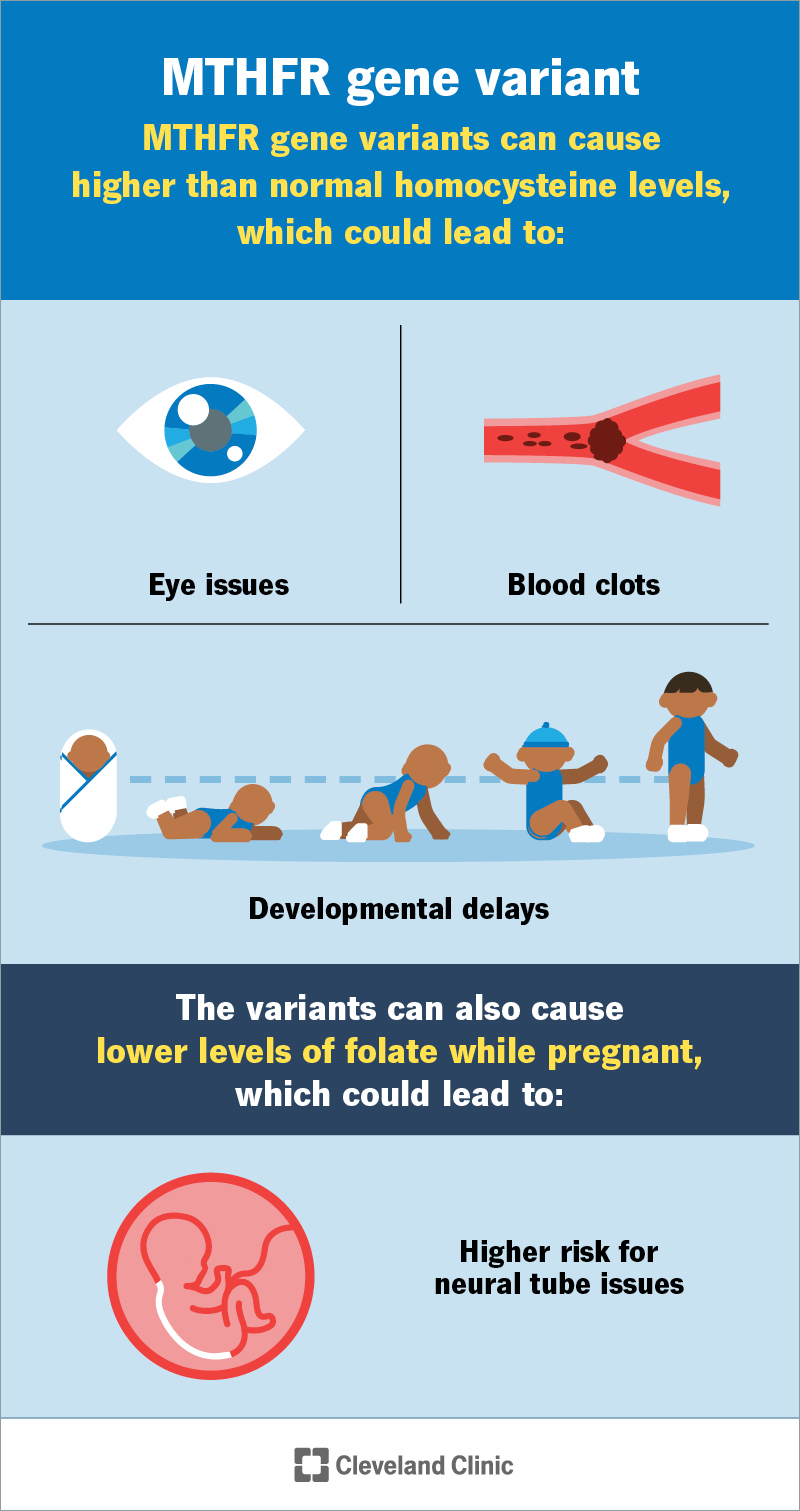
Image content: This image is available to view online.
View image online (https://my.clevelandclinic.org/-/scassets/images/org/health/articles/mthfr-gene-mutation.jpg)
Most often, MTHFR gene variants don’t affect your health or cause symptoms. Variants have sometimes been linked to a small increased risk of blood clots and early stroke. There’s also limited evidence linking variants in the gene to pregnancy complications.
If you have two copies of certain MTHFR gene variants, you may have slightly lower levels of folate. If you have low levels of folate while pregnant, your baby may be at higher risk for neural tube defects. But taking the recommended amount of folic acid during pregnancy should allow you to have normal levels of folate.
You’re born with the differences in your DNA that make up MTHFR gene variants. Each biological parent gives you a copy of the MTHFR gene. You can inherit a gene variant from one or both parents.
C677T and A1298C are the most common MTHFR variants. Around 2% of people with two copies of the C677T variant have higher-than-normal homocysteine levels.
The MTHFR gene test is a blood test. A positive result means you have the change. A negative result means you don’t.
But you usually don’t need to be tested for MTHFR gene variants. Most guidelines recommend against it because results don’t change your care. If you have a family history of early stroke or blood clots, your provider may check your homocysteine level rather than doing genetic testing.
There’s no specific treatment for the gene change itself. If you have high homocysteine levels, treatment recommendations are the same whether you have a MTHFR variant or not. Your provider might recommend taking B6, B12 and folic acid supplements.
Pregnancy care providers usually recommend taking folic acid supplements before and during pregnancy. This can help prevent neural tube defects, even in people with MTHFR variants. You don’t need special types of folate.
If you’re pregnant or have high homocysteine levels, talk to your provider about the best ways to manage your health. They might recommend supplements to help lower your homocysteine levels or to make sure you’re getting enough folic acid during pregnancy.
There’s no need to worry if you have an MTHFR gene variant. Many people have at least one. If you have signs of other health conditions, your provider will treat you for those.
There aren’t any foods you need to avoid if you have an MTHFR gene variant. It shouldn’t affect how you process folate in foods you eat. You don’t need to avoid folic acid.
Gene variants are what allow each of us to be unique. But having a different version of a gene can sometimes cause diseases. It’s unclear how much common variants of the MTHFR gene affect our health. Talk to your provider if you have concerns.
Advertisement



Sign up for our Health Essentials emails for expert guidance on nutrition, fitness, sleep, skin care and more.
Learn more about the Health Library and our editorial process.
Cleveland Clinic’s health articles are based on evidence-backed information and review by medical professionals to ensure accuracy, reliability and up-to-date clinical standards.
Cleveland Clinic’s health articles are based on evidence-backed information and review by medical professionals to ensure accuracy, reliability and up-to-date clinical standards.
Do certain health conditions seem to run in your family? Are you ready to find out if you’re at risk? Cleveland Clinic’s genetics team can help.
