



A lumbar hernia happens when tissue pushes through a weak spot in the muscles of your lower back. It doesn’t always cause symptoms, but when it does, you may notice a bulge, pain or pressure. Treatment usually involves surgery.
Advertisement
Cleveland Clinic is a non-profit academic medical center. Advertising on our site helps support our mission. We do not endorse non-Cleveland Clinic products or services. Policy
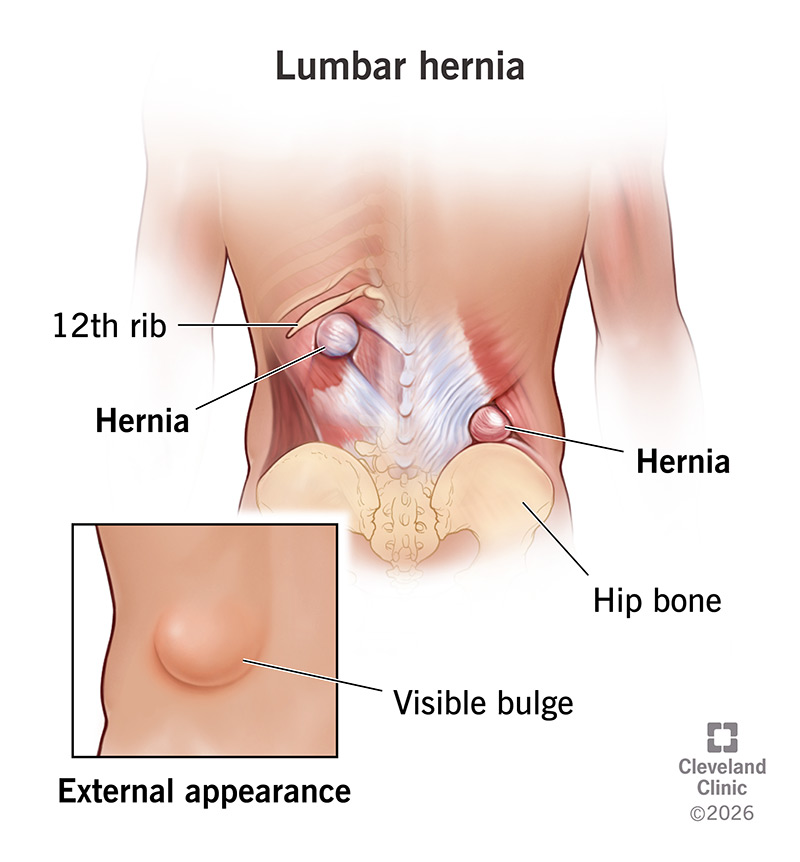
Image content: This image is available to view online.
View image online (https://my.clevelandclinic.org/-/scassets/images/org/health/articles/lumbar-hernia.jpg)
A hernia is when an organ or tissue pushes through a weak spot in a muscle. A lumbar hernia (or flank hernia) is when tissue pushes through a weak area in the muscles of your lower back. This type of hernia is rare.
Advertisement
Cleveland Clinic is a non-profit academic medical center. Advertising on our site helps support our mission. We do not endorse non-Cleveland Clinic products or services. Policy
Lumbar hernias often happen on their own when back muscles become weak. They can also happen after an injury or surgery. Symptoms may include a visible bulge and pain or pressure. Treatment is usually needed because the hernia can grow larger and cause problems.
You may not notice symptoms when the hernia is small.
If you have symptoms, they typically happen once the hernia grows. They could include:
Lumbar hernias usually happen in a naturally weaker area of muscle in your lower back. They occur beneath the 12th rib and above your hip bone.
You can be born with one (congenital) or develop it after birth (acquired). Congenital lumbar hernias usually happen along with other congenital conditions.
Most lumbar hernias are acquired. Acquired lumbar hernias can be either primary or secondary:
Advertisement
It’s most common in males between the ages of 50 and 70. Most lumbar hernias occur on the left side. Having any of these factors puts you at a higher risk:
Your risk is higher if you have a job that requires heavy lifting (especially lifting while twisting) or standing most of the day. People who participate in contact sports (like football) or sports that use a twisting motion (like golf) are also at a higher risk.
The main complications come from the hernia getting larger. This can cause more pain and make it harder to treat.
Other complications include:
A healthcare provider can usually see or feel a lumbar hernia. They’ll order imaging tests like a CT scan to confirm it. Since lumbar hernias are uncommon, they can be mistaken for back strain, fatty lump or a herniated disc.
Surgery is the main treatment for lumbar hernias. Hernia repair surgery involves closing the opening in the muscle. Your provider may try to use surgical mesh to help make the area stronger. This also reduces the chance that the hernia will come back. Full recovery from lumbar hernia repair can take a few weeks.
If the hernia is small, your provider may watch it over time. They may not need to repair it until it causes symptoms or becomes a problem. But most hernias get larger and eventually need repair.
Contact your provider if you have signs of a lumbar hernia, like a bulge in your back and pain in the area. They can examine you to take a closer look at what’s going on.
Most lumbar hernias aren’t serious. But they do need treatment before they become large and cause complications. Prompt treatment also reduces the risk of hernias causing problems in the future.
Lumbar hernias can come back. But following your provider’s recovery instructions can lower the chance of this happening. Ways to decrease your risk of future hernias include:
Advertisement
Finding a bulge in your lower back can be worrying. A lumbar hernia can cause this and lead to pressure or pain. Talk with your healthcare provider about any questions or concerns you have. They can go over which treatment is best for you.
With proper treatment, you should feel better and be back to your normal activities in no time. Be sure to follow your provider’s instructions to lower your risk of future hernias.
Advertisement



Sign up for our Health Essentials emails for expert guidance on nutrition, fitness, sleep, skin care and more.
Learn more about the Health Library and our editorial process.
Cleveland Clinic’s health articles are based on evidence-backed information and review by medical professionals to ensure accuracy, reliability and up-to-date clinical standards.
Cleveland Clinic’s health articles are based on evidence-backed information and review by medical professionals to ensure accuracy, reliability and up-to-date clinical standards.
Low back pain can be a constant interruption in your daily life. Cleveland Clinic’s experts can help craft a treatment plan to help you find relief.
