



Hallucinogen persisting perception disorder (HPPD) causes you to have perceptual disturbances, like halos and trails, long after using a mind-altering substance. These perceptions can be brief or long-lasting. Research is limited, but certain medications may help reduce symptoms.
Advertisement
Cleveland Clinic is a non-profit academic medical center. Advertising on our site helps support our mission. We do not endorse non-Cleveland Clinic products or services. Policy
Hallucinogen persisting perception disorder (HPPD) is when you have repeated visual hallucinations and distortions long after using certain substances, like LSD and MDMA. For example, you may see colors more intensely or objects changing in size. These perceptions may last for seconds or carry on for months or years.
Advertisement
Cleveland Clinic is a non-profit academic medical center. Advertising on our site helps support our mission. We do not endorse non-Cleveland Clinic products or services. Policy
LSD (lysergic acid diethylamide), a hallucinogen, is often linked to HPPD. But this disorder can also develop after using other drugs.
The Diagnostic and Statistical Manual of Mental Disorders (DSM) officially recognized HPPD as a condition in 1994, in the DSM-IV. Experts still have a lot to learn about HPPD, including effective ways to treat it.
HPPD has two subtypes:
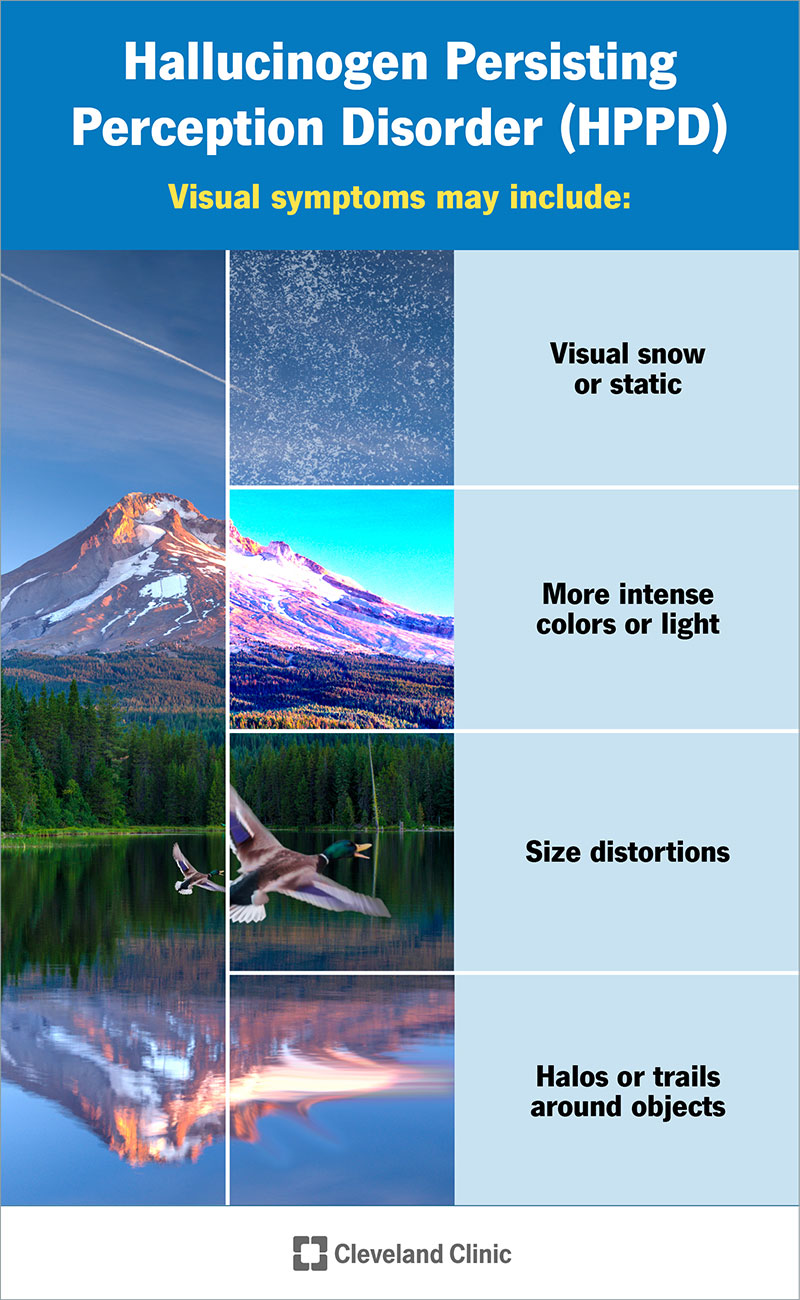
Image content: This image is available to view online.
View image online (https://my.clevelandclinic.org/-/scassets/images/org/health/articles/hallucinogen-persisting-perception-disorder)
Re-experiencing the effects of a hallucinogen long after it has worn off is the main symptom of HPPD. The perceptions may be the same ones you had when you used the substance. Or they may be different.
You may see:
Advertisement
These may come on briefly as flashbacks. Or they may last for a long time.
Researchers don’t know the exact cause of HPPD. But it likely involves changes to your brain after substance use, especially in the visual cortex.
Hallucinogens that have been linked to HPPD include:
Hallucinogen use isn’t the only cause of HPPD, despite the name of the condition. Natural and synthetic forms of cannabis (marijuana) are the second most-reported substances tied to HPPD. Others include ketamine and alcohol.
Researchers haven’t identified any risk factors yet. But they’re studying if there’s a connection between this disorder and visual snow syndrome (VSS), migraine with aura and tinnitus.
HPPD, especially type 2, can cause severe distress and issues with daily functioning. It may be very hard to focus on anything but the hallucinations.
Other complications include:
In the U.S., you can reach out to the 988 Suicide & Crisis Lifeline if you’re thinking about hurting yourself. Call or text 988 anytime for 24/7 help from specially trained providers and counselors.
Healthcare providers use criteria in the DSM-5-TR to diagnose hallucinogen persisting perception disorder. They’ll ask about your symptoms and substance use history.
It’s important to be honest about this history. This helps your provider tell the difference between HPPD and other conditions with similar symptoms, like schizophrenia spectrum disorders.
Your provider may recommend certain tests, like blood and imaging tests, to rule out conditions.
There’s no standard treatment for HPPD. That’s because there isn’t enough research on it. Certain medications may help reduce symptoms. Talk therapy can help you cope with symptoms and manage mental health complications, like anxiety.
The U.S. Food and Drug Administration (FDA) hasn’t approved any medications for HPPD. But your provider may prescribe one of the following medications to help with symptoms:
Due to a lack of research, it’s hard for healthcare providers to predict outcomes for people with HPPD. Each case is different.
Advertisement
It may take time to find a treatment plan that works well for you. Lean on your provider for support and guidance.
Being on a never-ending “trip,” unable to trust what you see, can be exhausting. No one can see what you do, so it can be hard to explain. You don’t have to endure this on your own. A healthcare provider can recommend treatments for hallucinogen persisting perception disorder. It may take a while to find an effective medication for you. But try not to lose hope.
Advertisement



Sign up for our Health Essentials emails for expert guidance on nutrition, fitness, sleep, skin care and more.
Learn more about the Health Library and our editorial process.
Cleveland Clinic’s health articles are based on evidence-backed information and review by medical professionals to ensure accuracy, reliability and up-to-date clinical standards.
Cleveland Clinic’s health articles are based on evidence-backed information and review by medical professionals to ensure accuracy, reliability and up-to-date clinical standards.
Your mental well-being is just as important as your physical well-being. Cleveland Clinic’s mental health experts can help you live life to the fullest.
