



Demodex blepharitis is a common condition that causes itchy eyes, puffy eyelids and crusty flakes along your eyelashes (called collarettes or cylindrical dandruff). It’s due to an overgrowth of Demodex mites, which are tiny parasites that naturally live on our skin. Prescription eye drops can get rid of the excess mites and relieve your symptoms.
Advertisement
Cleveland Clinic is a non-profit academic medical center. Advertising on our site helps support our mission. We do not endorse non-Cleveland Clinic products or services. Policy
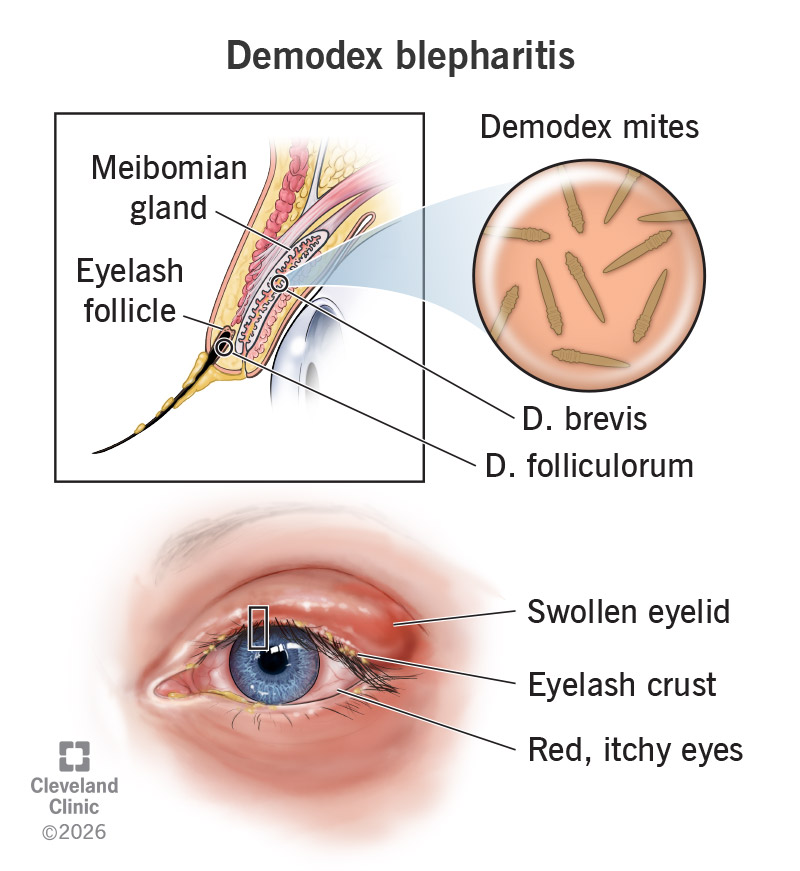
Image content: This image is available to view online.
View image online (https://my.clevelandclinic.org/-/scassets/images/org/health/articles/demodex-blepharitis)
Demodex blepharitis is a type of eyelid inflammation that’s due to an overgrowth of tiny parasites called Demodex mites. These mites live naturally on human skin, including on your face and eyelids, and normally don’t cause problems. But if they grow too numerous, they can cause itchy eyes, swollen eyelids and other symptoms that can disrupt daily life and threaten eye health. Treatment can get rid of the excess mites, relieve symptoms and prevent complications.
Advertisement
Cleveland Clinic is a non-profit academic medical center. Advertising on our site helps support our mission. We do not endorse non-Cleveland Clinic products or services. Policy
Demodex blepharitis is the most common form of blepharitis. Some experts estimate it may affect 25 million people in the U.S. This condition affects people of all ages, but it’s especially common among adults over age 65.
The most common symptom of Demodex blepharitis is itchy eyes. Your eyes might itch off and on throughout the day, or even constantly. Because the mites are most active at night, you might have the worst itching in the late evening or early morning.
Besides itchy eyes, other symptoms include:
These symptoms may make it hard for you to focus or see clearly. You may find yourself blinking or rubbing your eyes to try to relieve the symptoms. But with each blink, it might feel like something is rubbing against your eye that just won’t go away. These sensations can be distracting and frustrating.
Tiny parasites called Demodex mites cause Demodex blepharitis. They naturally live on everyone’s skin. Usually, they coexist with us peacefully. But sometimes, often for unknown reasons, they grow too numerous. A mite overgrowth damages the delicate skin along your eyelids and triggers inflammation, leading to symptoms.
Advertisement
Two specific species are responsible for Demodex blepharitis:
These mites also live elsewhere on your skin, including your cheeks, nose, forehead, scalp, neck and chest. But they’re so tiny you can only see them under a microscope. D. folliculorum mites are less than half a millimeter in length. D. brevis mites are less than a third of a millimeter. The typical lifespan for a mite is about three weeks. But they lay eggs in your eyelash follicles, allowing for continued reproduction.
Anyone can get Demodex blepharitis. People who are young and have no known risk factors develop this condition. But you have an increased risk if you:
Experts haven’t yet determined if Demodex blepharitis is transmissible between people.
Many people with Demodex blepharitis also have dry eye disease. There’s a strong link between these two conditions. Experts believe that because dry eye disease harms your eyes’ natural tear film, it may create an environment where the mites can flourish. On the other hand, having a Demodex overgrowth may lead to dry eye disease or make it worse.
Meibomian gland dysfunction (MGD) is also common among people with Demodex blepharitis. As the mite population goes up, the damage to these glands gets worse.
Without treatment, Demodex blepharitis can lead to long-term (chronic) eye problems. It can also affect how you feel from day to day. Possible complications include:
Demodex blepharitis can also make it harder for you to wear contacts. You may even stop using them completely.
Aside from affecting your eyes, this condition can also impact your self-image and mental health. Changes to your eyelids or lashes may make you feel self-conscious. You may also find yourself worrying about your eyes all the time, especially if you can’t seem to find any relief.
Advertisement
Eye care specialists diagnose Demodex blepharitis with a slit lamp exam. This means you’ll sit in a chair while your provider uses a special microscope to look closely at your eyes. You’ll see some bright lights coming from different angles. Your provider will ask you to look downward or close your eyelids. This lets them see the base of your upper eyelashes, where signs of Demodex blepharitis typically appear.
The main sign providers look for are “collarettes.” You might also hear this called cylindrical dandruff, cuffs, crusting, sleeves or lash debris. It’s a waxy substance that builds up around the base of your eyelash follicles when you have a Demodex mite overgrowth. Collarettes are made of waste products from the mites.
Your provider can judge the severity of the condition by how many collarettes they see. Collarettes may appear on just a few lashes or nearly all of them. The more you have, the more severe the infestation. Your provider may take photos through the microscope so you can see the debris on your eyelashes. It’s otherwise hard to see on your own.
Other Demodex signs your provider will look for include:
Advertisement
Treatment for Demodex blepharitis involves getting rid of the excess mites and relieving symptoms. Lotilaner ophthalmic solution (Xdemvy™) is the first and only U.S. Food and Drug Administration (FDA)-approved treatment that targets the root cause of this condition — mite overgrowth. These are prescription eye drops that you use twice a day for six weeks. The drops can get the mite population under control and relieve symptoms for at least one year after you start using them.
Your eye care specialist may also recommend:
Advertisement
Before lotilaner ophthalmic solution was approved in 2023, providers used other treatments to manage Demodex blepharitis. But they now know that these treatments are often ineffective or have risks that outweigh any potential benefits. These older treatments included topical tea tree oil and oral antiparasitic drugs like ivermectin and metronidazole.
Contact an optometrist or ophthalmologist if you have symptoms like itchy eyes, puffy eyelids or redness/discoloration anywhere along your lids. They’ll find the cause and help you get the right treatment.
After a Demodex diagnosis, contact your provider if:
Your provider will schedule follow-up visits with you to see how treatment is going.
Demodex blepharitis is a chronic condition that won’t go away on its own. You need treatment to feel better and protect your eyes. Today, thanks to improvements in treatments, you can find relief within weeks. In the past, people often spent months or years dealing with symptoms that simply wouldn’t go away.
Many people see improvement in their symptoms as early as one to two weeks after starting lotilaner ophthalmic solution. But you need to continue using the drops for the full six weeks. That allows enough time to get rid of adult mites plus their eggs. If you stop using the drops too soon, the condition can come right back.
After you finish your course of drops, your eye doctor will examine your eyes. Many people are “cured” of Demodex blepharitis at this point. But if your provider still sees evidence of excessive mites, they’ll recommend further treatment.
The best thing you can do is follow the treatment plan from your eye doctor. If you’ve used eye drops only rarely in the past, using them twice a day for six weeks might feel like a lot. But you’ll get used to it faster than you may think. Soon, it’ll become another part of your routine, just like brushing your teeth. A treatment log or phone reminder can help you stay on track.
You’ll also want to take extra good care of your eyelids. Your provider may talk with you about eyelid hygiene. This doesn’t mean your lids were dirty or you didn’t take good care of them in the past. Instead, it means your skin is a place where Demodex mites can easily thrive. So, do whatever you can to keep them at bay.
Your provider may recommend:
Excuse me, what?! That might be your reaction when hearing tiny bugs are to blame for your itchy eyes. But as strange as it may sound, Demodex mites are a normal and expected resident of human skin.
What’s not normal, though, is a rise in their numbers to the point where they start damaging your eyelids. You don’t have to put up with the discomfort or put your eye health at risk. Your eye doctor will start you on treatment right away so that you can feel better and protect your eyes.



Sign up for our Health Essentials emails for expert guidance on nutrition, fitness, sleep, skin care and more.
Learn more about the Health Library and our editorial process.
Cleveland Clinic’s health articles are based on evidence-backed information and review by medical professionals to ensure accuracy, reliability and up-to-date clinical standards.
Cleveland Clinic’s health articles are based on evidence-backed information and review by medical professionals to ensure accuracy, reliability and up-to-date clinical standards.
Cleveland Clinic’s ophthalmologists and optometrists have the highest training available. We provide exams, vision correction and care for many eye conditions.
