



You may get a diagnosis of delusional parasitosis if you believe an organism is living in your body despite medical proof that there’s no infestation. It’s a type of delusional disorder. Certain medications can treat the sensations you feel.
Advertisement
Cleveland Clinic is a non-profit academic medical center. Advertising on our site helps support our mission. We do not endorse non-Cleveland Clinic products or services. Policy
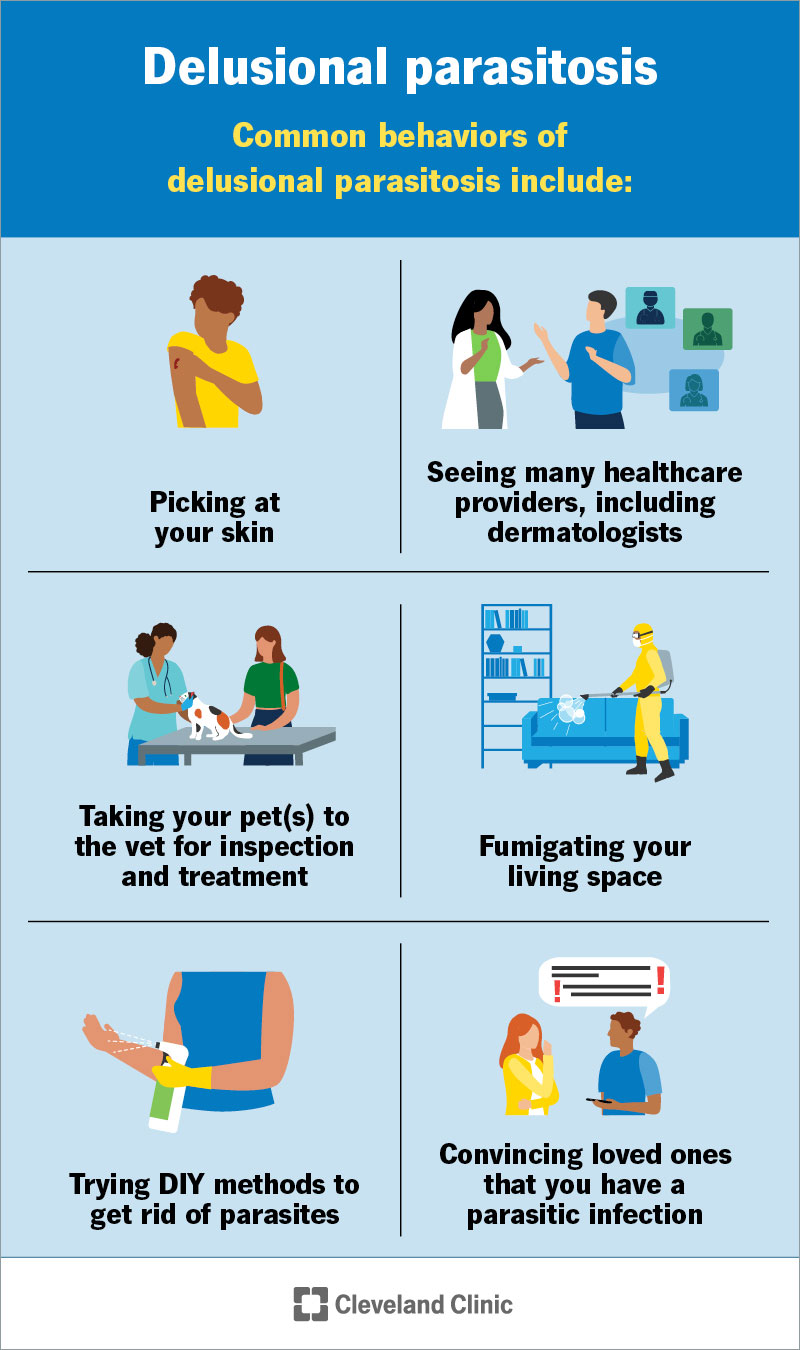
Image content: This image is available to view online.
View image online (https://my.clevelandclinic.org/-/scassets/images/org/health/articles/delusional-parasitosis)
Delusional parasitosis, also known as Ekbom syndrome, is an uncommon mental health condition in which you believe you’re infested with a living organism even though medical test results show you’re not.
Advertisement
Cleveland Clinic is a non-profit academic medical center. Advertising on our site helps support our mission. We do not endorse non-Cleveland Clinic products or services. Policy
For example, you might be convinced that you’re infested with parasites, fleas, worms, mites, bacteria or fungi.
Other names for it include delusional infestation and psychogenic parasitosis. It’s a specific form of delusional disorder.
In most cases, delusional parasitosis (DP) develops from an existing condition or as a side effect of a medication. This is called secondary DP. When it happens alone, it’s known as primary DP.
It may feel as if something is crawling on or underneath your skin. The sensations you feel are real. But the cause comes from your brain, not your skin. This may be confusing and hard to accept. Your feelings are valid. But try to stay open to other possible causes of your symptoms so you can get the relief you need.
The good news is that medications that balance brain chemical activity work well to treat symptoms.
The main symptom of delusional infestation is that you believe you have a parasitic infection even though there’s medical proof that you don’t. This belief lasts for at least six months.
You may feel like bugs are crawling in or on your skin, a symptom called formication. The sensation is real, but it’s not coming from actual parasites.
When you have DP, you may:
Advertisement
You may also feel frustrated or helpless that healthcare providers don’t believe you. These feelings are understandable. But it’s important to know that your provider does want to help. They’ll focus on your symptoms and getting you better.
Researchers don’t know the exact cause of this condition. They think it may be due to overactive dopamine signaling in your brain.
Most often, delusional infestation develops from another condition. Psychiatric disorders that can lead to it include:
Other causes of the symptoms may include:
Without treatment, complications of delusional parasitosis may include:
First, a healthcare provider will check for parasitic infections. They’ll:
If the results show that you don’t have a parasitic infection, the next step is to find out if there’s an underlying cause of your symptoms. Your provider may recommend other blood and pee tests to check for conditions like vitamin deficiencies and thyroid issues.
In some cases, there isn’t an underlying cause of delusional parasitosis.
Antipsychotics are the go-to treatment for delusional parasitosis. These medications help eliminate the crawling sensations that you feel. Your healthcare provider may prescribe one of the following medications:
You’ll start on the lowest possible dose to try to prevent medication side effects. It may take up to six weeks to notice the full effect of this treatment.
Advertisement
In most cases, antipsychotics work well to treat delusional parasitosis symptoms. After some time, your healthcare provider may taper you off the medication. If symptoms come back, starting the medication again usually works.
These medications can have disruptive side effects, like:
You’ll need to see your provider regularly to make sure the medication is helpful. Let them know if you develop any side effects.
Delusional parasitosis(DP), or Ekbom syndrome, can be a tough diagnosis to face. If you have creepy-crawly sensations, know that you’re not imagining it. The sensations and distress are real, and they can be overwhelming. Working with a healthcare provider you trust can go a long way. They can offer a safe space to explain what’s going on and recommend treatment options.
It can be stressful to see your loved one convinced there’s something wrong with them, even when medical tests show otherwise. In conditions like DP, it’s unlikely that you’ll be able to change their minds. Instead, acknowledge their distress and gently encourage them to follow medical advice.
Advertisement



Sign up for our Health Essentials emails for expert guidance on nutrition, fitness, sleep, skin care and more.
Learn more about the Health Library and our editorial process.
Cleveland Clinic’s health articles are based on evidence-backed information and review by medical professionals to ensure accuracy, reliability and up-to-date clinical standards.
Cleveland Clinic’s health articles are based on evidence-backed information and review by medical professionals to ensure accuracy, reliability and up-to-date clinical standards.
Your mental well-being is just as important as your physical well-being. Cleveland Clinic’s mental health experts can help you live life to the fullest.
