



Trigger finger happens tendons in your fingers or thumb swell up or thicken. The inflammation makes it hard for you to move them. Severe cases can “lock” your fingers in a flexed position. It’s also known as stenosing tenosynovitis. Treatments include rest, wearing a splint, medications and surgery.
Advertisement
Cleveland Clinic is a non-profit academic medical center. Advertising on our site helps support our mission. We do not endorse non-Cleveland Clinic products or services. Policy
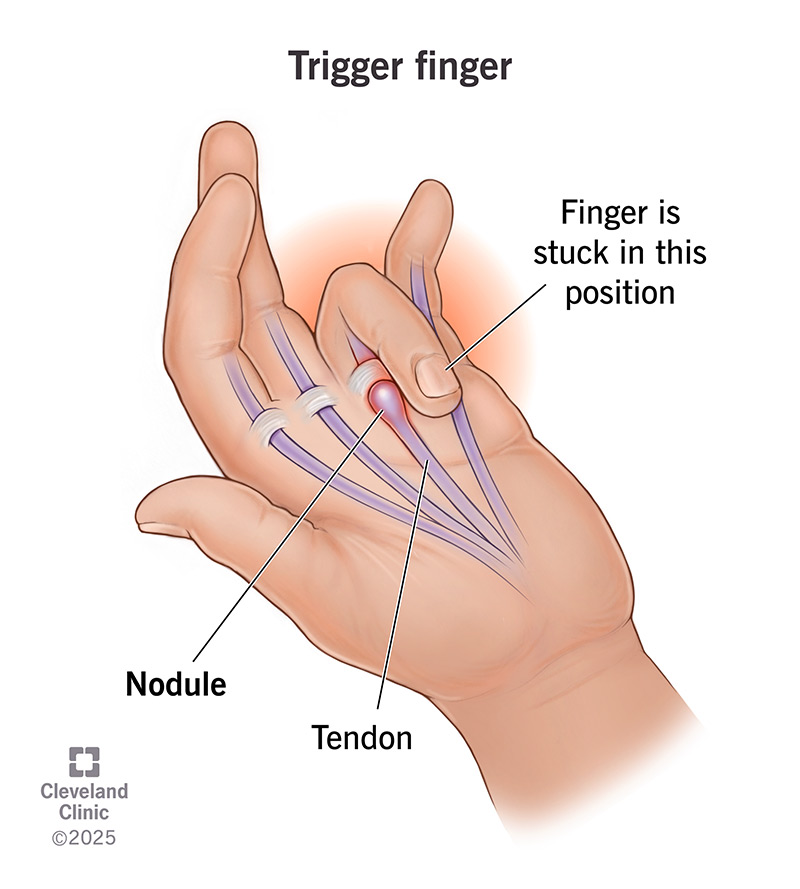
Image content: This image is available to view online.
View image online (https://my.clevelandclinic.org/-/scassets/images/org/health/articles/trigger-finger-2)
Trigger finger is a tendon condition that makes your fingers or thumb hard to move or “lock” flexed in toward your palm. In some cases, your finger or thumb will lock straight, and you won’t be able to bend it in toward your palm.
Advertisement
Cleveland Clinic is a non-profit academic medical center. Advertising on our site helps support our mission. We do not endorse non-Cleveland Clinic products or services. Policy
Trigger finger gets its name from the position your fingers can get stuck in. It looks like you’re trying to pull an invisible trigger. Trigger thumb is the same issue, but in your thumb. Stenosing tenosynovitis is the medical name for trigger finger or trigger thumb.
If you have trigger finger, it can be hard (or impossible) to straighten your affected fingers. Healthcare providers used to think it was most common in your ring finger. But a 2025 study found that it actually affects middle fingers most often.
Trigger finger can affect any of your digits. One in 3 people get it in more than finger at a time.
It can be upsetting to realize you can’t move part of your hand. But it’s treatable. Visit a healthcare provider if you can’t move part of your hand as well as normal.
The most common stenosing tenosynovitis symptoms in your fingers or thumb include:
Advertisement
Symptoms are usually worse first thing in the morning. This is especially true for stiffness and locked positions. The stiffness will usually get a little better as you start using your fingers and thumb throughout the day.
Swelling in or around the tendons in your hand causes trigger finger or trigger thumb.
Tendons are bands of tissue that attach muscles to bones. Tendons and muscles in your hands work together to flex and straighten your digits. A tunnel of tissue called a tendon sheath surrounds these tendons. The sheath protects them and keeps them in place.
Trigger finger happens when something irritates the tendons in your affected fingers or thumb. Irritation leads to inflammation and swelling. That makes it so they can’t easily slide through their sheaths. A bump called a nodule may also form on your affected tendon. This can make it even more difficult for the tendon to easily glide through its tendon sheath.
The nodule often catches or gets stuck on a part of your tendon sheath called the A1 pulley. If it’s harder for your tendon to slide through the A1 pulley, your finger will feel stiff or like it’s getting stuck.
Anyone can develop trigger finger. But it’s most common in people between the ages of 40 and 60.
Having a job or hobby that requires you to perform hard, repetitive motions with your hands is a common cause. Examples include:
Having certain health conditions can increase your risk, including:
A healthcare provider will diagnose trigger finger with a physical exam. They’ll examine your hand and fingers and ask about the symptoms you’ve noticed. Tell your provider when you first felt pain or stiffness. Make sure to mention if any activities make the symptoms worse.
Your provider might straighten your fingers or thumb to feel for clicking. This will help them understand how stiff your fingers are and whether your tendons are moving as they should. Tell them if any motion or position hurts.
Usually, providers don’t need any special tests to diagnose trigger finger. But they might use imaging tests like an ultrasound or X-rays to take pictures of the tissue and bones in your hand.
The best treatment for you depends on which finger has stenosing tenosynovitis and its severity. The most common treatments include:
Advertisement
Visit a healthcare provider if you notice any symptoms of trigger finger. Especially if you can’t move a finger or your thumb as far as usual. Go to the emergency room if you suddenly can’t move or use one of your digits.
Advertisement
Trigger finger won’t heal without treatment. Even if you only need rest or other nonsurgical treatments, a provider needs to examine your hand. They’ll diagnose the cause of your symptoms.
It can take anywhere from a few weeks to a few months before you can use your hand like usual. The symptoms should improve gradually after you start treating them. Your healthcare provider will tell you how long you’ll need each treatment.
If you need surgery, you’ll have to avoid using your fingers or thumb while you heal. Your surgeon will tell you what to expect.
Any health condition that makes it feel like you’re not in control of your body can be scary. The good news is that trigger finger is treatable. Even if you need surgery, you should be able to return to all of your usual activities and hobbies after your hand heals.
Visit a healthcare provider if you notice pain, stiffness or a decreased range of motion in your fingers or thumb. They’ll diagnose the cause and help you find treatments that will relieve the symptoms and restore your hand’s flexibility.
Advertisement



Sign up for our Health Essentials emails for expert guidance on nutrition, fitness, sleep, skin care and more.
Learn more about the Health Library and our editorial process.
Cleveland Clinic’s health articles are based on evidence-backed information and review by medical professionals to ensure accuracy, reliability and up-to-date clinical standards.
Cleveland Clinic’s health articles are based on evidence-backed information and review by medical professionals to ensure accuracy, reliability and up-to-date clinical standards.
Trigger finger can make everyday tasks tedious and painful. Cleveland Clinic experts can help you find relief with minimally invasive and nonsurgical options.
