



Raynaud’s syndrome is a blood flow problem from spasms in small blood vessels in your fingers and toes. It causes symptoms like skin color changes, cold skin and a pins and needles sensation. Common triggers of Raynaud’s attacks include cold weather and stress. Many people have mild symptoms that they can manage through lifestyle changes.
Advertisement
Cleveland Clinic is a non-profit academic medical center. Advertising on our site helps support our mission. We do not endorse non-Cleveland Clinic products or services. Policy
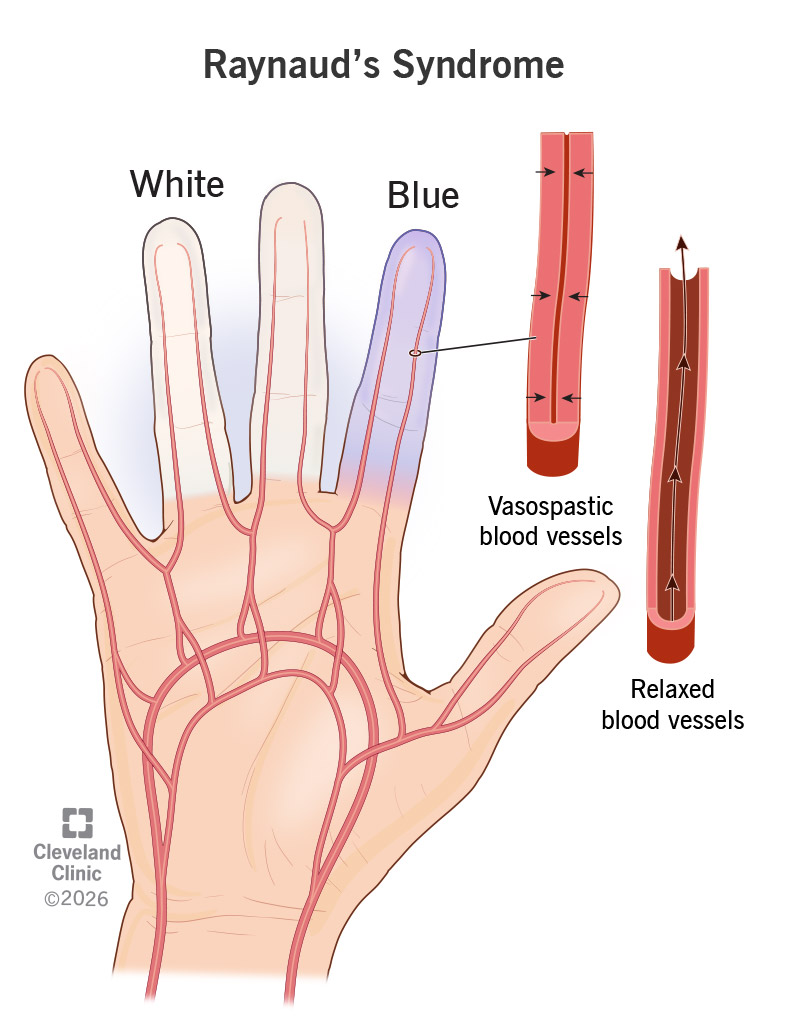
Image content: This image is available to view online.
View image online (https://my.clevelandclinic.org/-/scassets/images/org/health/articles/9849-raynauds-syndrome)
Raynaud’s (pronounced "ray-nodes") syndrome is a common disorder that restricts blood flow to your fingers and toes. It may also affect blood vessels in your nose, lips or ear lobes. Raynaud’s causes episodic spasms (vasospastic attacks) in response to cold temperatures or stress.
Advertisement
Cleveland Clinic is a non-profit academic medical center. Advertising on our site helps support our mission. We do not endorse non-Cleveland Clinic products or services. Policy
During a Raynaud’s attack, the small blood vessels in your fingers and toes tighten more than they should. As a result, the affected skin turns white and then sometimes blue. This color change happens because your blood lacks oxygen. Your skin may also feel cold or numb. As your blood vessels relax and open again, your skin may look red or feel tingly.
There are two main types of Raynaud’s — primary (Raynaud’s disease) and secondary (Raynaud’s phenomenon.) Most people use all of these terms to describe either type. But experts use them to set apart the types.
A typical episode, or attack, lasts 20 minutes. But attacks may be shorter or longer. Symptoms are usually mild in people with primary Raynaud’s, but more severe for people with Raynaud’s phenomenon.
Raynaud’s symptoms affect your skin and may include:
Advertisement
Primary Raynaud’s syndrome has no clear underlying cause.
Secondary Raynaud’s syndrome (Raynaud’s phenomenon) causes include:
Primary Raynaud’s syndrome usually affects:
Secondary Raynaud’s (Raynaud’s phenomenon) risk factors include:
You can’t prevent Raynaud’s syndrome. But with lifestyle changes, like avoiding tobacco products, you can prevent some of the conditions that cause it.
You can help prevent attacks by learning your triggers (like anxiety or cold places) and taking action to avoid them. Also, ask your healthcare provider if any of your current medications could cause your condition to flare up.
It’s also important to visit your provider for yearly checkups. Doing so can help your provider diagnose and treat underlying conditions that may cause Raynaud’s phenomenon.
Complications of Raynaud’s may include:
Healthcare providers can usually diagnose Raynaud’s from your symptoms. Your provider may ask you to take photos of your skin changes when they happen. They may also perform a physical exam and talk with you about your medical and family history.
Raynaud’s is typically easy to diagnose. But the type you have may not be obvious. That’s where testing, like nail fold capillaroscopy, can help. This involves looking at the base (nail fold) of your fingernail under a microscope. If your capillaries in the area are enlarged or abnormal, you may have a connective tissue disease. This could mean you have Raynaud’s phenomenon.
Other tests your provider may order include:
Advertisement
Raynaud’s treatment depends on whether you have the primary or secondary form and its severity. For many people (including children), lifestyle changes are enough to manage the condition.
Your healthcare provider will help you prevent attacks and reduce their severity. They’ll also help you prevent skin ulcers and tissue damage. Raynaud’s phenomenon treatment involves caring for the underlying disease or condition.
Raynaud’s syndrome treatments include:
If your child or teen starts to have symptoms of primary Raynaud’s disease, take them to see their healthcare provider. They may want to run tests to rule out an underlying condition.
Call your provider if you:
Advertisement
You may want to ask your provider these questions:
Primary Raynaud’s syndrome may disrupt some of your daily activities, but it’s not dangerous. It doesn’t damage your blood vessels. For most people with this type, the outlook is positive. Symptoms may bother you off and on, but the condition isn’t serious or life-threatening.
Secondary Raynaud’s syndrome can be more serious. It may lead to skin ulcers and, rarely, tissue death (gangrene). It may also impact your quality of life. Your outlook depends on the underlying disease, which may be severe in and of itself. Talk with your provider about what you can expect and how to manage Raynaud’s phenomenon.
Self-care is essential for managing Raynaud’s syndrome. If an attack happens, warm up by going to a warmer space, moving your arms in circles or running warm water over your fingers or toes. Meditation or deep breathing may also help.
The following tips can also help you avoid Raynaud’s triggers:
Advertisement
Having Raynaud’s syndrome can make you dread reaching into the freezer. But simple ways of keeping your hands warm can make a difference. Learning how to care for yourself at home can help you avoid and manage Raynaud’s attacks. If your symptoms are keeping you from doing the things you love, talk with your provider about treatment options. It may also help to connect with a support group to learn from others living with the same condition.



Sign up for our Health Essentials emails for expert guidance on nutrition, fitness, sleep, skin care and more.
Learn more about the Health Library and our editorial process.
Cleveland Clinic’s health articles are based on evidence-backed information and review by medical professionals to ensure accuracy, reliability and up-to-date clinical standards.
Cleveland Clinic’s health articles are based on evidence-backed information and review by medical professionals to ensure accuracy, reliability and up-to-date clinical standards.
Cleveland Clinic’s primary care providers offer lifelong medical care. From sinus infections and high blood pressure to preventive screening, we’re here for you.
