



Keratoconus makes your corneas lose their natural dome shape. Over time, they’ll change enough to affect your vision and lead to other symptoms. But this condition is treatable. You’ll probably need glasses or contacts to see clearly. Eventually, you might also need a procedure to reshape your corneas.
Advertisement
Cleveland Clinic is a non-profit academic medical center. Advertising on our site helps support our mission. We do not endorse non-Cleveland Clinic products or services. Policy
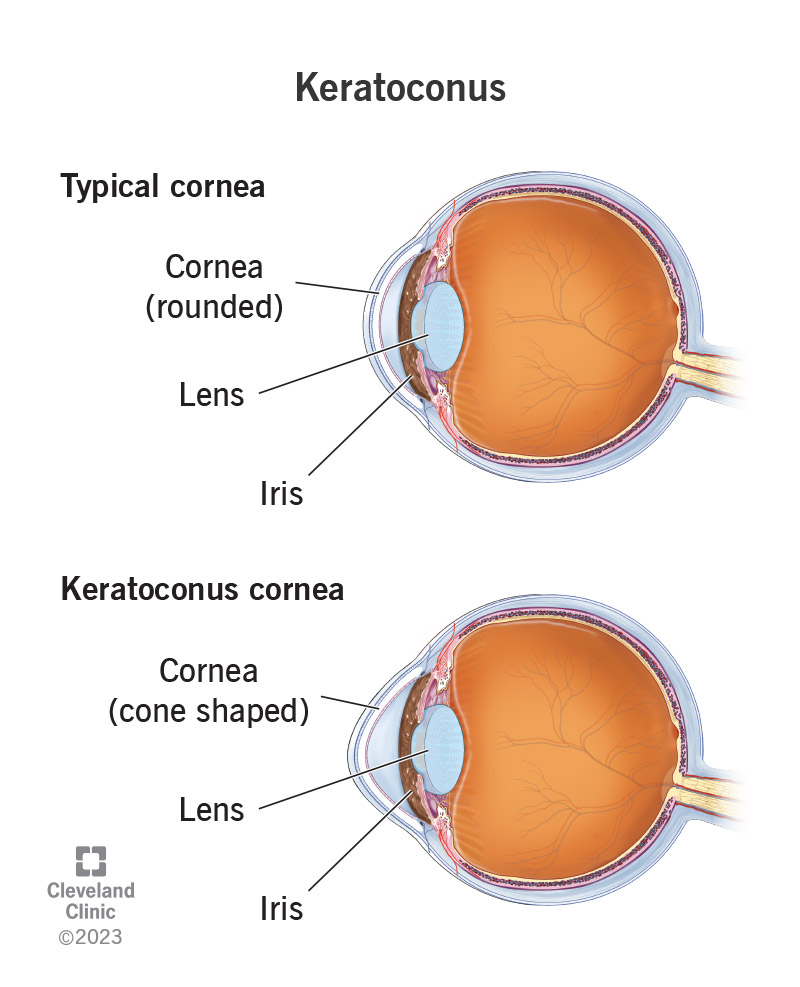
Image content: This image is available to view online.
View image online (https://my.clevelandclinic.org/-/scassets/images/org/health/articles/keratoconus-v2)
Keratoconus is an eye condition that happens when the corneas in your eyes bulge out into a cone shape. Normally, corneas are rounded, like domes.
Advertisement
Cleveland Clinic is a non-profit academic medical center. Advertising on our site helps support our mission. We do not endorse non-Cleveland Clinic products or services. Policy
If you have keratoconus, your corneas change shape slowly over time. Eventually, they won’t bend light that enters your eye like they should. This can affect your vision. It can make you more nearsighted and cause irregular astigmatism.
An eye doctor might diagnose keratoconus before you have any symptoms. This condition sometimes takes years to develop. It’s most commonly diagnosed in teens and young adults, but you can develop it at any age.
Keratoconus symptoms include:
Keratoconus usually happens in both eyes at the same time. But it can sometimes affect only one eye, or one eye more than the other.
Experts aren’t sure what causes keratoconus. It usually develops on its own without an obvious cause. It might run in biological families. But researchers haven’t been able to prove for sure that it’s a genetic condition.
There’s an association between rubbing your eyes a lot and having keratoconus. So, you might have a higher risk if you have allergies, dry eye or another health condition that makes you want to rub your eyes more often than usual. But experts haven’t been able to prove this link. It might just be a coincidence.
Advertisement
Complications are rare. But untreated keratoconus can increase your risk of:
An eye doctor will diagnose keratoconus with an eye exam. They’ll check your eyes inside and out. Tell them about any symptoms or changes you’ve noticed. Let them know if your vision has changed, and how quickly it seemed to happen.
You might need specific tests, like keratometry and corneal topography. This will help your eye doctor check the exact shape and curve of your corneas and diagnose keratoconus and astigmatism.
Your eye doctor will suggest treatments that help you see clearly and manage keratoconus. Some of the most common treatments include:
Visit an eye doctor as soon as you notice any changes in your eyes or vision. Especially if your vision suddenly gets worse.
Your eye doctor will tell you how often you’ll need eye exams in the future. They’ll monitor any changes in your eyes and make sure your treatments are working.
Keratoconus usually responds well to treatment. If you have a mild case, you may only need glasses or contacts. But you might need an updated prescription more often than usual. Your eye doctor will tell you what to expect.
Your eyes naturally change throughout your life, and that’s also true if you have keratoconus. You may need more or different treatments later, even if you only needed glasses or contacts at first.
Your vision might be worse or blurry for a few days after corneal cross-linking or getting Intacs, but it should clear up as you recover.
It might feel unsettling to hear part of your eye is changing shape from the inside. But keratoconus is treatable. Your eye doctor will help you understand what’s going on in your eyes, how you can manage any symptoms and what you’ll need to do to clear up your vision.
Talk to your eye doctor as soon as you notice any changes in your eyes. They’ll tell you when it’s time to consider different treatments.
Advertisement



Sign up for our Health Essentials emails for expert guidance on nutrition, fitness, sleep, skin care and more.
Learn more about the Health Library and our editorial process.
Cleveland Clinic’s health articles are based on evidence-backed information and review by medical professionals to ensure accuracy, reliability and up-to-date clinical standards.
Cleveland Clinic’s health articles are based on evidence-backed information and review by medical professionals to ensure accuracy, reliability and up-to-date clinical standards.
Cleveland Clinic’s ophthalmologists and optometrists have the highest training available. We provide exams, vision correction and care for many eye conditions.
