



Your axillary artery is a major blood vessel that supplies blood to your shoulder and upper arm. It’s located in your armpit (axilla), between your subclavian artery and brachial artery. You have six axillary artery branches that carry blood to nearby areas of your upper arm and chest.
Advertisement
Cleveland Clinic is a non-profit academic medical center. Advertising on our site helps support our mission. We do not endorse non-Cleveland Clinic products or services. Policy
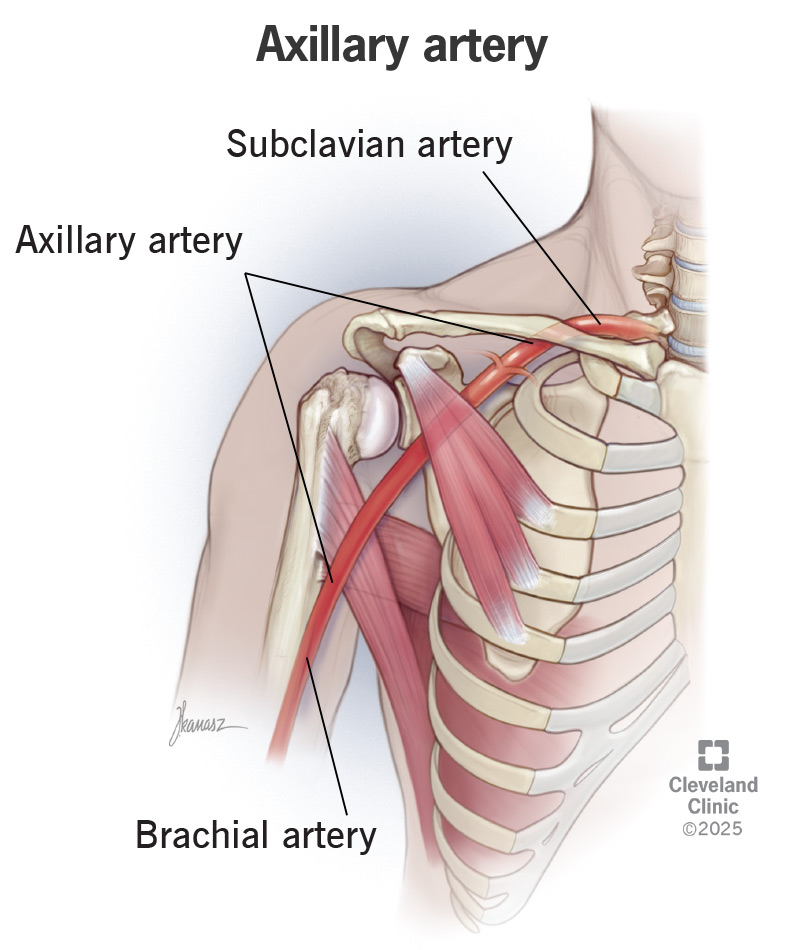
Image content: This image is available to view online.
View image online (https://my.clevelandclinic.org/-/scassets/images/org/health/articles/axillary-artery.jpg)
Your axillary artery is a blood vessel that runs through your armpit and delivers oxygen-rich blood to your upper limb. It’s a continuation of your subclavian artery. Once it’s below your shoulder blade, it becomes your brachial artery. You have two axillary arteries — one on each side of your body. These are called your right axillary artery and left axillary artery. They both play an important role in supporting normal blood flow in your upper body.
Advertisement
Cleveland Clinic is a non-profit academic medical center. Advertising on our site helps support our mission. We do not endorse non-Cleveland Clinic products or services. Policy
Your axillary artery supplies blood to your upper arm. This blood contains oxygen and nutrients that nourish your tissues. That’s an important job. Your muscles, bones and other parts of your arm need a constant supply of blood. This helps them stay healthy and work as they should.
Your axillary artery has other functions, too. But these aren’t ones you need every day. Rather, they become important when you receive medical care.
For example, this artery can serve as an access point when healthcare providers connect you to a heart-lung machine. Your provider inserts a thin tube called a cannula into the artery. This allows oxygen-rich blood from the machine to return to your body while you’re in surgery.
Your axillary artery is nestled inside your armpit area. It follows this course:
Another blood vessel, the axillary vein, runs next to your axillary artery. This vein carries oxygen-poor blood back toward your heart. That means blood in the axillary vein and the axillary artery travel in opposite directions. To picture this, imagine cars on a two-lane road.
Advertisement
Your axillary artery isn’t close to the surface of your skin. It’s deeper within your chest muscles. A bundle of nerves called the brachial plexus intertwines with the artery along its course.
Your axillary artery has several branch arteries. These vessels start at various points along your axillary artery. Then, they travel off in another direction. They carry blood to different areas of your chest, shoulder, armpit and upper arm. You can think of these like limbs on a tree, or side streets connecting to a main road.
Your axillary branch arteries include:
The most common conditions affecting your axillary artery are injuries to nearby bones. The bones may press on or poke through the artery. This can lead to internal bleeding and blood clots. The injury can also disrupt blood flow in your arm. If this happens, your arm may look paler than usual or feel cold to the touch.
Specific injuries that may damage your axillary artery include:
Seek medical care right away if you think you’ve broken a bone or if you experience a traumatic injury.
Rarely, axillary artery damage can occur as a complication of surgery, like shoulder replacement surgery.
Your axillary artery is one of many vessels that keep blood moving through your body. It’s tucked away in your armpit. So, you might not even realize it’s even there. But it plays an important role in helping you feel and move your arm. Talk to your healthcare provider if you have concerns about blood flow in your arm or the risk of injury to your artery during surgery.
Advertisement



Sign up for our Health Essentials emails for expert guidance on nutrition, fitness, sleep, skin care and more.
Learn more about the Health Library and our editorial process.
Cleveland Clinic’s health articles are based on evidence-backed information and review by medical professionals to ensure accuracy, reliability and up-to-date clinical standards.
Cleveland Clinic’s health articles are based on evidence-backed information and review by medical professionals to ensure accuracy, reliability and up-to-date clinical standards.
Cleveland Clinic’s primary care providers offer lifelong medical care. From sinus infections and high blood pressure to preventive screening, we’re here for you.
