



Social learning theory says we learn by watching others. If someone’s behavior is rewarded, we’re more likely to copy it. This process involves attention, memory (retention), imitation (reproduction) and motivation. It helps explain learning in everyday life.
Advertisement
Cleveland Clinic is a non-profit academic medical center. Advertising on our site helps support our mission. We do not endorse non-Cleveland Clinic products or services. Policy
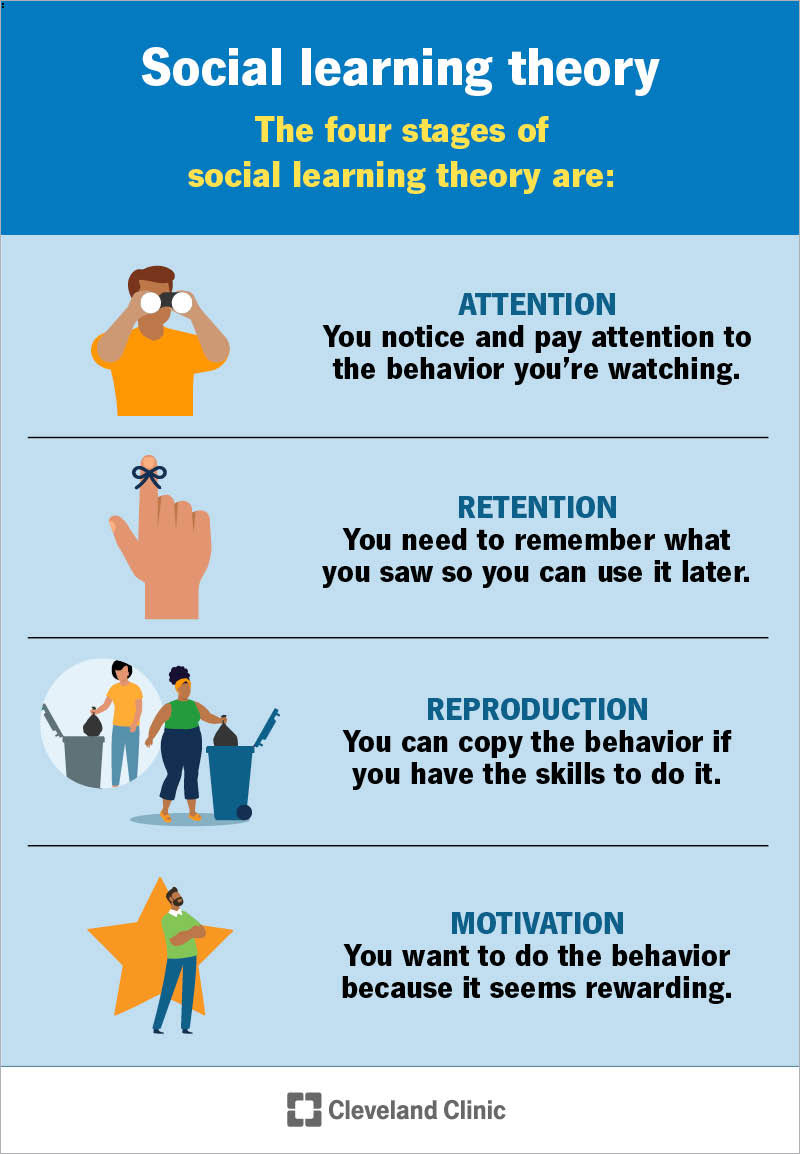
Image content: This image is available to view online.
View image online (https://my.clevelandclinic.org/-/scassets/images/org/health/articles/social-learning-theory)
Social learning theory is the idea that you learn by watching others. Learning doesn’t only come from experiences. It also comes from observing and remembering what happens next.
Advertisement
Cleveland Clinic is a non-profit academic medical center. Advertising on our site helps support our mission. We do not endorse non-Cleveland Clinic products or services. Policy
You’re more likely to repeat behaviors you see often or those with rewards. You’re less likely to copy behaviors you see punished. This is called observational learning (or modeling).
Albert Bandura developed this theory. Many people recognize it from the Bobo doll experiment. In this study, children copied aggressive behavior toward a doll after watching an adult do it. Later in the study, when the adult was punished, children were less likely to repeat the behavior, even though they still remembered it.
Bandura later expanded social learning theory into social cognitive theory. This adds an important idea: What you think and believe also matters. It explains that three things interact to shape behavior:
Together, these parts influence how you learn from others, then decide how to act.
A key idea in social cognitive theory is self-efficacy. This is your belief in your ability to succeed. When you believe you can make a change, you’re more likely to take action and stick with it.
Albert Bandura described four main stages in this theory:
Advertisement
When you experience all of these stages together, you’re more likely to learn from observation.
It works like this: First, you watch someone else do something. Then, you see what happens next. Finally, you decide whether or not to try the behavior yourself.
Here’s an example:
Here’s another everyday example:
You learn by observing how others act and what happens as a result. If you see someone rewarded for a behavior, you may be more likely to try it. If something feels natural, you might give it a try. But if someone else got a bad response, you might avoid it instead.
It’s important to remember that you may not copy all behavior. There are many reasons for that, like:
How you pay attention, remember what you see and think about outcomes helps guide your choices and decisions.
There are many uses. Here are a few common examples:
Advertisement
There are several strengths, including:
Social learning theory is widely used, but it has some limits.
One concern is that the theory can be too broad. It explains behavior as a mix of thoughts, actions and the environment. But it doesn’t always explain exactly how these parts work together in all situations. This can make the theory harder to test.
Another criticism is that some ideas aren’t clearly defined. Certain terms may mean different things in different settings. This may cause confusion.
Some critics also point out that the theory gives less attention to biology. It focuses on learning from others and the environment. It doesn’t fully explain how genetics or brain development affect behavior.
Because of these limits, many experts combine social learning with other theories to better explain why people behave the way they do.
Advertisement
You can think of social learning theory like a sponge. You absorb as much as you can from those around you, often without realizing it, until you start repeating those actions yourself.
Whether it’s how you handle stress, make choices or talk to others, you tend to mirror what you see, especially when it’s rewarded. And once you understand how observation and motivation shape your actions, you can use that insight to make more thoughtful choices.
Being aware of what you’re exposed to, and who you look to as examples, can be a powerful step toward growth. Not just for yourself, but for those watching in return.
Advertisement



Sign up for our Health Essentials emails for expert guidance on nutrition, fitness, sleep, skin care and more.
Learn more about the Health Library and our editorial process.
Cleveland Clinic’s health articles are based on evidence-backed information and review by medical professionals to ensure accuracy, reliability and up-to-date clinical standards.
Cleveland Clinic’s health articles are based on evidence-backed information and review by medical professionals to ensure accuracy, reliability and up-to-date clinical standards.
Your mental well-being is just as important as your physical well-being. Cleveland Clinic’s mental health experts can help you live life to the fullest.
