



Conception happens when sperm swims up through your vagina and fertilizes an egg in the fallopian tube. It happens in the hours or days after you have unprotected sex. After conception, the fertilized egg implants into your uterus and a pregnancy begins.
Advertisement
Cleveland Clinic is a non-profit academic medical center. Advertising on our site helps support our mission. We do not endorse non-Cleveland Clinic products or services. Policy
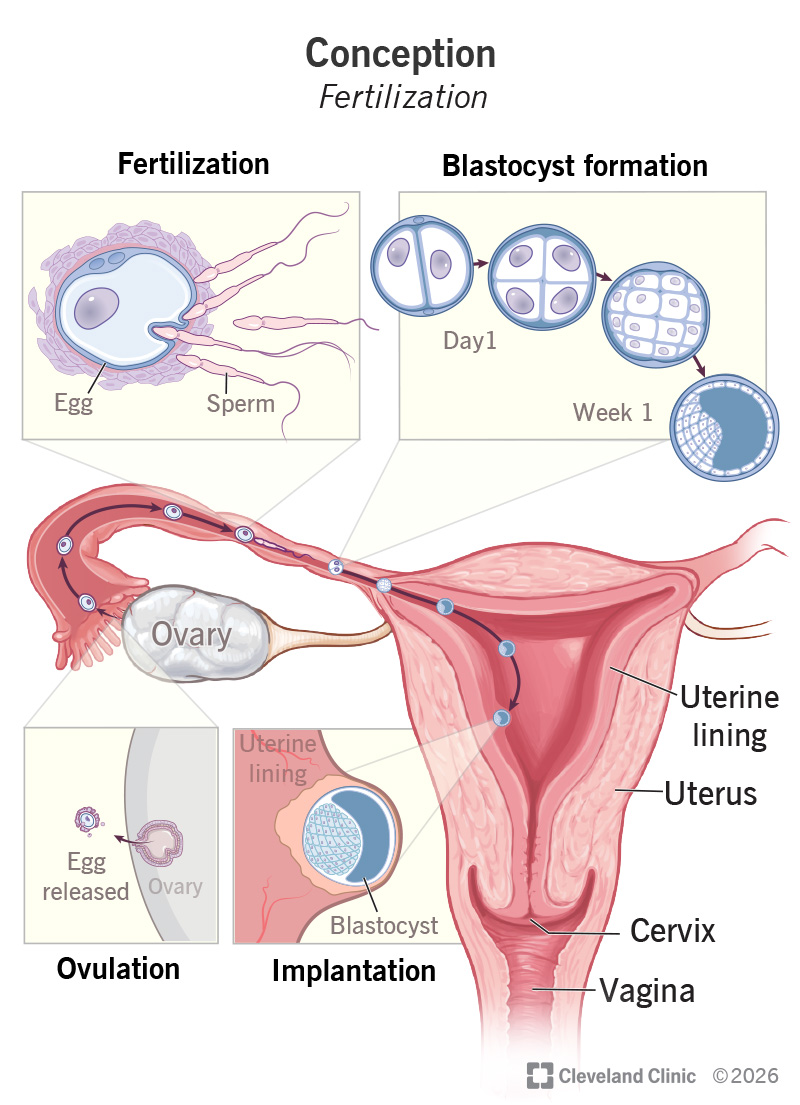
Image content: This image is available to view online.
View image online (https://my.clevelandclinic.org/-/scassets/images/org/health/articles/11585-conception)
Conception (also called fertilization) is when an egg and sperm join. It’s a key step in getting pregnant. The fertilization process begins with ovulation and ends when a fertilized egg implants in your uterus.
Advertisement
Cleveland Clinic is a non-profit academic medical center. Advertising on our site helps support our mission. We do not endorse non-Cleveland Clinic products or services. Policy
Ovulation is when your ovary releases an egg. It happens around the middle of your menstrual cycle. Tiny finger-like structures help guide the egg through your fallopian tubes toward your uterus. During this journey through your fallopian tubes, an egg can be fertilized by sperm.
During ejaculation, millions of sperm cells are set free with the sole purpose of finding an egg to fertilize. Sperm swim up through your vagina and into your fallopian tubes. Millions of sperm battle to reach and penetrate the egg. But only one breaks through the egg’s outer layer to fertilize it.
When a sperm enters the egg, the genetic material in both combine to form a single cell. This is called a zygote. If sperm doesn’t fertilize an egg, the egg dissolves.
The zygote continues to move down your fallopian tube, dividing into two cells, then four cells, then more cells. About a week after the sperm has fertilized the egg, the zygote has traveled to your uterus. It’s now a growing cluster of about 100 cells called a blastocyst.
The blastocyst attaches itself to your uterine lining. This attachment process is called implantation. If implantation doesn’t happen, the blastocyst dissolves.
If implantation happens, the cells continue to divide — some cells develop into a fetus and others form the placenta. You begin to release hormones that tell your body a pregnancy is happening. These hormones stop you from getting your period. This is usually the first way you know you’re pregnant.
Advertisement
Conception typically happens in your fallopian tubes. This is where an egg goes after it leaves your ovary and where sperm waits for an egg. Sometimes, fertilization can happen in your uterus.
Sperm can penetrate an egg and “fertilize” it within a few minutes. But the full fertilization process (when the genetic material from the sperm and egg combine) can take several hours.
Conception can occur between 12 and 24 hours after ovulation. It’s sometimes hard to pinpoint ovulation, so using ovulation predictor kits or tracking your menstrual cycle may be helpful.
There are many things that affect how long it takes to conceive. Age, how often you have sex and if you ovulate regularly all play a role. If you’re trying to conceive and it hasn’t happened, despite having sex regularly, it’s a good idea to talk to a healthcare provider. They may be able to recommend ways to increase your chances.
Just because an egg and sperm are near each other doesn’t mean conception will happen. In general, conception only occurs about 1 in 4 times. This percentage decreases once you reach age 35. There are many other factors that can affect your chances of conception.
Certain health conditions may affect your ability to conceive. Just because the sperm and egg meet doesn’t mean fertilization will occur. Some of the more common reasons conception isn’t happening are:
Not usually. You may notice signs of ovulation, like changes in your vaginal discharge. But most people don’t feel fertilization. You may feel a dull ache or have light bleeding several days after conception (implantation bleeding).
Fertilization can happen naturally or with medical help:
Yes, but knowing the exact date is hard to determine during natural fertilization. Because of this uncertainty, healthcare providers calculate your due date based on your last menstrual period (if you become pregnant). But if you conceive using IVF, your providers know the exact date of conception.
Advertisement
Conception is when sperm fertilizes an egg. It’s one of the many critical steps in getting pregnant. Conceiving a child is a complex process dependent on lots of factors. Being unable to conceive is a common problem, and there are many resources available to help you. Contact your healthcare provider if you’re struggling with conceiving. They can explain the process and identify any issues preventing conception and pregnancy.
Advertisement



Sign up for our Health Essentials emails for expert guidance on nutrition, fitness, sleep, skin care and more.
Learn more about the Health Library and our editorial process.
Cleveland Clinic’s health articles are based on evidence-backed information and review by medical professionals to ensure accuracy, reliability and up-to-date clinical standards.
Cleveland Clinic’s health articles are based on evidence-backed information and review by medical professionals to ensure accuracy, reliability and up-to-date clinical standards.
From routine pelvic exams to high-risk pregnancies, Cleveland Clinic’s Ob/Gyns are here for you at any point in life.
