



Nonverbal communication helps you share feelings and connect with others through body language, tone and gestures. It’s a big part of how people understand each other. Getting better at it starts with self-awareness, like knowing how you feel, how you’re acting and how others might see you.
Advertisement
Cleveland Clinic is a non-profit academic medical center. Advertising on our site helps support our mission. We do not endorse non-Cleveland Clinic products or services. Policy
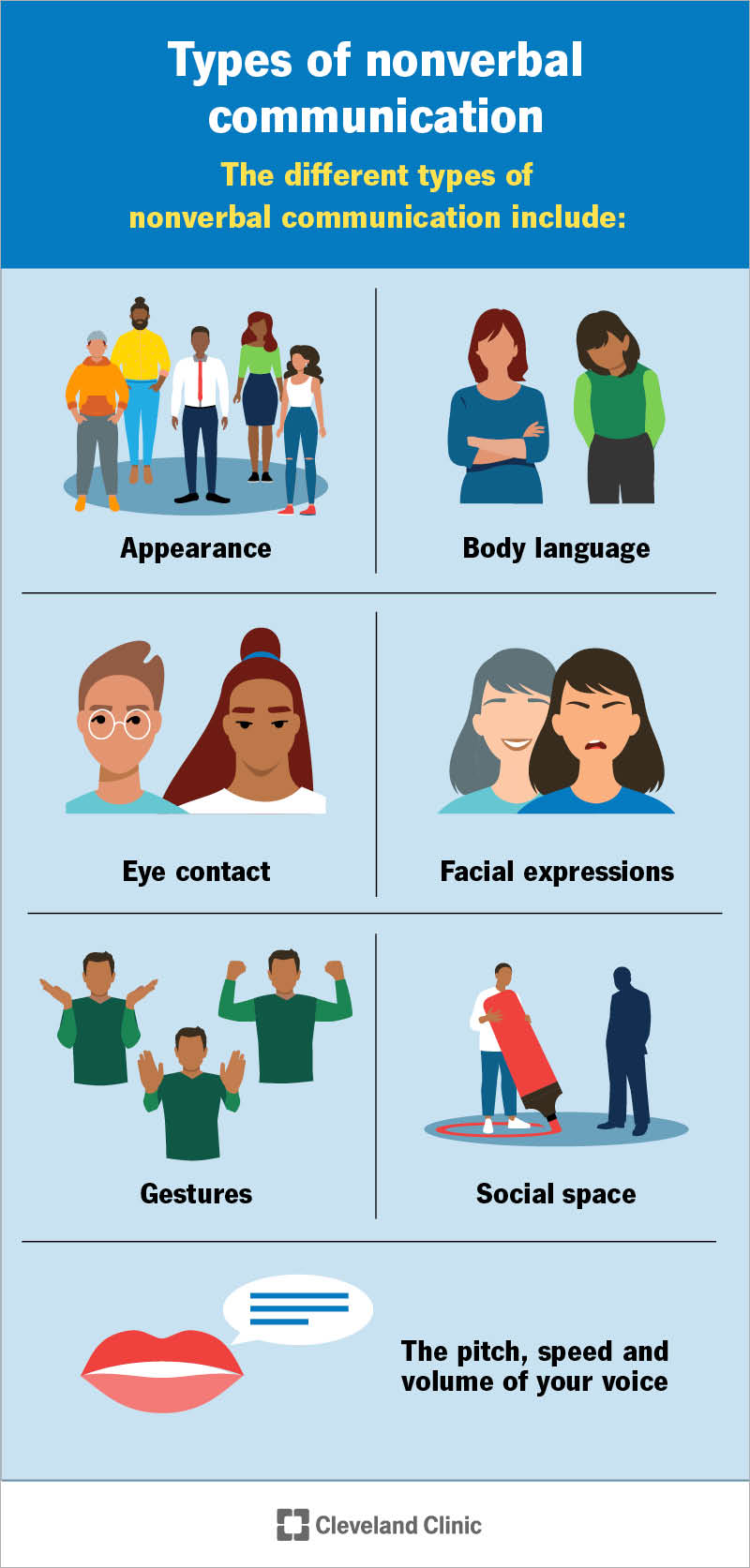
Image content: This image is available to view online.
View image online (https://my.clevelandclinic.org/-/scassets/images/org/health/articles/nonverbal-communication)
Nonverbal communication is a way to share information without speaking. It includes many different cues, like facial expressions, hand gestures, body language and tone of voice. It allows you to show feelings and ideas through your actions, movements and the way you present yourself.
Advertisement
Cleveland Clinic is a non-profit academic medical center. Advertising on our site helps support our mission. We do not endorse non-Cleveland Clinic products or services. Policy
Some signals can strengthen a conversation, like a smile or a nod. Others, like offering too strong a handshake and slouching in a chair, may send different messages. Learning to notice and adjust these cues is an important step in building your nonverbal communication skills.
The different types of nonverbal communication include:
Advertisement
It’s important to remember that types of nonverbal communication can mean different things in different cultures. For example, in some cultures, eye contact shows respect, while in others it may feel uncomfortable.
Nonverbal communication is important because it helps people fully understand what you mean. Without it, conversations can feel flat. This is a reason why we add emoticons or emojis to emails or text messages to help readers understand our meaning and tone. It would also be hard to sense feelings if body language and tone didn’t exist.
It builds stronger connections, too. A gesture or tone of voice can show care, comfort and understanding in ways words alone can’t.
Sometimes, nonverbal communication can replace speech. For example, sign languages use hand movements, facial expressions and body language to share ideas and feelings without spoken words.
A large part of communication is nonverbal. How much exactly is up for debate. This means people often rely on more than just words to understand each other. Tone of voice, facial expressions and body language all play a major role.
In many everyday situations, nonverbal cues can carry as much or more meaning than spoken words, especially when emotions are involved. For example, you may notice someone’s mood from how they sound or move before they explain how they feel.
Words are still important. But they’re only one part of communication. Most messages are understood through a combination of words, tone and body language, not words alone.
Paying attention to all of these signals helps you better understand what someone is feeling or trying to say.
There are many reasons why someone may be nonverbal. Each person starts out as nonverbal when they’re a baby. They then learn and develop language skills.
Sometimes, something affects parts of the brain that control speech and language. This may make someone nonverbal. It may affect their vocal cords that control speech. Some mental health conditions may cause someone to feel too afraid or unable to speak.
Some common causes include:
If you or a loved one is having trouble with speech, talk with a healthcare provider. They can help find the cause and suggest the right support.
Here are simple ways you can strengthen your nonverbal communication skills:
Advertisement
Nonverbal communication isn’t just about what you say — it’s about how you show up. A glance, shrug or grimace can tell a story before words even leave your mouth. Sometimes, this language is stronger than the words themselves.
Understanding how you communicate beyond speaking can help you connect more deeply with others, especially when emotions are involved or when words aren’t enough. And if you or someone you love finds speech hard or not possible, these nonverbal signals can become powerful tools to share thoughts, feelings and needs.
Like any skill, you can learn and improve them over time. Even small changes, like relaxing your shoulders or offering a simple head nod during a conversation, can make others feel more at ease around you. They can open doors, build trust and make everyday interactions a little more human.
Advertisement



Sign up for our Health Essentials emails for expert guidance on nutrition, fitness, sleep, skin care and more.
Learn more about the Health Library and our editorial process.
Cleveland Clinic’s health articles are based on evidence-backed information and review by medical professionals to ensure accuracy, reliability and up-to-date clinical standards.
Cleveland Clinic’s health articles are based on evidence-backed information and review by medical professionals to ensure accuracy, reliability and up-to-date clinical standards.
Your mental well-being is just as important as your physical well-being. Cleveland Clinic’s mental health experts can help you live life to the fullest.
