Cognition is your brain’s ability to think, learn and use information. It includes skills like memory, attention, reasoning and problem-solving that help you navigate daily life. Factors like age, stress, sleep and physical health can all affect how well your brain functions.
Advertisement
Cleveland Clinic is a non-profit academic medical center. Advertising on our site helps support our mission. We do not endorse non-Cleveland Clinic products or services. Policy
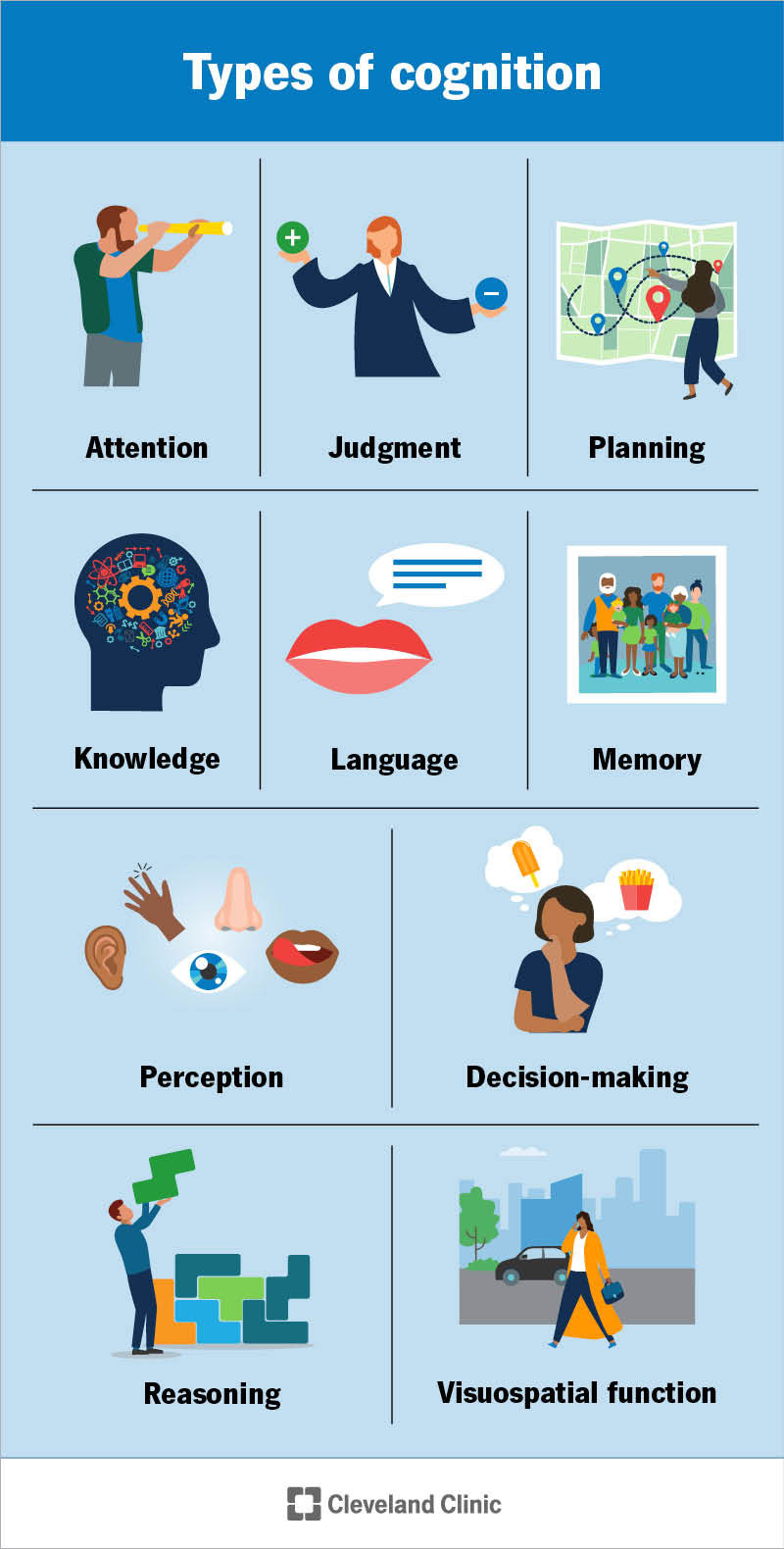
Image content: This image is available to view online.
View image online (https://my.clevelandclinic.org/-/scassets/images/org/health/articles/cognition)
Cognition is how your brain takes in, understands and uses information. It involves mental skills you use every day, like paying attention, remembering, learning, making decisions, using language and planning. These thinking processes help you use what you already know and gain new knowledge from your experiences and senses.
Advertisement
Cleveland Clinic is a non-profit academic medical center. Advertising on our site helps support our mission. We do not endorse non-Cleveland Clinic products or services. Policy
There are many different types of cognition including:
Cognition depends on different parts of your brain working together. Groups of connected brain regions, called neural networks, speak through electrical signals and chemical messengers. Each network helps with certain mental skills, like attention, memory and decision-making.
Advertisement
These networks rely on neurons (nerve cells) that send messages across small gaps (synapses) using neurotransmitters. Neurotransmitters are chemicals that help your brain communicate.
The neurotransmitters that help with cognition are:
When these signals move smoothly through your brain networks, they help you think clearly, solve problems and respond quickly to what’s happening around you.
Here’s how your brain uses cognition:
When all these steps work together, your brain can think, learn and stay focused on goals. When something interrupts this process, it can cause problems like forgetfulness, trouble focusing or slower thinking.
Many things can affect how well your brain works, including:
You can support healthy cognition by:
There are a lot of conditions that can affect how signals move through your brain. Some of the most common ones include:
Advertisement
Your provider may give you a brief cognitive screening test to see how well your brain is working. These tests are quick and painless, and they don’t require any studying. They simply show how your thinking skills are working right now.
Common types include:
These tests check skills like memory, attention, problem-solving, language and awareness of space and time.
If the results suggest possible changes in thinking or memory, your provider may do more detailed tests. They might also repeat the cognitive tests from time to time to track how your brain function changes.
Cognition isn’t something you usually think about — it’s what’s working as you think. But the term might come up during an appointment if something feels off, like if you’re forgetting names, having trouble focusing or feeling mentally foggy.
If you notice changes in how you think or focus, a healthcare provider can help you find out why and determine what to do next. Some things you can work on at home, like getting enough rest, staying connected with loved ones and keeping your mind active. For everything else, your provider can guide you toward the right care to help your brain stay strong and healthy.
Advertisement
Advertisement



Sign up for our Health Essentials emails for expert guidance on nutrition, fitness, sleep, skin care and more.
Learn more about the Health Library and our editorial process.
Cleveland Clinic’s health articles are based on evidence-backed information and review by medical professionals to ensure accuracy, reliability and up-to-date clinical standards.
Cleveland Clinic’s health articles are based on evidence-backed information and review by medical professionals to ensure accuracy, reliability and up-to-date clinical standards.
If you have a neurological condition, you want expert advice. At Cleveland Clinic, we’ll work to create a treatment plan that’s right for you.