



Tonsillectomy is the surgical removal of your tonsils. It’s done to treat sleep-related breathing issues or frequent infections. While surgeons perform tonsillectomies less often than they used to, the procedure is still common today. Tonsillectomy recovery takes up to two weeks.
Advertisement
Cleveland Clinic is a non-profit academic medical center. Advertising on our site helps support our mission. We do not endorse non-Cleveland Clinic products or services. Policy
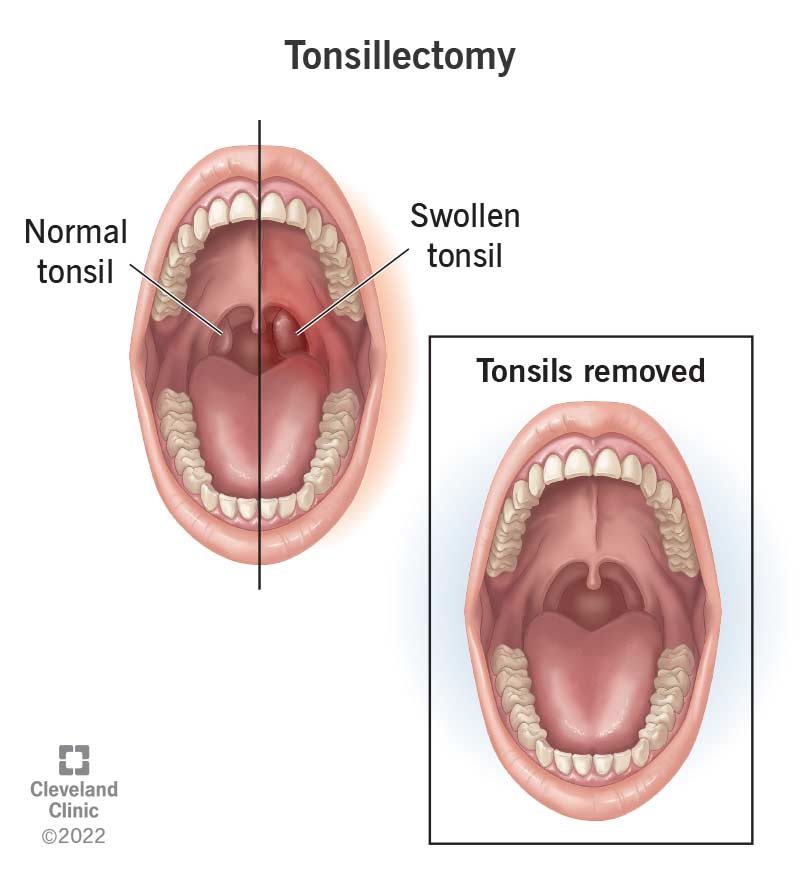
Image content: This image is available to view online.
View image online (https://my.clevelandclinic.org/-/scassets/Images/org/health/articles/15605-tonsillectomy)
Tonsillectomy (tahn-suh-LEK-tuh-me) is surgery to remove your tonsils. Tonsils are round, fleshy masses in the back of your throat. Unless you’ve had them removed, you have two — one on each side. They’re a part of your immune system.
Advertisement
Cleveland Clinic is a non-profit academic medical center. Advertising on our site helps support our mission. We do not endorse non-Cleveland Clinic products or services. Policy
Sometimes, they can become inflamed and cause painful sore throats. They can swell and block part of your airway. This may make it harder to breathe during sleep.
While adults sometimes need tonsillectomies, it’s more common in children. Your tonsils get bigger during childhood and can shrink as you get older. That’s why children are more likely to need a tonsillectomy.
Healthcare providers recommend this surgery for two main reasons:
Up until the 1980s, providers frequently performed tonsillectomies for tonsillitis. Nowadays, providers do them more often to treat sleep apnea.
Before surgery, your healthcare provider will check to make sure you’re healthy enough for surgery. This may involve getting blood tests.
Your provider will give you instructions to help you prepare. For example, you may need to stop taking certain medicines several days before surgery. You may need to fast the night before.
Follow these guidelines closely.
Your healthcare provider will give you general anesthesia to keep you asleep and comfortable during your procedure. Next, they’ll remove your tonsils. Since you’re asleep, you won’t feel pain. Surgeons use many methods to perform tonsillectomies, including:
Advertisement
A tonsillectomy usually takes about 20 to 30 minutes to complete. It could take longer in some instances.
For example, some children need surgery to remove their adenoids and tonsils. Like tonsils, your adenoids can become swollen. Instead of performing the procedures separately, providers often perform them together. This may add to the total surgery time.
Having a tonsillectomy can offer many benefits, including:
While complications are rare, they can happen. Possible risks include:
After your surgery, your medical team will move you to a recovery area. There, your healthcare provider will check your vital signs and make sure there are no complications.
Tonsillectomy is usually an outpatient procedure. This means you can go home on the same day. Complications are rare. But if they arise, your provider might keep you in the hospital overnight to monitor your progress.
On average, most people reach full recovery in about two weeks. Recovery time depends on things like the type of tonsillectomy you had, how quickly your body typically heals and whether you experienced any complications.
While healing looks a little different for everyone, here’s a general timeline of what to expect during recovery:
One to two days after
Three to five days after
Five to 10 days after
Drinking lots of fluids is key to a successful recovery. You’ll want to eat soft, cool foods for the first week. You can try solid foods once your comfort level allows. But you should avoid crunchy and spicy foods, as they can irritate the surgical area.
Food and drink recommendations during recovery include:
Advertisement
It’s best to take at least 10 days off work or school following a tonsillectomy. Staying at home helps reduce your risk of colds or other infections after surgery.
After a tonsillectomy, you should call your healthcare provider if you develop:
The 7 5 3 rule helps healthcare providers decide whether a child needs surgery for tonsillitis. It’s also called the Paradise criteria. It’s named after Dr. Paradise, the pediatrician who developed it.
Your child may be a good candidate for this procedure if any of the following applies:
You can expect to feel some pain and discomfort following a tonsillectomy. This is normal and usually improves in a week or two. In general, recovery is more difficult for adults than for children. Your healthcare provider will give you medications and instructions to help ease any pain.
Advertisement
Many people worry that removing their tonsils will have a negative impact on their immune systems. But having a tonsillectomy doesn’t weaken your immune system. Your body can still fight off germs.
Keep in mind, though — even if you have your tonsils removed, the tissues in your throat can still become infected and sore.
Although surgeons don’t do as many tonsillectomies as they used to, a tonsillectomy is still a common procedure. If you or your child has symptoms related to enlarged tonsils, speak to a healthcare provider. Sometimes, medical management is all the treatment that’s needed. But if it’s not helping enough, removing your tonsils may do the trick.
Advertisement



Sign up for our Health Essentials emails for expert guidance on nutrition, fitness, sleep, skin care and more.
Learn more about the Health Library and our editorial process.
Cleveland Clinic’s health articles are based on evidence-backed information and review by medical professionals to ensure accuracy, reliability and up-to-date clinical standards.
Cleveland Clinic’s health articles are based on evidence-backed information and review by medical professionals to ensure accuracy, reliability and up-to-date clinical standards.
Not just kids need a tonsillectomy. Adults who have frequent sore throats or snore a lot get them, too. Cleveland Clinic is here to help.
