



CPR (cardiopulmonary resuscitation) is an emergency procedure for someone who’s in cardiac arrest. CPR with breaths and hands-only CPR are the two types. Even if you’re not CPR-certified, you can do hands-only CPR. This involves doing 100 to 120 chest compressions per minute. Start CPR immediately to give the person the best chance of survival.
Advertisement
Cleveland Clinic is a non-profit academic medical center. Advertising on our site helps support our mission. We do not endorse non-Cleveland Clinic products or services. Policy
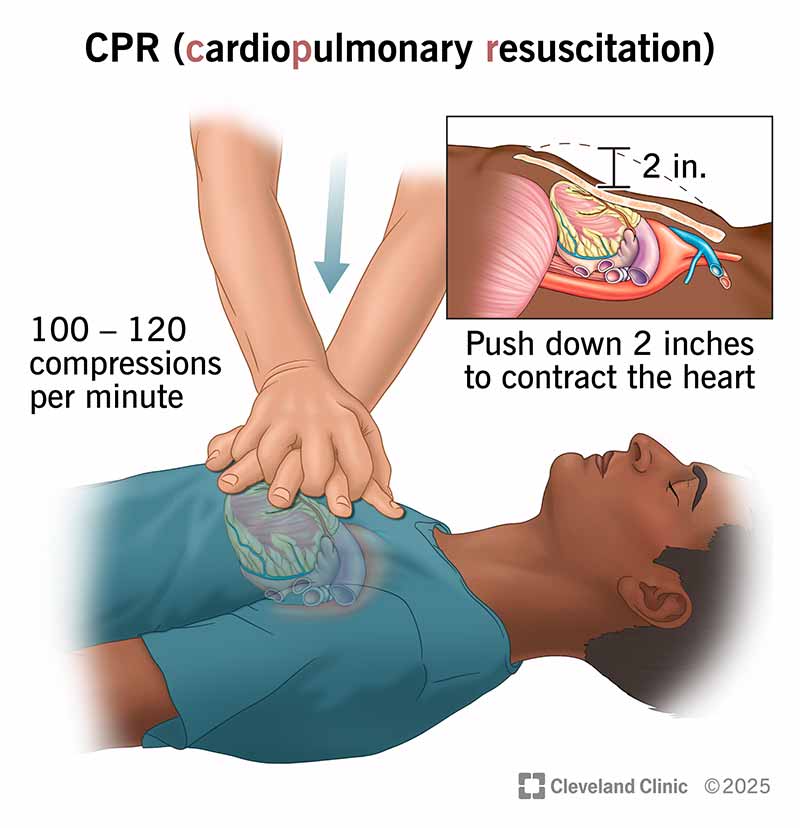
Image content: This image is available to view online.
View image online (https://my.clevelandclinic.org/-/scassets/images/org/health/articles/cpr)
CPR stands for cardiopulmonary resuscitation. It’s an emergency procedure that can save your life if you’re in cardiac arrest. This means your heart stops beating and can’t pump blood out to your body. The key part of CPR is chest compressions (pushing hard and fast in the center of the chest). This keeps some blood flowing to vital organs. CPR may also involve mouth-to-mouth breaths, which give you oxygen.
Advertisement
Cleveland Clinic is a non-profit academic medical center. Advertising on our site helps support our mission. We do not endorse non-Cleveland Clinic products or services. Policy
Healthcare providers, like doctors, nurses and paramedics, routinely perform CPR both in and out of hospitals. Others, called lay rescuers, can also perform CPR wherever it’s needed, like at homes, gyms and shopping malls.
If you’re reading this and aren’t a healthcare provider, you have the opportunity to be a lay rescuer. This means you can save someone’s life, no matter who you are. Lay rescuers include people with CPR certification (you take classes and get an official certificate), as well as those without it. You’ll do the type of CPR that reflects your training and comfort level.
There are two main types of CPR:
Both types are effective and can be lifesaving within the first few minutes of cardiac arrest in adults. However, CPR with breaths is more helpful in situations where CPR must go on for longer than a few minutes. This is because the person’s blood needs more oxygen at that point to prevent damage to vital organs like the brain.
Advertisement
A person needs CPR if they’re unconscious and have absent or abnormal breathing. Here’s what that means:
These are signs that the person is in cardiac arrest.
When someone’s in cardiac arrest, do NOT delay CPR in order to:
The only time to check the airways for a lodged object is if you witness someone collapse while choking. In that case, quickly look in their mouth. Don’t feel around for an object. But if you can clearly see an object and it’s easily removed, you can remove it. Otherwise, start CPR right away.
Video content: This video is available to watch online.
View video online (https://cdnapisec.kaltura.com/p/2207941/sp/220794100/playManifest/entryId/1_jvfs4k5s/flavorId/1_5f3sgelj/format/url/protocol/https/a.mp4)
Learn how to perform CPR.
Before starting CPR, quickly ask someone to:
It may take some minutes for emergency services to arrive and for someone to find an AED. Don’t wait. Start CPR immediately.
Advertisement
Continue doing CPR until any of the following happen:
If at any point, you feel too tired to continue, let someone else who’s ready step in. Make the switch as quickly as possible so there aren’t long breaks in between compressions. Generally, it’s advised to switch personnel every two minutes.
There are some key differences when you’re doing CPR for anyone 12 or younger. Here’s what to know:
Advertisement
When performing CPR on an infant (1 to 12 months old), use one of the following techniques for chest compressions:
CPR can save your life if you receive it right after going into cardiac arrest. CPR keeps blood moving through your body. This may prevent organ damage, like cerebral hypoxia.
Some people with certain preexisting health conditions might not experience the same benefits from CPR. It depends on how sick you are before you go into cardiac arrest. Consider speaking with a healthcare provider you trust about what your recovery or outlook might look like if you needed CPR.
Possible risks of CPR include broken ribs and injury to organs in your chest. This is because chest compressions must be forceful to keep blood circulating and keep you alive.
If you’re a lay rescuer, you’ll step back when first responders arrive. They’ll take over and begin providing medical care. They’ll transport the person to a hospital as soon as possible. If the person survives, healthcare providers will check for any organ damage from a lack of oxygen. They’ll also determine the cause of cardiac arrest and provide any needed treatment.
Advertisement
If a cardiac arrest occurs at home and an individual wakes up after CPR from a non-trained family member, they should be evaluated immediately by a healthcare team. This is true even if they look well.
Most cardiac arrests that happen outside a hospital are at home. So, you could be helping a relative or friend if you know CPR. You may want to get CPR certification if you have a loved one at risk of cardiac arrest. You can earn it through organizations like the American Red Cross and the American Heart Association. That way, you’ll be ready to help and confident in your ability.


Sign up for our Health Essentials emails for expert guidance on nutrition, fitness, sleep, skin care and more.
Learn more about the Health Library and our editorial process.
Cleveland Clinic’s health articles are based on evidence-backed information and review by medical professionals to ensure accuracy, reliability and up-to-date clinical standards.
Cleveland Clinic’s health articles are based on evidence-backed information and review by medical professionals to ensure accuracy, reliability and up-to-date clinical standards.
Whether you need stitches, a broken bone set or think your appendix might be causing your abdominal pain, Cleveland Clinic’s emergency medicine team is here to help.
