



Vestibular neuritis happens when an infection causes inflammation in your vestibulocochlear nerve in your inner ear. It causes symptoms that develop very fast and include severe vertigo, intense dizziness and balance issues. Medication and physical therapy may ease your symptoms.
Advertisement
Cleveland Clinic is a non-profit academic medical center. Advertising on our site helps support our mission. We do not endorse non-Cleveland Clinic products or services. Policy
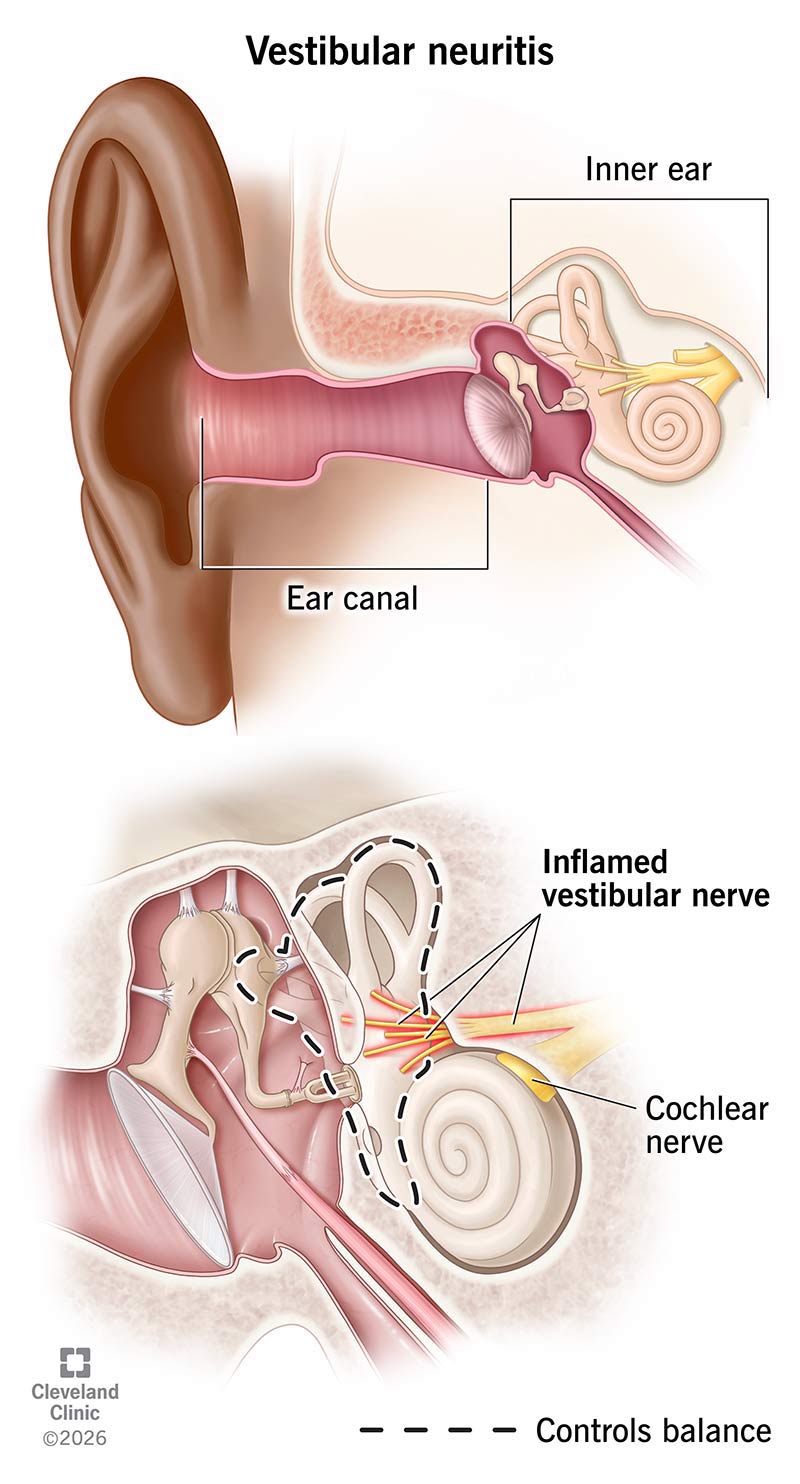
Image content: This image is available to view online.
View image online (https://my.clevelandclinic.org/-/scassets/Images/org/health/articles/vestibular-neuritis-illustration)
Vestibular neuritis is an inner ear disorder that affects the vestibulocochlear nerve. This nerve receives information from your inner ear about the position and movement of your head. It sends that information to your brain, which uses the information to help you maintain your sense of balance.
Advertisement
Cleveland Clinic is a non-profit academic medical center. Advertising on our site helps support our mission. We do not endorse non-Cleveland Clinic products or services. Policy
An infection that causes inflammation in your inner ear can make this nerve swell or become inflamed. When that happens, your brain can’t read the information your nerve sends, and you have dizziness, vertigo or other balance issues.
This condition affects about 4 in every 100,000 people in the U.S. Anyone may develop vestibular neuritis, but it’s more common in adults than in children. Treatment often involves medication to ease your symptoms.
The symptoms can vary depending on whether you’re experiencing the acute or chronic phase of vestibular neuritis.
The acute phase can last up to a week and cause symptoms like:
The chronic phase may last for a few weeks up to several months. It can cause symptoms like:
Experts don’t know the exact cause but believe that viral infections may trigger the condition. The infection may be in your inner ear. But it can spread to your inner ear from another part of your body. Either way, a viral infection may cause inflammation that affects your vestibulocochlear nerve. Infections that may affect this nerve include:
Advertisement
No, you can’t catch vestibular neuritis from someone else. But you can catch a virus that may cause the nerve to swell or become inflamed.
The effects of vestibular neuritis may cause long-term symptoms, like dizziness or unsteadiness. You may have spatial disorientation, when you can’t determine your body’s position relative to your surroundings.
This condition rarely involves hearing loss.
A healthcare provider will ask about your symptoms. They may do an MRI with contrast to rule out other causes, like:
After ruling out other causes, your provider may refer you to an audiologist. That provider may do:
Treatment may be a combination of medication and physical therapy to manage your symptoms. Your healthcare provider may prescribe:
They may recommend vestibular rehabilitation therapy if your symptoms continue. This treatment involves exercises that help you manage dizziness and balance issues.
Talk to a healthcare provider if you have dizziness, lightheadedness or balance issues that happen for no obvious reason and don’t improve. If you have vestibular neuritis, talk to your provider if treatment doesn’t ease your symptoms or if they get worse.
Some people may recover in just one week. Others may have lingering symptoms that last weeks, months or even years. If your symptoms aren’t improving, talk to your healthcare provider about additional treatment options.
Vestibular neuritis can come back, but that doesn’t happen very often.
Vestibular neuritis happens when something affects your vestibulocochlear nerve. With labyrinthitis, there’s inflammation in your labyrinth. This is the part of your inner ear that contains organs that support hearing and balance.
Vestibular neuritis and benign paroxysmal positional vertigo (BPPV) cause many of the same symptoms. But these are very different conditions. BPPV happens when tiny crystals (otoconia) in your inner ear move from a fluid-filled cavity in your inner ear to fluid-filled tubes that help with balance.
Advertisement
Vestibular neuritis typically causes severe vertigo, dizziness and balance issues that happen very fast. It can be unnerving and even a little frightening if you suddenly feel very unsteady on your feet or as if the world is spinning around you. Fortunately, medications can help ease symptoms. If your symptoms don’t go away, talk to your healthcare provider. They can help find a treatment that works best for you.
Advertisement



Sign up for our Health Essentials emails for expert guidance on nutrition, fitness, sleep, skin care and more.
Learn more about the Health Library and our editorial process.
Cleveland Clinic’s health articles are based on evidence-backed information and review by medical professionals to ensure accuracy, reliability and up-to-date clinical standards.
Cleveland Clinic’s health articles are based on evidence-backed information and review by medical professionals to ensure accuracy, reliability and up-to-date clinical standards.
Vertigo, dizziness and balance disorders can make you feel unsteady on your feet. Cleveland Clinic’s experts can craft a treatment plan that works for you.
