



Huntington’s disease is a rare, inherited condition that slowly affects your movement and thinking abilities. A gene change causes damage in areas of your brain that control coordination, memory and emotions. Symptoms build over time. A healthcare provider can help you understand these changes and plan for care.
Advertisement
Cleveland Clinic is a non-profit academic medical center. Advertising on our site helps support our mission. We do not endorse non-Cleveland Clinic products or services. Policy
Huntington’s disease causes nerve cells in your brain to break down, leading to movement, thinking and emotional challenges.
Advertisement
Cleveland Clinic is a non-profit academic medical center. Advertising on our site helps support our mission. We do not endorse non-Cleveland Clinic products or services. Policy
A change in one of your genes causes an abnormal protein to build up in brain cells. It damages the cells and affects how they function. In most cases, you inherit this gene change from one of your biological parents.
You may notice twitching, trouble thinking clearly, or changes in mood or personality — usually after the age of 30. These symptoms can be difficult for both you and your loved ones. A healthcare provider can help you understand what’s happening and support you as symptoms change.
There are two main types of Huntington’s:
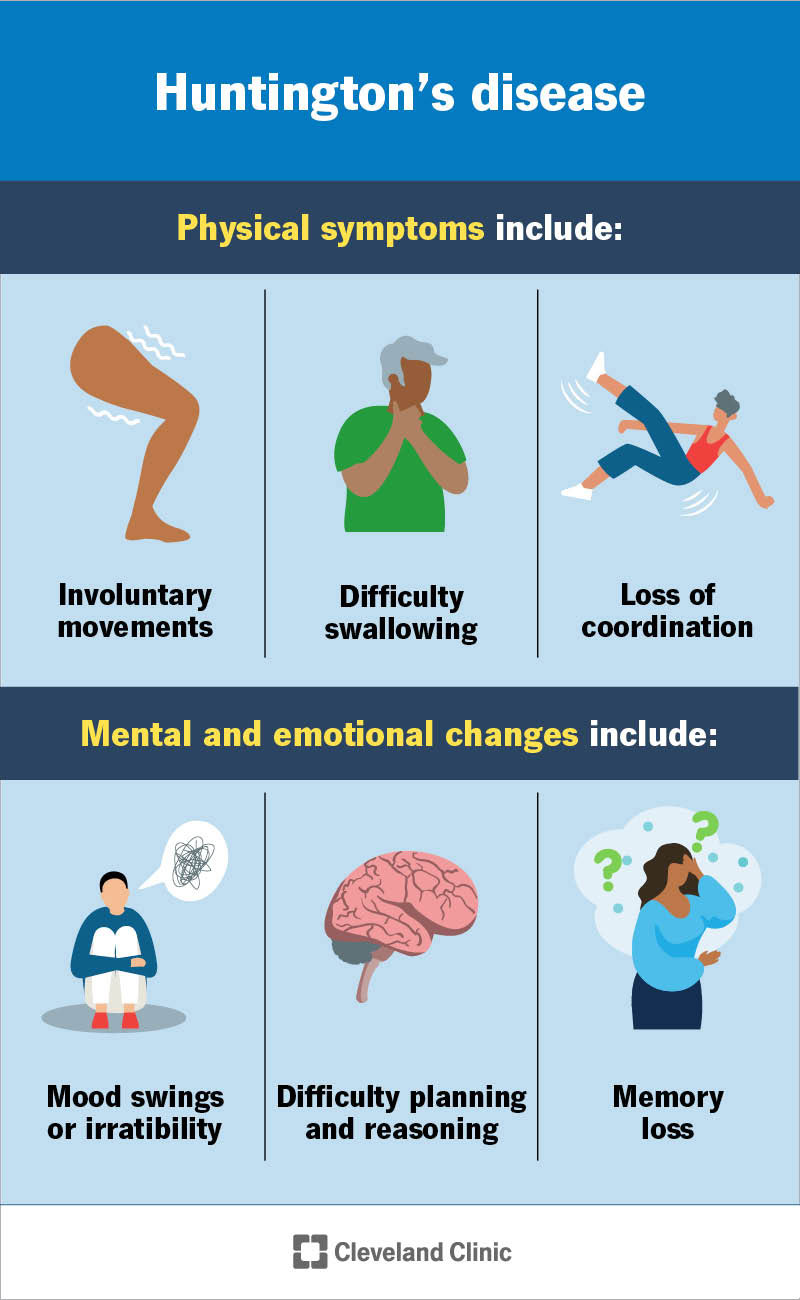
Image content: This image is available to view online.
View image online (https://my.clevelandclinic.org/-/scassets/images/org/health/articles/14369-huntingtons-disease)
Signs and symptoms usually start slowly and get worse over time.
One of the first signs is chorea. Huntington’s disease used to be called “Huntington’s chorea” because of this. It’s a jerky or twisting movement you can’t control. Chorea often begins in your hands, fingers or face. It then spreads to your arms, legs and body. This movement can make it hard to speak, eat or walk.
Other physical symptoms may include:
Advertisement
Huntington’s disease also changes how you think and feel. These emotional and mental symptoms may appear before physical ones:
These changes can affect work, school and relationships. As the disease progresses, physical and emotional symptoms can make everyday tasks harder.
This type usually progresses faster and can look different from the adult form. Common symptoms in children and teens include:
Teens may also develop chorea and emotional changes similar to adult Huntington’s disease. As time goes on, movement and thinking problems usually become more noticeable.
A change in a gene called HTT causes Huntington’s disease. You can inherit it. You only need to get the changed gene from one biological parent to develop the condition. This is called autosomal dominant inheritance. In rare cases, the gene change can happen for the first time in someone with no family history of the disease.
The HTT gene normally makes a protein called huntingtin. It helps your brain cells stay healthy and communicate. The huntingtin protein supports movement, learning and emotional balance.
When the HTT gene changes, it makes a harmful form of the huntingtin protein. This faulty protein doesn’t fold the right way. Think about it like folding a piece of paper. You want it to fold neatly with aligned edges. It instead crumples into a ball.
Because the folding process doesn’t go as planned, it starts to clump together inside your brain cells. Over time, these clumps:
As it affects more brain cells, symptoms become more noticeable.
Anyone can develop Huntington’s. But it’s most common if someone in your biological family has the condition. If one of your parents has Huntington’s disease, you have a 50% chance of developing it. There’s no known way to prevent it.
Complications of Huntington’s disease may include:
Advertisement
Children with juvenile Huntington’s disease may experience seizures.
Doctors diagnose Huntington’s disease by looking at your:
To confirm the diagnosis, your provider may order a genetic test to look for the HTT gene change. You’ll likely meet with a genetic counselor before and after testing to help you understand what the results mean for you and your family.
Your provider might also suggest a brain MRI to look for brain damage.
If you or your partner already know you carry the Huntington’s gene, testing during pregnancy or embryo testing can screen for the gene change.
There’s no cure for Huntington’s disease right now. But researchers are doing clinical trials to test new treatments that may slow the disease’s progression.
Certain treatments may help ease your symptoms. Your care team can help you stay independent for as long as possible with medications, supportive care and clinical trials.
Medications may help with movement, mood and behavior changes. Common options include:
Advertisement
Your care team will watch for side effects and adjust your medications as needed.
Supportive care helps you manage symptoms, stay safe and maintain comfort. It may include:
Social workers or case managers can connect you and your family with community resources, home health aides and support groups.
Researchers are studying new treatments that may slow the disease, like:
These treatments may be available through clinical trials. Ask your care team if this is an option for you.
See your healthcare provider if you notice new or worsening symptoms. Let them know if symptoms make it hard to do your daily activities safely. If you’re already in treatment, your provider may need to adjust your care plan as the condition changes.
Advertisement
Call emergency services if you or your child:
Your provider can also help you plan for the future. They may talk with you about creating an advance directive. This is a legal document that shares your wishes for medical care if you’re ever unable to speak for yourself.
Huntington’s disease gets worse over time. The speed and order of symptoms can be different for everyone, but the condition usually moves through three main stages:
Your care team will support you and your family through each stage. They can help you manage symptoms and maintain comfort and safety.
People with Huntington’s disease usually live about 15 to 20 years after symptoms begin.
The disease itself isn’t directly fatal. But it causes changes that make daily activities harder over time. How quickly it progresses is different for everyone.
Most deaths happen because of complications, like infections (especially pneumonia) or injuries from falls. Regular care and support can help manage symptoms and lower these risks.
It’s a strange and difficult feeling to know that changes to your brain and body are coming, but not all at once. You may want to prepare, yet still feel uncertain about what’s ahead. Living with Huntington’s disease can be overwhelming — not just physically, but also emotionally.
Your care team is there to guide you through each stage and help you focus on what you can control today. Some days may feel heavier than others, but small moments of comfort and connection still matter.



Sign up for our Health Essentials emails for expert guidance on nutrition, fitness, sleep, skin care and more.
Learn more about the Health Library and our editorial process.
Cleveland Clinic’s health articles are based on evidence-backed information and review by medical professionals to ensure accuracy, reliability and up-to-date clinical standards.
Cleveland Clinic’s health articles are based on evidence-backed information and review by medical professionals to ensure accuracy, reliability and up-to-date clinical standards.
A Huntington’s disease diagnosis can leave you feeling uncertain. Cleveland Clinic is here to answer your questions and help you manage your symptoms.
