



Gallbladder cancer is a rare form of cancer that often doesn’t cause signs or symptoms in the early stages. As a result, most cases aren’t diagnosed until the cancer has spread and is hard to treat. Treatments include gallbladder removal surgery, radiation and chemotherapy. Clinical trials are an important option for gallbladder cancer treatment.
Advertisement
Cleveland Clinic is a non-profit academic medical center. Advertising on our site helps support our mission. We do not endorse non-Cleveland Clinic products or services. Policy
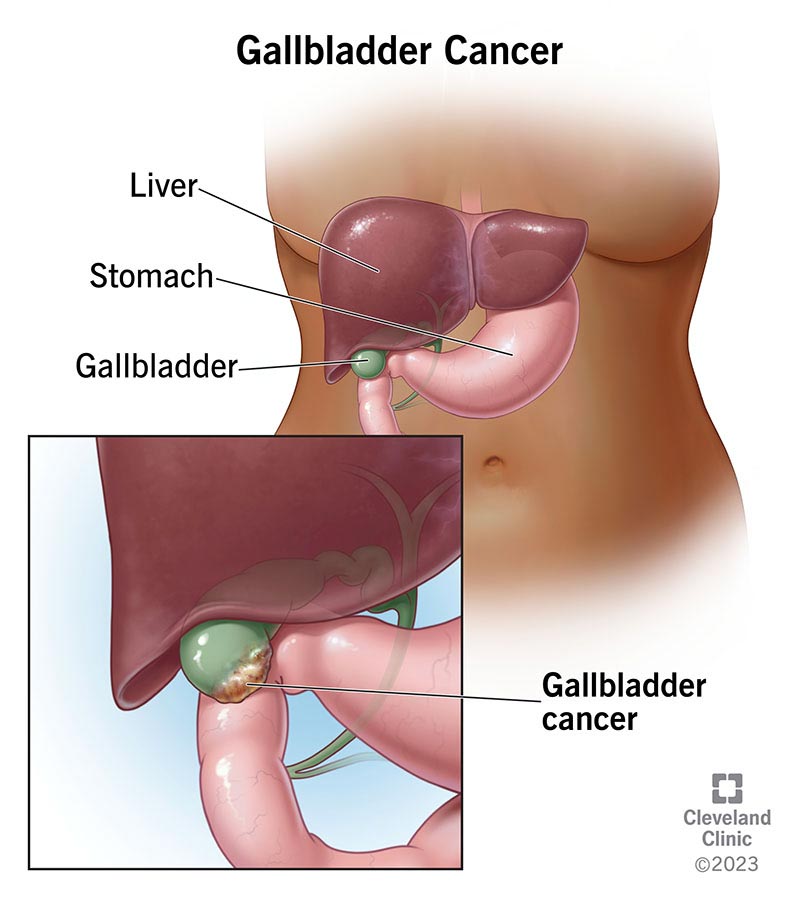
Image content: This image is available to view online.
View image online (https://my.clevelandclinic.org/-/scassets/Images/org/health/articles/17013-gallbladder-cancer)
Gallbladder cancer starts in your gallbladder — the pear-shaped organ in the upper right of your belly, just under your liver. Your gallbladder stores and delivers a fluid called bile that helps you digest fats. The disease begins in the inner layer of your gallbladder. From there, it spreads outward.
Advertisement
Cleveland Clinic is a non-profit academic medical center. Advertising on our site helps support our mission. We do not endorse non-Cleveland Clinic products or services. Policy
This condition can be difficult to detect in the early stages because it often doesn’t cause symptoms until it’s advanced. When symptoms start, they’re a lot like those you’d have with less serious gallbladder conditions. In fact, healthcare providers commonly find the cancer by chance after doing gallbladder surgery to treat gallstones.
Gallbladder cancer is often hard to treat because diagnosis and treatment usually happen late in the course of the disease. Still, your outlook depends on lots of factors unique to you. These include your overall health and how likely it is that surgery can remove all the cancer.
The first signs are like those in common gallbladder conditions. It’s easy to mistake symptoms for gallstones. They include:
Gene changes (mutations) cause cells in your gallbladder to turn into cancer. The cells grow out of control and can spread. Experts don’t know what causes the changes. But they seem to occur during a person’s lifetime. Gallbladder cancer doesn’t seem to happen because of gene changes present at birth.
Advertisement
Anyone can have gallbladder cancer. But it’s most common in females over 65. In the U.S., most people diagnosed are American Indian, Alaska Native and Asian/Pacific Islander.
The biggest risk factors are noncancerous conditions that affect your gallbladder, like:
Smoking and obesity may also increase your risk.
It’s important to know that most people with these risk factors never develop gallbladder cancer. For instance, most people with gallbladder cancer have a history of gallstones. But less than 1% of people with gallstones go on to have this cancer.
Healthcare providers often find gallbladder cancer while investigating a different condition, usually gallstones. Arriving at a gallbladder diagnosis may involve tests and procedures like:
The cancer stage helps providers know which treatments to use. It also helps them determine your outlook. Early-stage cancers haven’t spread beyond your gallbladder. They may be curable with surgery. Cancers in later stages are harder to treat.
The stages of gallbladder cancer are:
Treatment depends on the cancer stage and your overall health and preferences. Your healthcare provider will review your options with you. They’ll let you know what results to expect based on the treatments you choose.
Treatments include:
Advertisement
Ask your provider if you should take part in a clinical trial. This is a study that tests new treatments. Participating in one may lead to better results than current therapies can provide.
Palliative care helps people manage cancer symptoms and treatment side effects. No matter your treatment plan for gallbladder cancer, palliative care can help you feel better. Many of the treatments used to get rid of gallbladder cancer may also be palliative. For example, radiation therapy and chemotherapy can be forms of palliative care when the main goal is to relieve your symptoms.
Surgery can also be a form of this treatment. For example, you may need procedures to relieve symptoms if a tumor is blocking parts of your digestive tract.
Gallbladder cancer can be cured when surgery removes all traces of a tumor.
Cancers that can’t be removed or that have spread aren’t curable. But there are treatments that can help you feel better. Some may help you live longer.
Still, when it comes to cancer, the treatment landscape is always changing because of new therapies available through clinical trials. Ask your healthcare provider if they recommend you take part in one.
Survival rates for gallbladder cancer are low because it’s not usually diagnosed until it’s advanced.
Advertisement
Medical experts report cancer survival rates based on how many people are alive five years after their diagnosis. For gallbladder cancer, this rate is only around 5% to 13%. Most people with this diagnosis die from it before reaching the five-year mark.
The five-year survival rate for early-stage gallbladder cancer is much higher, at 60%. This means that 6 in 10 people are alive five years later.
The numbers can feel jarring. But it’s important to remember that your future health is much more complex than any number can capture. This is why it’s best to discuss things like survival rates and life expectancy with your healthcare provider. They’re your best resource for understanding what comes next.
When it comes to any cancer diagnosis, knowledge is power. Make sure you understand your condition, including all the benefits and risks related to treatment. Ask your healthcare provider about the results you should expect.
You may also want to ask your provider if they recommend palliative care. These professionals can attend to your comfort and needs no matter your treatment goals. Making the most of all available support can go a long way in making a hard diagnosis feel more manageable.
Advertisement
It depends on where you live. Gallbladder cancer is rare in the U.S., affecting about 2 people per 100,000. It’s more common in Chile, India, Japan, Pakistan, and North and South Korea. These countries have higher rates of gallstones and other conditions that are risk factors for gallbladder cancer. The odds of getting this condition are much higher there.
How fast this cancer spreads depends on lots of factors unique to your diagnosis. For example, some cancer cells may involve gene mutations that cause the cancer to spread faster than cancers without those mutations.
Cancer grade also makes a difference. “Grade” refers to how abnormal the cells look compared to normal cells. High-grade cells tend to spread faster than low-grade ones.
These are just a few examples of factors that can play a role. There are many more.
The most important thing to know is that this cancer often spreads before causing symptoms. This can make it difficult to detect in the early stages, when treatments work best. Your provider will tell you how much the cancer has already spread as part of your diagnosis. They’ll also let you know how aggressive it may be, based on what they discover during your workup.
Gallbladder cancer is both rare and serious. And the frustrating part is that it can progress silently. That means there’s not much a person can do to get diagnosed early, when it’s easier to treat.
But there’s a lot you can do if you learn you have it. First, know that reaching out to a healthcare provider was the right thing to do. Whether the goal of your treatment is curative or palliative (symptom relief), there is care available that can help you feel better. And there’s support that can prepare you for the days ahead.
The more you know about your health, the more empowered you are to choose your next steps. Your care team will be right there beside you to help you take them.



Sign up for our Health Essentials emails for expert guidance on nutrition, fitness, sleep, skin care and more.
Learn more about the Health Library and our editorial process.
Cleveland Clinic’s health articles are based on evidence-backed information and review by medical professionals to ensure accuracy, reliability and up-to-date clinical standards.
Cleveland Clinic’s health articles are based on evidence-backed information and review by medical professionals to ensure accuracy, reliability and up-to-date clinical standards.
Having a rare condition like gallbladder cancer means you need specialized care. At Cleveland Clinic, our expert surgeons are trained to treat this uncommon cancer.
