Syringomyelia happens when a fluid-filled cyst forms in your spinal cord. It may cause pain, numbness or weakness over time. It’s rare and usually links to Chiari malformations or past spinal injuries. Treatment depends on your symptoms and may include surgery.
Advertisement
Cleveland Clinic is a non-profit academic medical center. Advertising on our site helps support our mission. We do not endorse non-Cleveland Clinic products or services. Policy
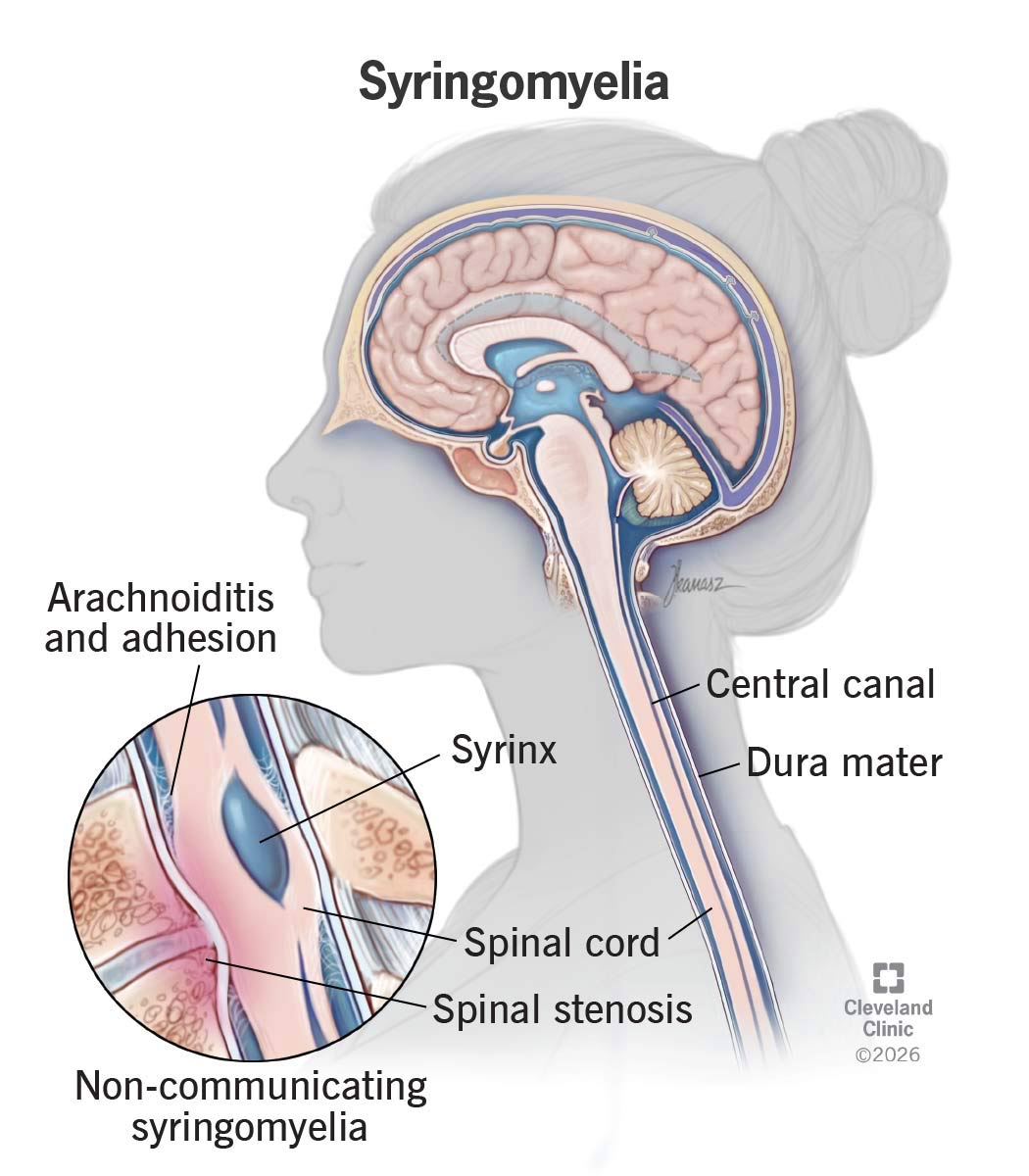
Image content: This image is available to view online.
View image online (https://my.clevelandclinic.org/-/scassets/images/org/health/articles/syringomyelia)
Syringomyelia is a neurological disorder where a fluid-filled cyst, called a syrinx, forms inside your spinal cord. The cavity fills with cerebrospinal fluid (CSF). The cyst can press on the nerves in your spine and cause problems over time. It often targets the upper parts of your spinal cord near your neck and upper back.
Advertisement
Cleveland Clinic is a non-profit academic medical center. Advertising on our site helps support our mission. We do not endorse non-Cleveland Clinic products or services. Policy
The condition may develop slowly over many years. Symptoms can affect how you feel sensations or move. In some cases, your provider may discover a syrinx incidentally on an MRI. It may stay the same size and not cause symptoms as time progresses (remain stable).
This condition can happen for different reasons. It’s often linked to a Chiari malformation (when part of your brain sits lower than usual) or it can happen months to years after a traumatic spinal cord injury.
Syringomyelia (pronounced “sr-in-jow-mai-EH-lee-uh”) is rare. Research suggests that it affects about 8 people per 100,000.
Your provider can help you plan the best care to relieve symptoms if you experience them.
There are a couple types of syringomyelia. They differ by how the cyst forms and what it connects to:
Your provider may describe syringomyelia by its underlying cause (like Chiari-related).
Advertisement
Symptoms usually develop slowly and may get worse over many years. They depend on where the syrinx sits in your spine, how big it is and how far it stretches. You might not have any symptoms for a while if the syrinx is small.
Common symptoms include:
A classic neurological finding is loss of pain and temperature sensation. While vibration and position senses stay normal, you might feel a “cape-like” pattern across your shoulders and upper arms.
Symptoms can affect one or both sides of your body and may be mild or severe.
Children may have symptoms like:
If you or your child has these symptoms, it’s important to see a healthcare provider as soon as possible. Early treatment may prevent permanent nerve damage.
Healthcare providers don’t know the exact reason a syrinx forms. Most theories say it happens when the flow of cerebrospinal fluid (CSF) changes or gets blocked.
Syringomyelia has two main types of causes:
Sometimes, a syrinx forms with no known cause. This is called idiopathic syringomyelia.
These conditions change the structure of your brain or spine. They can block CSF flow. Congenital causes include:
These causes happen after birth. They change how CSF moves around your spine:
This condition can affect anyone. Most people get a diagnosis between the ages of 20 and 50. But it can also develop in children or adults after age 50.
Advertisement
Syringomyelia can slowly damage your spinal cord over time. In late-stage and severe cases, complications may include:
To diagnose syringomyelia, a provider will review your medical history and ask about your symptoms. They’ll also do a physical and neurological exam to check your strength, feeling, reflexes, balance and coordination.
Imaging tests help confirm the diagnosis. The most important test is an MRI. This can show the syrinx (a fluid-filled cyst) in your spinal cord. The MRI also helps your provider see where the syrinx is, how large it is and how far it extends. It can also show possible causes, like a Chiari malformation or a tumor. Your provider may use a cine flow (dynamic) MRI to evaluate how cerebrospinal fluid flows around your brain and spinal cord.
Your provider may order other tests if they need to rule out conditions with similar symptoms. There are other testing options available if you can’t have an MRI.
Treatment focuses on reducing pressure in your spine and improving the flow of cerebrospinal fluid. Your provider might recommend:
Advertisement
If you have this condition, you’ll need regular visits with your care team. These check-ins monitor your symptoms and track any changes in the syrinx. They help whether you’ve had surgery or not.
Symptoms that need immediate medical attention include:
Advertisement
If you had surgery, your provider will tell you when to return for follow-up visits. Contact your care team right away if you notice any signs of a problem, like:
Most people with syringomyelia live a normal lifespan. Treatment can help manage the cause and lower the chance of serious problems. This helps keep you safer over time.
Your outlook can depend on:
The condition can change slowly for some. Others may see symptoms get worse more quickly.
Early diagnosis and treatment may help slow these changes. Many people improve with surgery, especially when the syrinx is in your neck area. Strength and movement may get better, but pain or numbness may not fully go away.
A syrinx can return, so regular follow-up visits are important. Your provider will let you know how often these visits should be so you can stay on top of your care.
Your spinal cord has an important job, but you may not think about it until something feels off. You might notice tingling, pain or weakness that doesn’t make sense. Syringomyelia might be one possible cause of these changes.
The name of this condition can sound intimidating, and treatment can feel complex. But getting attention early may help protect your nerves and prevent long-term problems.
If you already have a diagnosis, regular follow-up visits and paying attention to your symptoms are important. Whether your plan includes physical therapy, medication or surgery, your care team is there to support you and help you feel as well as possible.



Sign up for our Health Essentials emails for expert guidance on nutrition, fitness, sleep, skin care and more.
Learn more about the Health Library and our editorial process.
Cleveland Clinic’s health articles are based on evidence-backed information and review by medical professionals to ensure accuracy, reliability and up-to-date clinical standards.
Cleveland Clinic’s health articles are based on evidence-backed information and review by medical professionals to ensure accuracy, reliability and up-to-date clinical standards.
If you have a neurological condition, you want expert advice. At Cleveland Clinic, we’ll work to create a treatment plan that’s right for you.