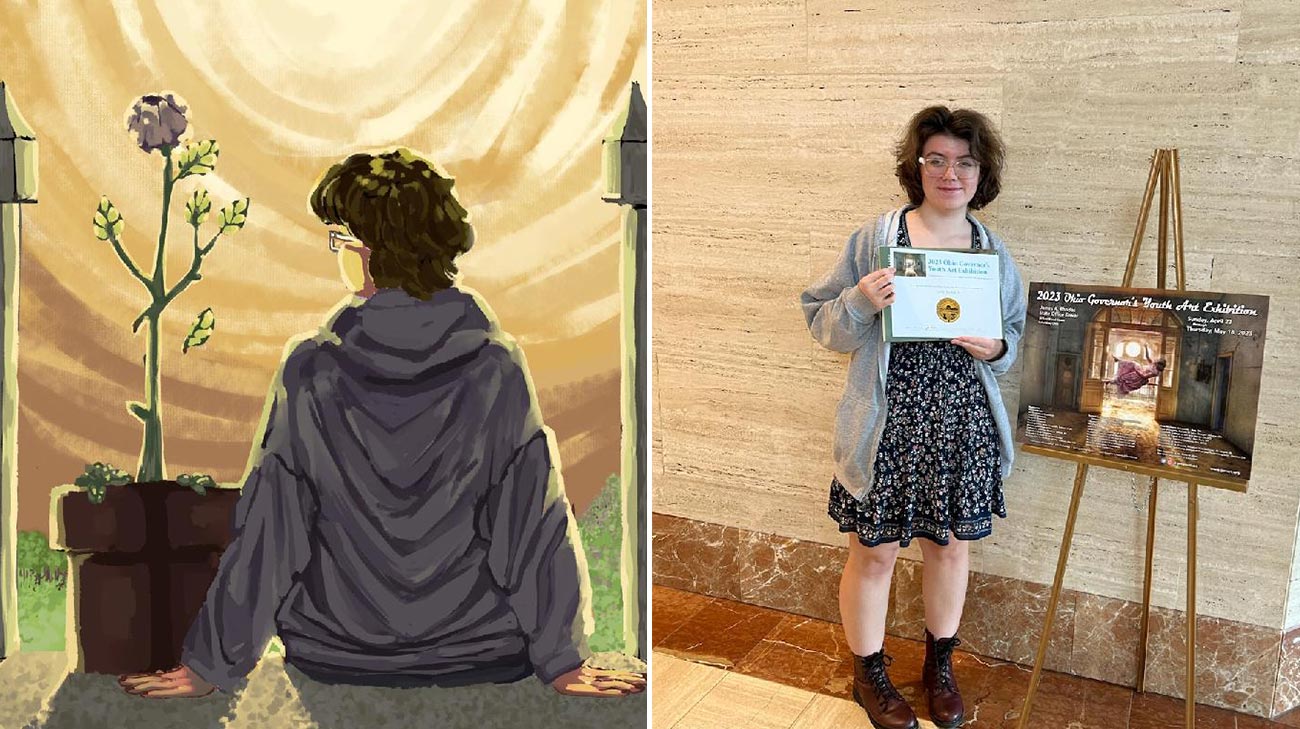
18-year old Sara Render has a gift for drawing and has even won awards for her art. But drawing isn’t just a passion for Sara, it’s also an outlet to express her feelings and cope with her chronic migraines.
Beginning in February 2020, Sara started to develop nearly debilitating headaches and sought treatment. Over the course of a year, she was prescribed antibiotics, steroids, anti-inflammatories, physical therapy, and chiropractic treatment.
“The pain was so intense and severe. I had to finish my sophomore year of high school online because I couldn’t even think straight or sit through my classes,” recalls Sara.
As daily chronic headaches and intense, sharp pains continued, Sara was eventually diagnosed with migraines and ice pick headaches — a type of headache disorder that causes unexpected, sharp, stabbing pain with no underlying cause.
Medication provided limited relief and caused additional issues. Sara was bouncing between going to school in person and online. She wasn’t enjoying life or doing things high schoolers do like hanging out with friends. “I just wanted to be in my bedroom away from the world and in the dark,” says Sara.
Two years of migraines made much of her world dark. “Sara’s drawings changed with the onset of her migraines. Her artwork became very dark during this time,” remembers Sara’s mother, Denise Render.
A physician recommended that Sara seek treatment at Cleveland Clinic Children’s Hospital for Rehabilitation (CCCHR). Denise called for an appointment which entailed a day-long evaluation with caregivers from Cleveland Clinic Children's Pediatric Pain Rehabilitation Program.
The Program offers care for children and families coping with chronic pain and related functional disability, even after standard therapies, surgeries and medications have proven unsuccessful.
“Caregivers from psychology, traditional medicine and therapy work together to help pediatric patients with chronic daily headaches get back on track,” explains Ethan Benore, PhD, Clinical Director, Pediatric Pain Rehabilitation Program, CCCHR.
In November 2022, Sara began the three-week outpatient program five days a week from 8 a.m. to 4 p.m.
“When Sara began the program she was in pain, was withdrawn and struggled to engage with others,” remembers Jennifer Ramasami, PHD, pediatric psychologist, CCCHR. “I worked with her to develop strategies to help her get back to her previous life.”
Sara’s treatment plan each day involved physical and occupational therapy (including aquatic therapy, yoga, meditation, exercises and educational programs), psychology (individual, group or family), recreational therapy and time for school work.
“The first day I wanted to leave the program, but after talking to Dr. Ramasami I saw everyone at the Pain Rehabilitation Clinic wanted to help me succeed,” says Sara. “Dr. Ramasami was a big part of my success. She made me feel more in control of my migraines and taught me different ways to manage the pain.”
By the end of the three week program, Sara’s migraines and pain weren’t totally gone but were much easier to deal with.
“I can pick up migraines earlier now and know what to do to stop or lessen them. The Pediatric Pain Rehabilitation Program taught me to have more control rather than be a victim,” says Sara.
The positive change with Sara’s health also brought a positive change in her life and art. She’s back to hanging out with her friends, her drawings are much lighter in nature and she was accepted to the Cleveland Institute of Art.
“The tone of her art during her migraine period expresses the challenges many of our chronic pain patients experience,” says Dr. Ramasami. “I was so impressed with Sara and couldn’t have asked for a better outcome for her.”
Related Institutes: Cleveland Clinic Children'sPatient Stories

Teen Relearns To Walk and Talk After Rare 1-In-A-Million Brain Disorder
Oct 27, 2026
Cleveland Clinic Team Helps Florida Patient Breathe Easier After Complex Lung Surgery
Oct 21, 2026