



Tunneled catheters get their name from how they tunnel under your skin for a short distance. Tunneling secures the line in place and lowers your odds of an infection. A tunneled catheter can help you avoid repeated needle insertions that would need to happen with standard IV lines. And tunneled catheters can stay in place for months or even years.
Advertisement
Cleveland Clinic is a non-profit academic medical center. Advertising on our site helps support our mission. We do not endorse non-Cleveland Clinic products or services. Policy
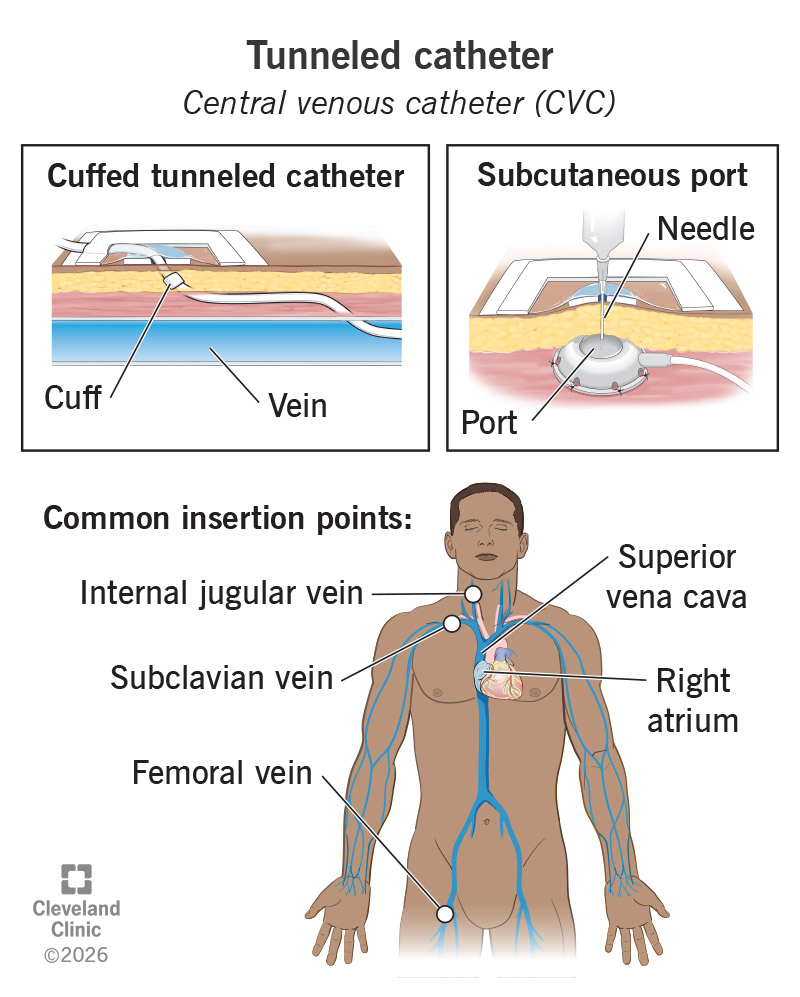
Image content: This image is available to view online.
View image online (https://my.clevelandclinic.org/-/scassets/Images/org/health/articles/tunneled-catheter.jpg)
A tunneled catheter is a type of central venous catheter (CVC). Its name comes from how it “tunnels” under your skin before entering a central vein. Central venous catheters are also known as central lines, and they’re important for certain types of treatments, including lifesaving ones.
Advertisement
Cleveland Clinic is a non-profit academic medical center. Advertising on our site helps support our mission. We do not endorse non-Cleveland Clinic products or services. Policy
Central venous catheters are tubes that go into a vein and lead down to your heart. The end of the catheter tube may sit in the superior vena cava, just outside your heart, or in your heart’s right atrium. That’s the first chamber that blood enters when it goes into your heart.
Healthcare providers use tunneled catheters for:
While tunneled catheters can be long-term or even permanent for some people, they can also be a short-term option until a long-term treatment is possible. Examples include people who need surgery to create an arteriovenous fistula (when a surgeon makes one, it’s known as a dialysis fistula) or arteriovenous graft. Both of those are common for people who need long-term dialysis.
There are two types of tunneled catheters:
Cuffed tunneled catheters have a small ring of fiber material around their tube. Once the catheter is inside your body, your body will heal around the ring. Some of the scar tissue that forms will grow into the ring, locking the tube into place. One end of the catheter stays outside your skin. That end has attachments that providers can use to take blood, give medicines and more. This type is semi-permanent, meaning it should stay in place until you have a procedure to remove it.
Advertisement
Subcutaneous ports connect to a tunneled catheter, but the port doesn’t stick out through an opening in your skin. Instead, the port sits just under your skin. All a provider needs to access the port is a special needle made for the port itself.
Placing a tunneled catheter is usually something a surgeon does in an operating room. Doing this in a sterile environment is best to lower the odds that you get an infection. Before they start, they’ll sterilize your skin and inject a local anesthetic to numb the area. That way, you won’t feel pain during the procedure.
To place the catheter, they’ll make a small incision in your skin near a major vein, usually one in your chest or groin. Then, they’ll insert the catheter tube into the incision and run it underneath your skin for a short distance. Once there, they’ll insert the tube into the vein, similar to using a needle to enter a vein on your arm or hand.
Once the catheter is inside the vein, the surgeon will thread the catheter tube through your veins and down into the right atrium of your heart. That’s the first chamber that blood goes through once it’s inside your heart.
But placing a tunneled catheter isn’t always done the same way. The procedure can vary based on:
There are three major veins that healthcare experts will use for tunneled catheters. They are your:
The type of catheter matters when it comes to selecting which site to use. Cuffed tunneled catheters work with all three major vein sites. Subcutaneous ports are only an option for tunneled catheters using the IJ and SC veins. Your provider can tell you more about your options and offer recommendations.
Tunneled catheters have clear benefits under the right circumstances. The benefits include:
Advertisement
But tunneled catheters also have risks, and some of them are severe. They include:
Your provider can tell you more about which risks are most likely in your case and guide you on avoiding them.
Your healthcare provider needs to know about any changes at or around your catheter site. That includes where cuffed tunneled catheters enter your skin and where catheters with ports sit under your skin.
Some things to watch for include:
Your provider needs to know about these issues right away. Ask your provider what to do if any of these happen to you. Being prepared can help you avoid complications, including some that are dangerous or life-threatening.
Advertisement
If you have a tunneled catheter, caring for it will help you get the most out of it.
Here's what to do:
Here's what NOT to do:
Ask your provider questions if there’s some part of catheter care that you don’t understand. Your provider will answer all your questions to help you stay safe and healthy.
Tunneled catheters are a literal lifeline. A single procedure to place a tunneled catheter can spare you from repeated needle insertions. Better still, these catheters are multipurpose. Your healthcare provider can use them to draw blood or deliver medicines, fluids or IV nutrients. Your provider can guide you on caring for your tunneled catheter, so you can get the most benefit out of it and avoid complications.
Advertisement



Sign up for our Health Essentials emails for expert guidance on nutrition, fitness, sleep, skin care and more.
Learn more about the Health Library and our editorial process.
Cleveland Clinic’s health articles are based on evidence-backed information and review by medical professionals to ensure accuracy, reliability and up-to-date clinical standards.
Cleveland Clinic’s health articles are based on evidence-backed information and review by medical professionals to ensure accuracy, reliability and up-to-date clinical standards.
Cleveland Clinic’s primary care providers offer lifelong medical care. From sinus infections and high blood pressure to preventive screening, we’re here for you.
