



Orthokeratology can correct refractive errors that make your vision blurry. You’ll wear a special set of contact lenses at night. They’ll gently flatten the front of your eyes while you sleep so you have clear vision without glasses or contacts during the day. You’ll need to wear them every night to make sure your eyes don’t reshape themselves.
Advertisement
Cleveland Clinic is a non-profit academic medical center. Advertising on our site helps support our mission. We do not endorse non-Cleveland Clinic products or services. Policy
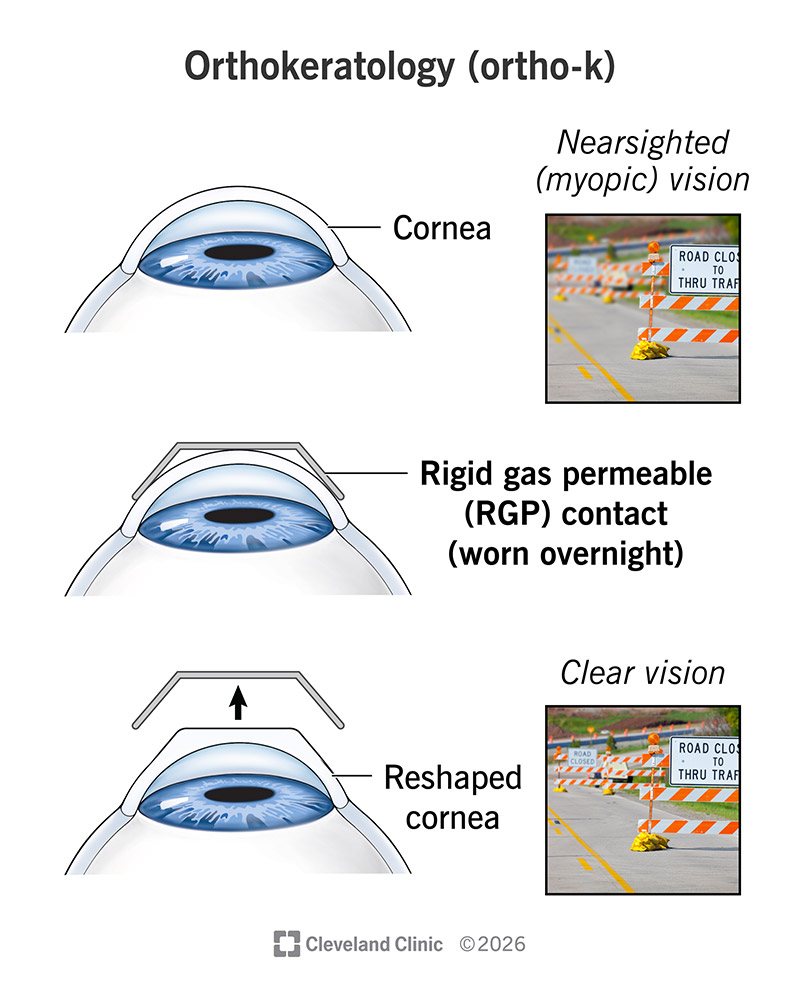
Image content: This image is available to view online.
View image online (https://my.clevelandclinic.org/-/scassets/images/org/health/articles/orthokeratology-ortho-k)
Orthokeratology (ortho-k) is wearing a special set of contact lenses to reshape the corneas in your eyes. Changing the shape of your corneas improves your vision and corrects common refractive errors.
Advertisement
Cleveland Clinic is a non-profit academic medical center. Advertising on our site helps support our mission. We do not endorse non-Cleveland Clinic products or services. Policy
Eye doctors usually suggest ortho-k to manage nearsightedness (myopia). You’ll wear the contacts at night while you sleep. The contacts will flatten the front of your eyes and corneas overnight. Then, in the morning, you can take the contacts out and have clear vision during the day. This can be an alternative to wearing glasses or contacts all the time.
Eye doctors might also prescribe ortho-k for a child if their vision is getting worse quickly. Kids’ eyes change quickly as they grow and develop. But sometimes their corneas change too fast. Orthokeratology can help slow down these changes.
Ortho-k works by gently flattening the front of your eye to reshape your cornea.
The contacts you’ll wear are a little different than the ones you’re probably familiar with. They’re a type of rigid gas permeable (RGP) contacts. These are hard lenses that hold their shape and don’t flex or bend as much as soft lenses. This rigid shape is what helps them change your corneas.
It’s a bit like wearing a retainer for your eyes. If you had braces in the past, you might need to wear a retainer sometimes to help your teeth keep their correct alignment. The ortho-k contacts work like that. They reshape the front of your eyes each night so you have clear vision during the day.
Advertisement
Ortho-k can be a good option to correct your vision if you don’t want to wear glasses or contacts. The main benefit is that it reshapes your corneas safely and effectively. It’s a simple solution that’s easy to try.
There aren’t any serious risks to trying ortho-k. Eye infections are usually the biggest issue you could face. But washing your hands before touching your eyes and contacts can help prevent them. Your eye doctor will tell you how to keep your contacts clean and sterile.
The rigid lenses can feel annoying or uncomfortable, especially when you’re first getting used to them. They might bother you enough to make it hard to fall asleep or stay asleep. But most people adjust in a few days.
Orthokeratology doesn’t work instantly. You’ll probably have to wear the contacts each night for a few weeks before you notice any improvement in your vision. Your eye doctor will tell you what to expect.
It’s important to wear your contacts as often as your eye doctor says. If you skip any nights, your eyes can rebound to their natural shape and make your vision blurry again. This can happen quickly, even after a few missed nights in a row.
Your eye doctor will schedule follow-up eye exams to check your eyes and test your vision. Let them know if you notice your vision changing or getting worse.
See an eye doctor right away if you think you have an eye infection. They’ll tell you if you should stop wearing your ortho-k contacts while you have an infection.
If an eye doctor prescribes ortho-k for your child, they’ll explain how long it’ll be necessary. Your child’s vision might stabilize once you slow the changes in their corneas. But they still might need some kind of vision correction to help them see clearly.
Orthokeratology is less common than wearing glasses or typical contacts. But if you want the flexibility of seeing clearly without corrective lenses, it can be a great option. Talk to an eye doctor about the best ways to improve your vision.
Getting used to wearing ortho-k contacts might be annoying at first. But stick with it. You should adjust in a few days. Talk to your eye doctor if you feel any pain during or after wearing your contacts.
Advertisement



Sign up for our Health Essentials emails for expert guidance on nutrition, fitness, sleep, skin care and more.
Learn more about the Health Library and our editorial process.
Cleveland Clinic’s health articles are based on evidence-backed information and review by medical professionals to ensure accuracy, reliability and up-to-date clinical standards.
Cleveland Clinic’s health articles are based on evidence-backed information and review by medical professionals to ensure accuracy, reliability and up-to-date clinical standards.
Getting an annual eye exam at Cleveland Clinic can help you catch vision problems early and keep your eyes healthy for years to come.
