



Facial paralysis is the inability to move the muscles on one or both sides of your face due to nerve damage. Possible causes include inflammation, trauma, stroke and tumors. Treatment depends on the underlying condition that led to paralysis. Facial paralysis may be temporary or permanent.
Advertisement
Cleveland Clinic is a non-profit academic medical center. Advertising on our site helps support our mission. We do not endorse non-Cleveland Clinic products or services. Policy
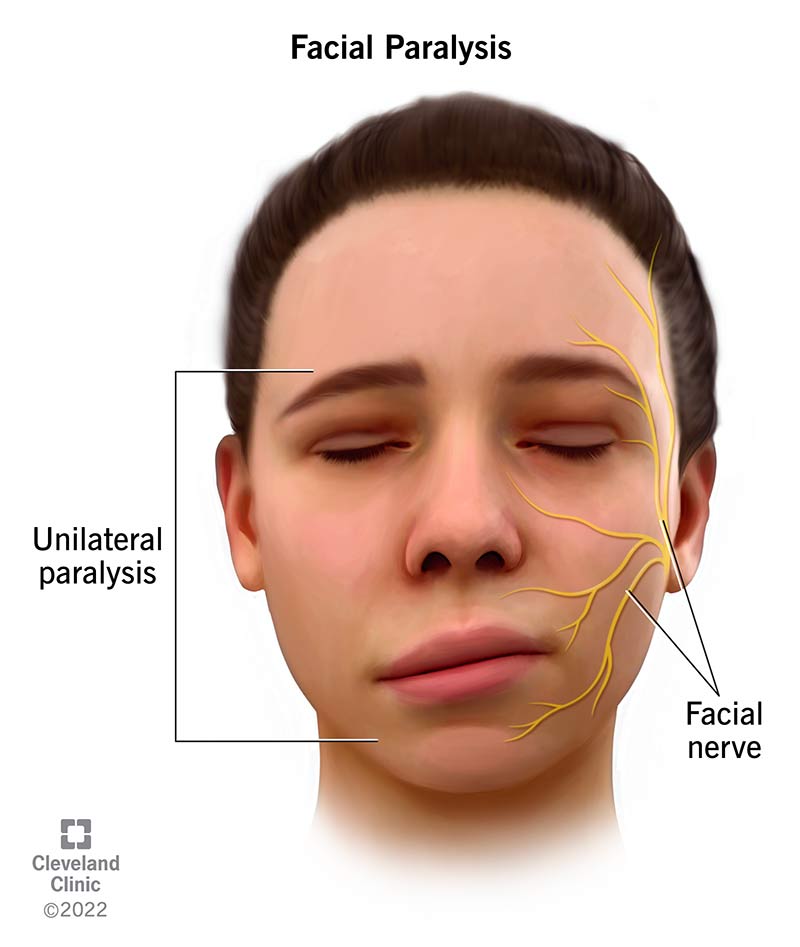
Image content: This image is available to view online.
View image online (https://my.clevelandclinic.org/-/scassets/Images/org/health/articles/facial-paralysis)
Facial paralysis happens when your facial nerve (cranial nerve 7) becomes damaged. This results in weakness, droopiness and a loss of facial movement on one side (unilateral) or both sides (bilateral) of your face.
Advertisement
Cleveland Clinic is a non-profit academic medical center. Advertising on our site helps support our mission. We do not endorse non-Cleveland Clinic products or services. Policy
Facial nerve damage can occur for several reasons, including infection, trauma or stroke. It can also happen without a known cause. This is referred to as Bell’s palsy, or facial nerve palsy. Facial paralysis may be complete or partial and can be temporary or permanent.
For most causes, facial paralysis improves within a few months. But it can be permanent. Your provider may recommend medications or surgery for facial paralysis, depending on how severe it is and what’s causing it.
Facial paralysis can make it hard to perform facial movements, like:
It can make your face appear asymmetrical and impact how you speak and eat.
These difficulties can take a toll on your physical health. And problems moving your face can make it hard to communicate your emotions without words. This is why it’s important to see a healthcare provider for help.
Some people are born with facial nerve paralysis. If you’re not born with it, you can still develop it for one of two reasons:
Advertisement
Facial paralysis causes may include:
Treatment depends on what’s causing it. For example:
There are several nonsurgical and surgical facial paralysis treatments available. The type you need depends on both the cause and how long you’ve had facial paralysis.
Nonsurgical treatments may include:
Advertisement
Surgical treatments may include:
Everyone’s situation is unique. Your provider will talk to you about the treatments that are right for you.
Facial paralysis that affects your eyes can lead to chronic dry eye and other issues. In these cases, your healthcare provider will recommend treatment to prevent your eyes from drying out too much. You may need:
You can’t always prevent facial paralysis, especially in cases of trauma. With Bell’s palsy, symptoms often occur with no warning.
Advertisement
But you can take steps to reduce your risk of facial paralysis from a stroke. This includes managing conditions like diabetes and heart disease and maintaining a weight that’s healthy for you.
Ask your healthcare provider about ways to prevent stroke based on your health.
If you develop facial paralysis, call a healthcare provider immediately. They can find out what caused your symptoms and treat any underlying conditions.
If you or someone you know develops stroke symptoms — like trouble walking, coordination issues, blurred vision or slurred speech — call 911 or your local emergency number, or go to the nearest emergency room.
The most common causes are Bell’s palsy and stroke. Healthcare providers act fast to distinguish between the two causes since a stroke requires emergency care. A key difference is that a stroke usually involves more symptoms, like loss of balance and weakness that affects the entire side of your body.
Experts haven’t been able to prove it yet, but many healthcare providers think that there’s a link between stress and the onset of Bell’s palsy. Experts believe that stress can weaken your immune system, resulting in infections that can damage your facial nerve.
Facial paralysis itself isn’t dangerous, but it can cause major symptoms while present. It can also be a sign of a serious underlying condition, like a stroke. You should never ignore facial paralysis. If you or a loved one develops it, call a healthcare provider right away.
Advertisement
How long facial paralysis lasts varies depending on the cause. In some cases, facial paralysis is permanent. But many people see improvement or fully recover with time and/or treatment. For instance, Bell’s palsy usually goes away on its own in a few months.
If you develop facial paralysis — whether gradually or suddenly — you should see a healthcare provider right away. Even though facial nerve paralysis isn’t dangerous itself, you might have a serious health condition that’s causing it. Prompt medical treatment is the best way to foster a full recovery.
If facial paralysis is permanent, your provider will work with you to reduce your risk of further damage and help you manage the condition.
Advertisement



Sign up for our Health Essentials emails for expert guidance on nutrition, fitness, sleep, skin care and more.
Learn more about the Health Library and our editorial process.
Cleveland Clinic’s health articles are based on evidence-backed information and review by medical professionals to ensure accuracy, reliability and up-to-date clinical standards.
Cleveland Clinic’s health articles are based on evidence-backed information and review by medical professionals to ensure accuracy, reliability and up-to-date clinical standards.
Facial paralysis can be treated. At Cleveland Clinic, our providers use innovative treatments to restore function and help you smile again.
