



Renal denervation is a procedure that may help lower blood pressure when medicines and lifestyle habits aren’t enough. Using a catheter, a healthcare provider damages nerves that signal your blood pressure to rise. Most people go home the same day. Results can take weeks or months.
Advertisement
Cleveland Clinic is a non-profit academic medical center. Advertising on our site helps support our mission. We do not endorse non-Cleveland Clinic products or services. Policy
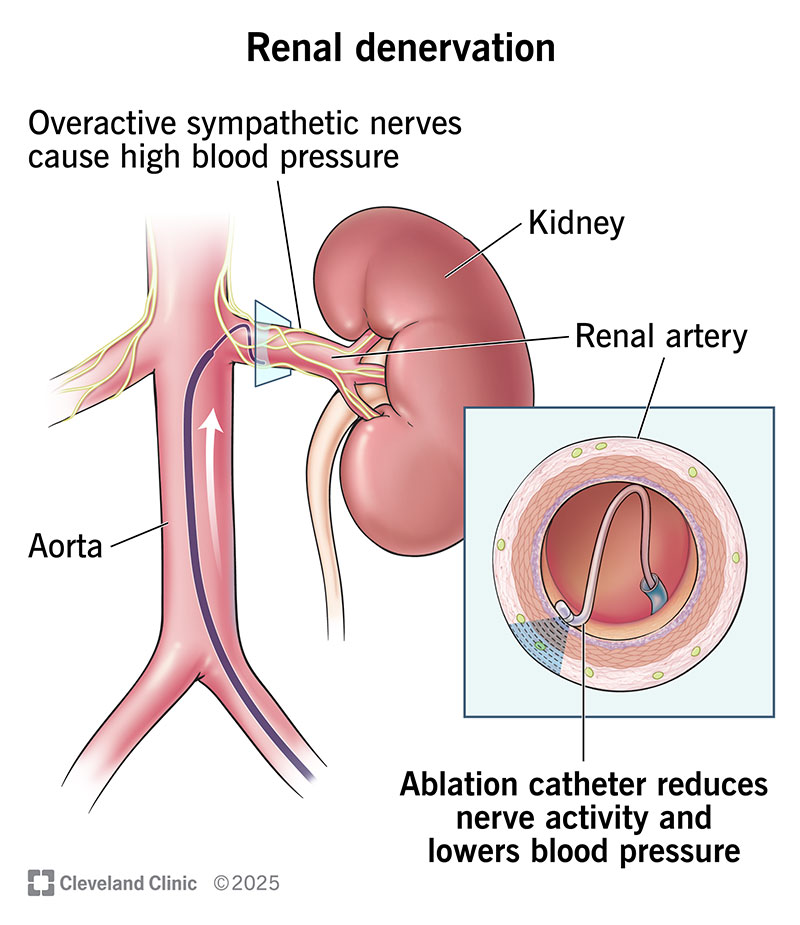
Image content: This image is available to view online.
View image online (https://my.clevelandclinic.org/-/scassets/images/org/health/articles/renal-denervation-illustration-revised)
Renal denervation is a minimally invasive procedure for some people with high blood pressure. Using ultrasound or radiofrequency energy, the procedure damages certain nerves near your kidneys. This keeps the nerves from sending signals to raise your blood pressure. A healthcare provider uses a catheter (small tube) to send energy through renal artery walls and reach the nerves.
Advertisement
Cleveland Clinic is a non-profit academic medical center. Advertising on our site helps support our mission. We do not endorse non-Cleveland Clinic products or services. Policy
This procedure can help people who have high blood pressure that isn’t getting better with several medicines and lifestyle changes. People may have resistant hypertension or just aren’t able to take certain drugs because of side effects.
You need to have healthy kidneys (and arteries that connect to them) to get this procedure. Your renal arteries need to be wide enough and in good shape for this treatment.
The U.S. Food and Drug Administration approved this procedure in 2023.
Before the procedure, your healthcare provider may want to do blood tests to make sure your kidneys work well. They may also do imaging tests. Ask your healthcare team if you should stop eating and drinking at a certain time before the procedure. They can also tell you if (and when) you need to stop taking any medicines before renal denervation.
Also, you should arrange for someone to come with you and drive you home. On the day of the renal denervation procedure, it can be helpful to wear clothes and shoes that are easy to get back into before you go home.
A renal denervation procedure takes about one to two hours. Healthcare providers usually perform the procedure on nerves for both kidneys.
A healthcare provider will:
Advertisement
Renal denervation treatment may work as well as taking one blood pressure medicine. It can lower your blood pressure by 5 to 10 millimeters of mercury (mmHg). This can help lessen your risk of heart or kidney issues.
After the procedure, your provider may change your blood pressure medicine doses. But you’ll still need to take blood pressure medicine and have healthy habits after renal denervation.
You may need to wait weeks or months to see results. For some people, this one-time procedure doesn’t work at all.
Renal denervation side effects (some are rare) may include:
Your healthcare team will monitor you to make sure your artery has stopped bleeding after the procedure. You may also need medicine for pain.
You can go home after renal denervation treatment. Most people don’t need to stay overnight at the hospital. You should receive instructions from your care team about caring for yourself at home. You should avoid exerting yourself for a few days after you get home.
You’ll need follow-up visits with your provider to check your blood pressure over the coming weeks and months. If your blood pressure comes down, your provider may decrease the amount of medicine you take. Only decrease your dose if your provider tells you to.
Contact your provider if you have bleeding or signs of infection (like a fever) after you go home. Leg swelling, chest pain and shortness of breath could be signs of a blood clot. If you have these, get medical care right away.
You’ve tried many types of medicines to manage your blood pressure. You’re taking walks several times a week. But it doesn’t seem to be enough. A procedure that can help with high blood pressure could be just the thing. But it’s not right for everyone. That’s why talking with your healthcare provider can help you make an informed decision about it. Choosing a healthcare team with expertise in this procedure may give you peace of mind.
Advertisement



Sign up for our Health Essentials emails for expert guidance on nutrition, fitness, sleep, skin care and more.
Learn more about the Health Library and our editorial process.
Cleveland Clinic’s health articles are based on evidence-backed information and review by medical professionals to ensure accuracy, reliability and up-to-date clinical standards.
Cleveland Clinic’s health articles are based on evidence-backed information and review by medical professionals to ensure accuracy, reliability and up-to-date clinical standards.
When your heart needs some help, the cardiology experts at Cleveland Clinic are here for you. We diagnose and treat the full spectrum of cardiovascular diseases.
