



If the hip abductor muscles on one side of your body are too weak, you might develop Trendelenburg gait. The weakened muscles can’t hold your pelvis in alignment when you lift one leg to walk. It can make it harder to walk or stand on one leg. Physical therapy to strengthen those muscles is the most common treatment.
Advertisement
Cleveland Clinic is a non-profit academic medical center. Advertising on our site helps support our mission. We do not endorse non-Cleveland Clinic products or services. Policy
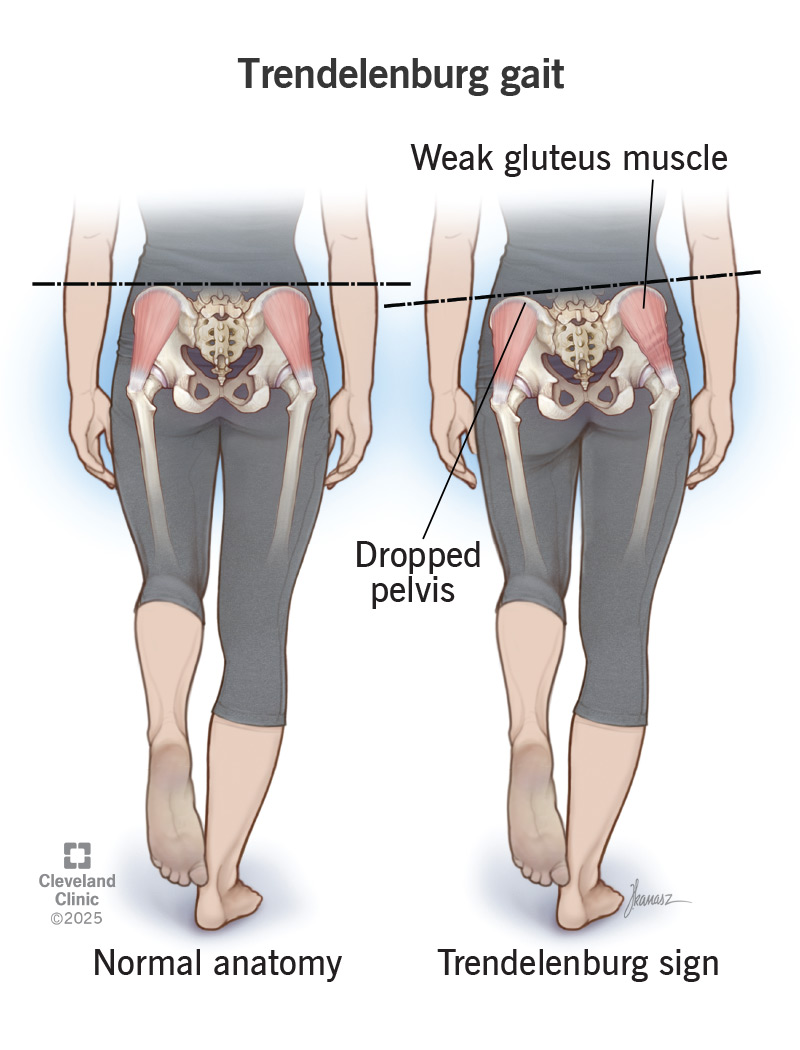
Image content: This image is available to view online.
View image online (https://my.clevelandclinic.org/-/scassets/images/org/health/articles/trendelenburg-gait)
The Trendelenburg gait is what happens when your pelvis dips to one side when you walk or stand on one leg. It’s a type of gait abnormality. These are conditions that affect the way you walk or move.
Advertisement
Cleveland Clinic is a non-profit academic medical center. Advertising on our site helps support our mission. We do not endorse non-Cleveland Clinic products or services. Policy
It affects one side of your body. Weak hip muscles on that side are the most common cause. But any condition affecting your hips or their muscles can lead to walking with a Trendelenburg gait.
The shift in your pelvis is the most noticeable symptom. Healthcare providers call it Trendelenburg sign. This is because the tilt is the biggest clue you have Trendelenburg gait.
When you walk, your pelvis will tip toward the side of the leg that’s not on the ground. For example, when you lift your left leg off the ground to walk, your pelvis will dip to the left. This can affect your balance. You might:
Your pelvis will also fall to one side when you stand on one foot. This might make you lean your torso and upper body to the opposite side.
These changes in how you walk or stand will happen automatically as your body adjusts to help you keep your balance as best it can. You probably won’t even notice you’re doing them.
Untreated Trendelenburg gait can lead to pain in your hips, knees and ankles. Walking unevenly puts extra stress on the joints you use to move. Over time, that can lead to more wear and tear than normal.
Advertisement
Having weak hip abductor muscles is the most common cause of Trendelenburg gait. This includes your gluteus medius and gluteus minimus muscles. They help you open your hips and move your legs away from the center of your body. They also help keep your pelvis stable when you move.
You’ll have symptoms on the side opposite your weak abductor muscles. That’s because the muscles on the affected side aren’t strong enough to hold your pelvis level on their own. So, if the abductors near your right hip are too weak, your pelvis will dip to the left when you walk or lift your left leg off the ground.
Anything that makes your hips weaker than usual can cause Trendelenburg gait. Other causes are much less common, but can include:
A healthcare provider can usually diagnose Trendelenburg gait with a simple physical exam. Your provider will ask about any pain or other symptoms you’ve noticed. They’ll ask you to stand normally and/or on one leg. They’ll also probably ask you to walk to check for any shifting in your pelvis.
They might check the strength of your gluteus medius muscles, too. You’ll lie on your side and lift your leg while your provider gently presses down it.
Tell your provider if you have any health conditions that affect your joints. Let them know if you recently had surgery or experienced a hip injury.
You probably won’t need any tests. But your provider may order a hip X-ray, ultrasound or an MRI to take pictures of your hips. These can help them diagnose what’s causing it.
Strengthening your abductor muscles is the best way to treat Trendelenburg gait. Your healthcare provider might refer you to physical therapy. They’ll develop a customized set of exercises to strengthen your hip muscles.
Your physical therapist will show you how to do the movements safely and correctly. You might do some exercises with just your bodyweight. It’s also common to wear stretchy resistance bands while you do your exercises. These will give you more of a challenge as you start to build your strength. You may use specific gym equipment when you visit your physical therapist. Some exercises you can do at home.
If something else causes the Trendelenburg gait, you may need different treatments. Your provider will tell you how to manage any other conditions that affect your hips, muscles or nerves.
Advertisement
Visit your healthcare provider if you feel like anything is making it harder to walk or move. Or if you notice your balance isn’t what it used to be. They’ll help you figure out what’s causing it and how you can rebuild your strength.
Your provider will tell you if you’ll need follow-up exams or tests in the future. They’ll check your gait for changes over time.
It can take a few months to strengthen your hips. But Trendelenburg gait should get better over time. You’ll notice improvements in your gait slowly as you start physical therapy and get more comfortable with your exercise routine.
Tell your healthcare provider or physical therapist if you notice any new or worsening pain. You might have some soreness after doing your exercises. But you shouldn’t have constant pain in your hips or other joints.
Staying active and keeping your hips strong is the best way to prevent Trendelenburg gait. That doesn’t mean you have to become an Olympic weightlifter. There are lots of ways to exercise your hips. Cycling, swimming, yoga and tai chi can all help.
Talk to your healthcare provider or physical therapist about specific kinds of physical activities that are good options for you.
Anything that affects how you walk and move can throw you out of alignment. In this case, literally. Trendelenburg gait can develop over time and make it hard to move like you’re used to. But it’s usually treatable with some simple exercises to strengthen your hips.
Advertisement
Don’t be afraid to ask lots of questions, especially if you’re just starting new exercises. People sometimes worry they should just know how to work out. But just like any other skill, it takes practice and learning. Your healthcare provider and physical therapist will help you find the right ways to stay active and keep your joints working like they should.
Advertisement



Sign up for our Health Essentials emails for expert guidance on nutrition, fitness, sleep, skin care and more.
Learn more about the Health Library and our editorial process.
Cleveland Clinic’s health articles are based on evidence-backed information and review by medical professionals to ensure accuracy, reliability and up-to-date clinical standards.
Cleveland Clinic’s health articles are based on evidence-backed information and review by medical professionals to ensure accuracy, reliability and up-to-date clinical standards.
Parkinson’s disease, essential tremor and dystonia are common movement disorders. And Cleveland Clinic has the expert care and support you need to manage them.
