



A synovial cyst usually forms between joints in your spine. Most of the time, they happen naturally as you age. Inflammatory arthritis and spine injuries can also cause them. Most cysts don’t cause symptoms. If you do need treatment, there are lots of options.
Advertisement
Cleveland Clinic is a non-profit academic medical center. Advertising on our site helps support our mission. We do not endorse non-Cleveland Clinic products or services. Policy
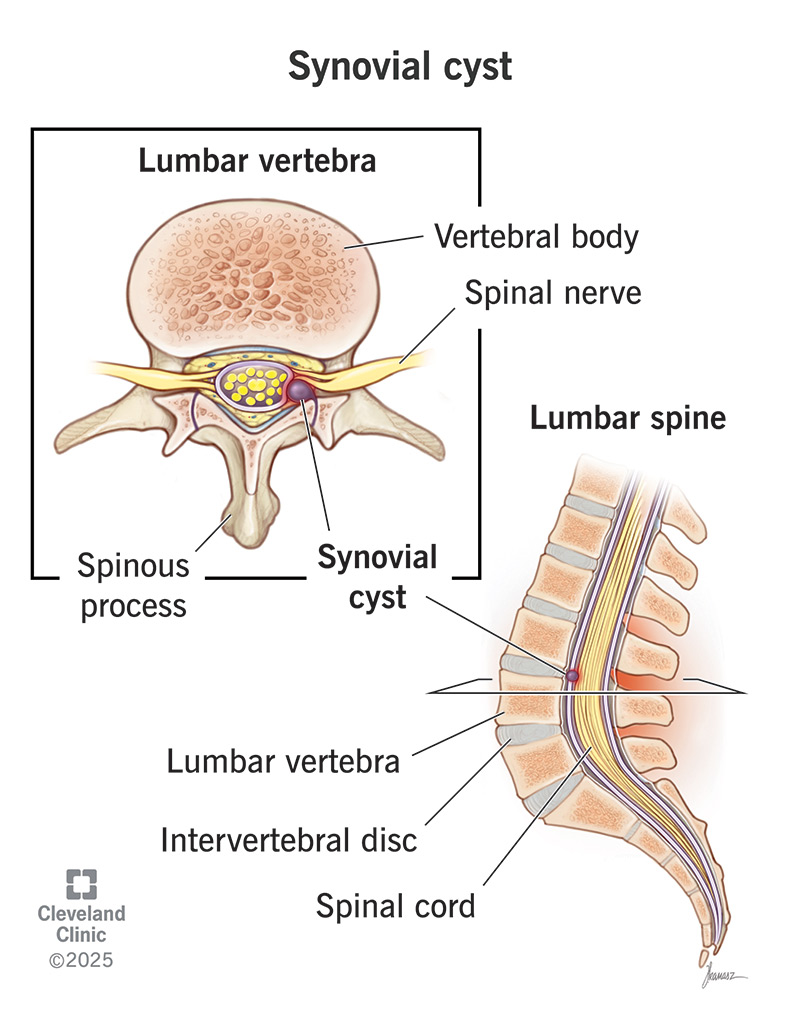
Image content: This image is available to view online.
View image online (https://my.clevelandclinic.org/-/scassets/images/org/health/articles/synovial-cyst)
A synovial cyst is a fluid-filled sac that forms between joints in your spine. They’re most common in your lumbar spine in your lower back.
Advertisement
Cleveland Clinic is a non-profit academic medical center. Advertising on our site helps support our mission. We do not endorse non-Cleveland Clinic products or services. Policy
Synovial cysts form when fluid builds up inside the synovial membrane in a joint. The membrane swells up and balloons out of its usual place. The cyst can stick out from between the bones in your joint. Cysts are almost never cancerous.
You might have a spinal synovial cyst and never know it. Many don’t cause symptoms. If you do experience symptoms, you might feel:
Pain from a synovial cyst is often referred. That means you’ll feel pain or other symptoms in another part of your body. That’s why you might have symptoms in your butt or legs. A cyst in your spine can press on nerves and cause symptoms lower in your body, where those nerves travel.
You might notice the symptoms change depending on what you’re doing. It may feel better to stand up or move. Or symptoms may get better when you sit or lie down.
Small facet joints hold all the bones in your spine together. Facet joints rest on each other to keep two spine bones connected. A synovial membrane cushions the space between them.
Spinal synovial cysts form when facet joints wear down. Your body might make extra synovial fluid in response. The excess fluid fills up the membrane like a tiny water balloon.
Advertisement
Causes of synovial cysts can include:
Synovial cysts almost always develop in people over 50. That’s because they usually happen after natural aging wears down your facet joints.
Synovial cysts can cause spinal stenosis. This can make symptoms like pain and numbness worse. It can also make it hard to walk and move.
Severe cases can press on nerves that help you control your bladder and bowel. This can make you lose control of your pee or poop. But this is very rare.
A healthcare provider will diagnose a synovial cyst with a physical exam and imaging tests. They’ll examine your back and ask about the symptoms you’re feeling. Tell your provider when the symptoms started. Let them know if any positions or movements make symptoms better or worse.
Your provider will use imaging tests to take pictures of your spine. You might need:
You may not need treatment for a synovial cyst. Especially if it’s not causing symptoms. Your healthcare provider might suggest keeping an eye on it with follow-up appointments and imaging tests. If you need them, treatments can include:
Advertisement
Visit a healthcare provider if you have back pain that lasts for more than a week. See a provider right away if you lose feeling in any part of your body, or feel weakness in your arms or legs that gets worse quickly. Especially if you lose your ability to control functions like peeing or moving.
A synovial cyst is usually treatable. But you should expect to try a few different treatments. Your provider will help you find the right ones. And they’ll tell you when it’s time to think about removing the cyst.
There’s always a chance a cyst will grow back. Even if you have it removed. Tell your provider if you notice symptoms coming back or getting worse.
Synovial cysts and ganglion cysts are the same kind of cyst. But they usually grow in different places. Ganglion cysts usually form on your hands, wrists or feet. Synovial cysts almost always happen between facet joints in your neck or lower back.
Technically, a ganglion cyst is a type of synovial cyst. It’s a growth full of synovial fluid. But healthcare providers use the catch-all term synovial cyst to refer to the kind that grows in your spine.
Visit a healthcare provider if you have a new or changing growth anywhere on your body. No matter what they end up calling it.
Advertisement
It can be scary to find out there’s a growth in your spine. But synovial cysts shouldn’t worry you too much. A synovial cyst shouldn’t have any long-term effects on your health. There’s a good chance you’ll never know you have one. And if you do have symptoms, they respond well to treatments. Remember, these cysts are never a sign of cancer. And having one doesn’t mean you have a higher cancer risk.
Advertisement



Sign up for our Health Essentials emails for expert guidance on nutrition, fitness, sleep, skin care and more.
Learn more about the Health Library and our editorial process.
Cleveland Clinic’s health articles are based on evidence-backed information and review by medical professionals to ensure accuracy, reliability and up-to-date clinical standards.
Cleveland Clinic’s health articles are based on evidence-backed information and review by medical professionals to ensure accuracy, reliability and up-to-date clinical standards.
Back pain can stop you in your tracks. But you don’t have to live like that. Cleveland Clinic is here to help you get moving again.
