



Scalded skin syndrome happens when bacterial toxins attack your skin. The damaged skin layer separates and sheds away, exposing raw, reddened skin beneath. It’s a severe condition that needs immediate care. It’s more common in children, and their outlook is usually excellent. While rare in adults, it’s also usually more dangerous for them.
Advertisement
Cleveland Clinic is a non-profit academic medical center. Advertising on our site helps support our mission. We do not endorse non-Cleveland Clinic products or services. Policy
Scalded skin syndrome is a skin disease that happens when bacteria damage areas of your child’s skin. Skin from those areas sheds and falls off, leaving shiny areas that look like burns. It’s most common in children, especially those under 6 years old.
Advertisement
Cleveland Clinic is a non-profit academic medical center. Advertising on our site helps support our mission. We do not endorse non-Cleveland Clinic products or services. Policy
The full name of the condition is staphylococcal scalded skin syndrome, or just staph scalded skin syndrome. That’s because Staphylococcus-type bacteria cause it. In children, it’s also known as Ritter disease, and sometimes SSSS for short.
IMPORTANT: Scalded skin syndrome can lead to dangerous or even life-threatening complications without treatment. And it has similar symptoms to several dangerous conditions. Having the skin symptoms means you need to go to a hospital or emergency room right away.
Scalded skin syndrome can cause several skin symptoms. But before the skin symptoms start, most people develop vague symptoms. Those often look like an upper respiratory infection and can include:
About 24 hours after those early symptoms, the skin symptoms start. They include:
Advertisement
The skin symptoms can affect the whole body in newborns. In infants and preschool- or school-age children, the symptoms usually only affect their upper bodies.
The most common places for the rash to show are your child’s:
It doesn’t affect the palms of your hands, soles of your feet, or mucous membranes like those inside your mouth or nose.
Scalded skin syndrome happens because of Staphylococcus bacteria like Staphylococcus aureus. This can happen in two ways:
But staph bacteria don’t cause it directly. Instead, it’s from toxins the bacteria make. The toxins are harmful substances that can cause these skin changes.
About 1 in 20 of the known S. aureus strains make toxins called exfoliatins. These toxins get into your bloodstream and spread throughout your body. Once exfoliatins get to your skin, they attack proteins that help skin cells stick together. Without those proteins, your epidermis (the outermost layer) and dermis (the layer right beneath) pull apart. That’s why the epidermis can shed or peel off.
There are a few main risk factors that contribute to having scalded skin syndrome. They include:
Experts suspect that children under 6 have a higher risk because of the other two factors. Young children don’t have strong immune systems. And their kidneys might not be mature enough to filter toxins effectively.
Other risk factors include having:
Handwashing may lower the odds of scalded skin syndrome in some cases.
Other things that may lower your risk include:
Advertisement
Scalded skin syndrome has a few major complications. They include:
Healthcare providers can diagnose scalded skin syndrome using a combination of tools. They include:
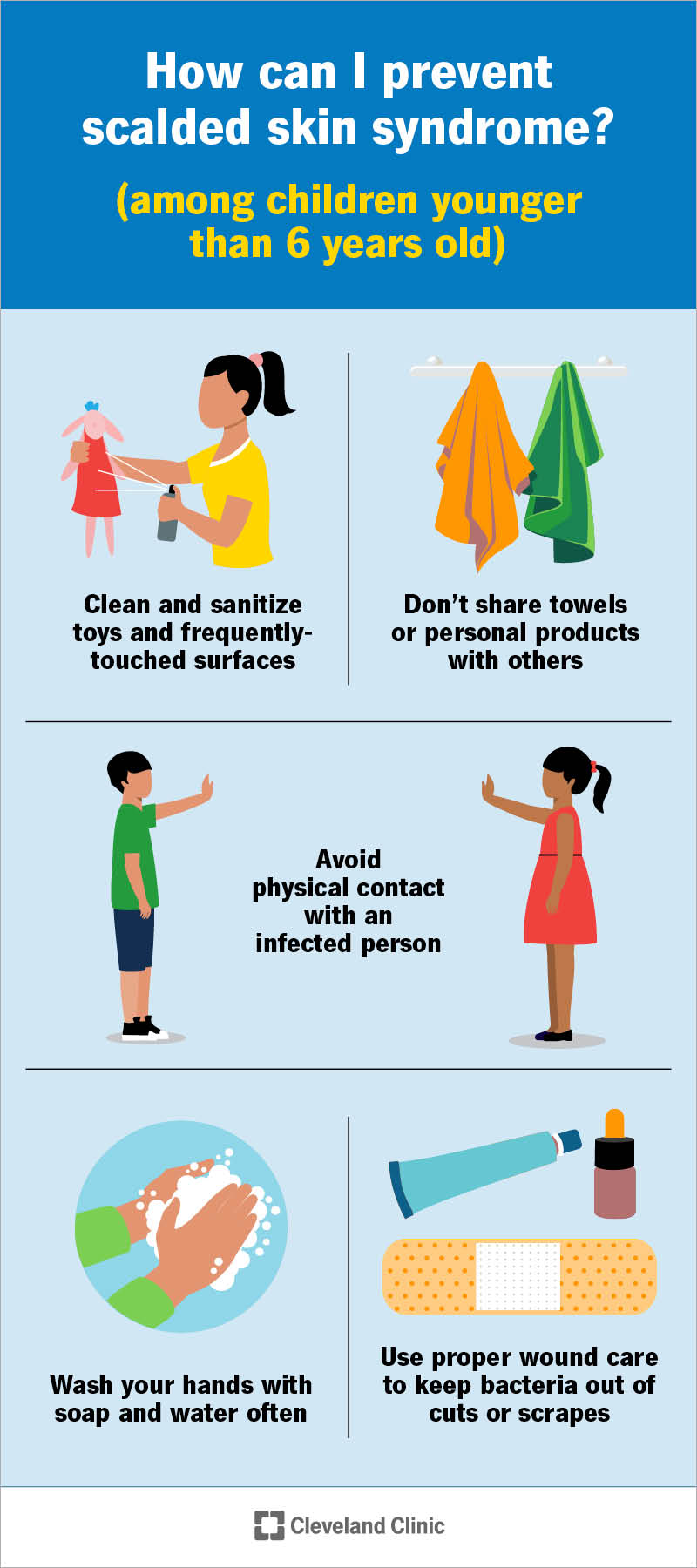
Image content: This image is available to view online.
View image online (https://my.clevelandclinic.org/-/scassets/images/org/health/articles/staph-scalded-skin-syndrome.jpg)
Antibiotics are the main treatment for scalded skin syndrome. These mainly come through an intravenous (IV) line, usually in your child’s hand or arm.
The other treatments for scalded skin syndrome are mostly supportive. That means they help with other symptoms or effects of this condition. They include:
Advertisement
It’s common for children with scalded skin syndrome not to want to be touched or held. That’s because of discomfort or pain from the condition. And that’s why many treatments focus on minimizing and managing skin effects or symptoms.
Scalded skin syndrome heals quickly, especially in children. It usually heals within five to seven days, but can take up to three weeks.
Scalded skin syndrome in children often looks severe. And while it can be dangerous and needs immediate care, the overall outlook (prognosis) is good. Most children will make a full recovery without any scarring.
The outlook for scalded skin syndrome in adults isn’t as favorable. That’s usually because of the risk factors and underlying conditions that can contribute when adults have it.
The survival rate for scalded skin syndrome in children is very high. Even in very severe cases, the survival rate is between 89% and 96%.
In adults, scalded skin syndrome has a survival rate of about 2 out of 5. Typically, it only happens in adults with underlying conditions that make it more severe.
It started as a fever and what looked like a cold, or something similar. Now, your child has a rash and doesn’t want to be touched or held. Scalded skin syndrome can be a scary-looking condition, and it does need immediate medical care. Fortunately, the outlook for this condition is excellent when children get that care quickly. Most children fully recover and won’t even have a scar left behind.
Advertisement
If you have questions about whether your child might be showing symptoms, talk to their pediatrician. They can advise you on how to proceed. And when in doubt, you know your child best. There’s nothing wrong with acting out of caution to make sure they’re OK.



Sign up for our Health Essentials emails for expert guidance on nutrition, fitness, sleep, skin care and more.
Learn more about the Health Library and our editorial process.
Cleveland Clinic’s health articles are based on evidence-backed information and review by medical professionals to ensure accuracy, reliability and up-to-date clinical standards.
Cleveland Clinic’s health articles are based on evidence-backed information and review by medical professionals to ensure accuracy, reliability and up-to-date clinical standards.
Whether you need stitches, a broken bone set or think your appendix might be causing your abdominal pain, Cleveland Clinic’s emergency medicine team is here to help.
