



You may have heard terms like “secondary drowning” or “dry drowning” to describe a death that occurred days after a drowning incident. But it doesn’t exactly work that way. While it’s possible to develop complications after a drowning, they don’t occur days or weeks later. Still, you need to seek emergency medical care if you have any symptoms.
Advertisement
Cleveland Clinic is a non-profit academic medical center. Advertising on our site helps support our mission. We do not endorse non-Cleveland Clinic products or services. Policy
Before 2002, there were at least 33 different definitions worldwide for drowning incidents. To avoid confusion, the World Health Organization agreed on one definition of drowning with three possible outcomes:
Advertisement
Cleveland Clinic is a non-profit academic medical center. Advertising on our site helps support our mission. We do not endorse non-Cleveland Clinic products or services. Policy
“Dry drowning” is an outdated medical term. It meant a drowning victim had very little to no water in their lungs. If this happened, it meant they didn’t take in (aspirate) any water. If they didn’t aspirate, they may have had a laryngospasm during the drowning incident. Laryngospasm is a reflex. It causes your body to close your airway so water can’t enter your lungs.
Healthcare providers used the term “wet drowning” to describe drowning due to water entering a victim’s lungs. Now, we know that a lack of oxygen causes drowning. It doesn’t have anything to do with whether water enters your lungs. But taking in water can lead to severe lung issues. If this happens, you experience nonfatal drowning with injury.
Along with “dry drowning” and “wet drowning,” healthcare providers no longer use the terms “secondary drowning” or “silent drowning.” In the past, providers used these terms to describe a drowning victim who developed breathing issues within eight hours of rescue. We don’t use the term anymore. But the premise behind secondary drowning can still happen. If you aspirate water, it can lead to serious lung complications.
Advertisement
But fatal drowning doesn’t happen unexpectedly days or weeks later if you don’t have symptoms within the first eight hours to begin with. New symptoms that develop days later are rarely related to the drowning incident.
If your child has new symptoms, they should see a healthcare provider immediately. These symptoms could mean your child has an unrelated, underlying medical condition.
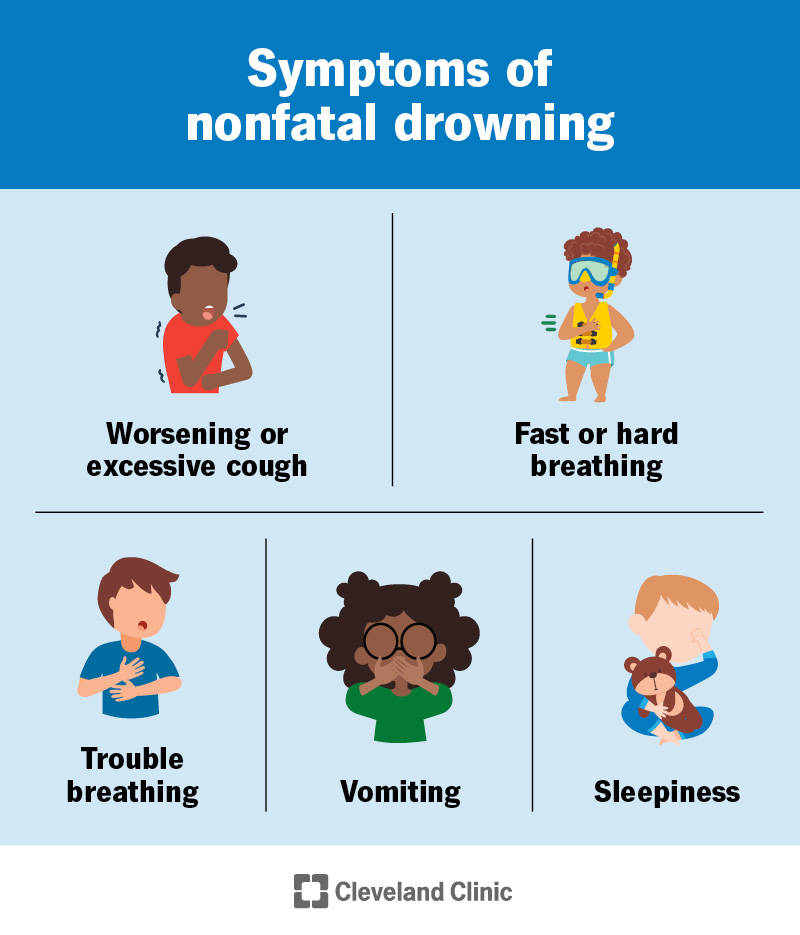
Image content: This image is available to view online.
View image online (https://my.clevelandclinic.org/-/scassets/images/org/health/articles/secondary-drowning.jpg)
A nonfatal drowning victim may experience symptoms up to eight hours after a drowning incident. Signs of nonfatal drowning include:
Nonfatal drowning victims who develop any of these symptoms should seek emergency medical attention.
If you aspirate any amount of water into your lungs, your air sacs can become inflamed. That can damage the blood-air barrier in your lungs.
The blood-air barrier is important. It’s where your bloodstream and your lungs exchange oxygen and carbon dioxide. When the blood-air barrier is damaged, fluid can leak into your air sacs. This can result in a serious condition called pulmonary edema. It can also lead to low oxygen levels in your blood (hypoxemia).
The risk factors for nonfatal drowning are the same as the risk factors for fatal drowning. Most often, they affect:
But the main risk factor is not seeking medical care if you develop any symptoms after a drowning incident. The sooner you get help, the better your outcome.
If your child has been involved in a drowning incident and develops symptoms, it’s important to seek medical care. A healthcare provider will perform a physical exam and ask about your child’s symptoms. They’ll want to know exactly what happened.
To find out if your child has fluid in their lungs, a provider will use a stethoscope to listen to their lungs. They’ll pay special attention to your child’s respiratory (breathing) rate. They’ll also listen for whistling, wheezing or crackling sounds. Your child may need certain tests, including:
If a healthcare provider finds fluid in your child’s lungs, they need immediate treatment with supplemental oxygen. This may include:
Advertisement
If your child develops any new or worsening symptoms within eight hours of a drowning incident, they should get medical attention right away. This condition is no longer called dry drowning. But it could mean your child has developed a serious lung complication.
Any time your child is involved in a drowning incident, it can be scary. Whether they had breathing issues or other symptoms right away or hours later, complications can be serious. It’s vital that they get urgent medical care if they develop any new or worsening symptoms. Early treatment could improve your child’s outcome.
Yes, 90% of all drowning cases are preventable. You and your child can prevent drowning by:
You can prevent further complications after a drowning incident by seeking medical attention right away. Even if you don’t have any serious symptoms, your healthcare providers will want to observe you for up to eight hours to make sure nothing develops.
Knowing the facts about drowning — and letting go of outdated terms like “secondary drowning” — can help you focus on what really matters: prevention and quick action. While the idea of delayed symptoms can sound frightening, remember that drowning doesn’t happen days or weeks later without warning signs.
Advertisement
If your child has been in a drowning incident, the most important step is to watch closely for any new or worsening symptoms and get medical care right away. Early attention can make a big difference in ensuring a good outcome.
Advertisement



Sign up for our Health Essentials emails for expert guidance on nutrition, fitness, sleep, skin care and more.
Learn more about the Health Library and our editorial process.
Cleveland Clinic’s health articles are based on evidence-backed information and review by medical professionals to ensure accuracy, reliability and up-to-date clinical standards.
Cleveland Clinic’s health articles are based on evidence-backed information and review by medical professionals to ensure accuracy, reliability and up-to-date clinical standards.
Whether you need stitches, a broken bone set or think your appendix might be causing your abdominal pain, Cleveland Clinic’s emergency medicine team is here to help.
