Hyperthymesia, or highly superior autobiographical memory, lets you remember daily life events in vivid detail. You don’t have to try to recall these events. It comes easily. While this rare ability can be useful, it may also bring emotional challenges when past memories are hard to forget.
Advertisement
Cleveland Clinic is a non-profit academic medical center. Advertising on our site helps support our mission. We do not endorse non-Cleveland Clinic products or services. Policy
Hyperthymesia, also known as highly superior autobiographical memory (HSAM), is when you can remember large amounts of personal life details without trying. You may be able to recall events starting from childhood.
Advertisement
Cleveland Clinic is a non-profit academic medical center. Advertising on our site helps support our mission. We do not endorse non-Cleveland Clinic products or services. Policy
Your memory is so active that you can vividly remember daily events, conversations and emotions. It’s almost like replaying a timeline in your mind.
This trait is extremely rare. Fewer than 100 people around the world have been identified with HSAM.
This skill may be helpful when remembering what you did on a specific day of the week. But it can make it hard to forget painful or upsetting memories. A healthcare provider can help you manage its effects if you need it.
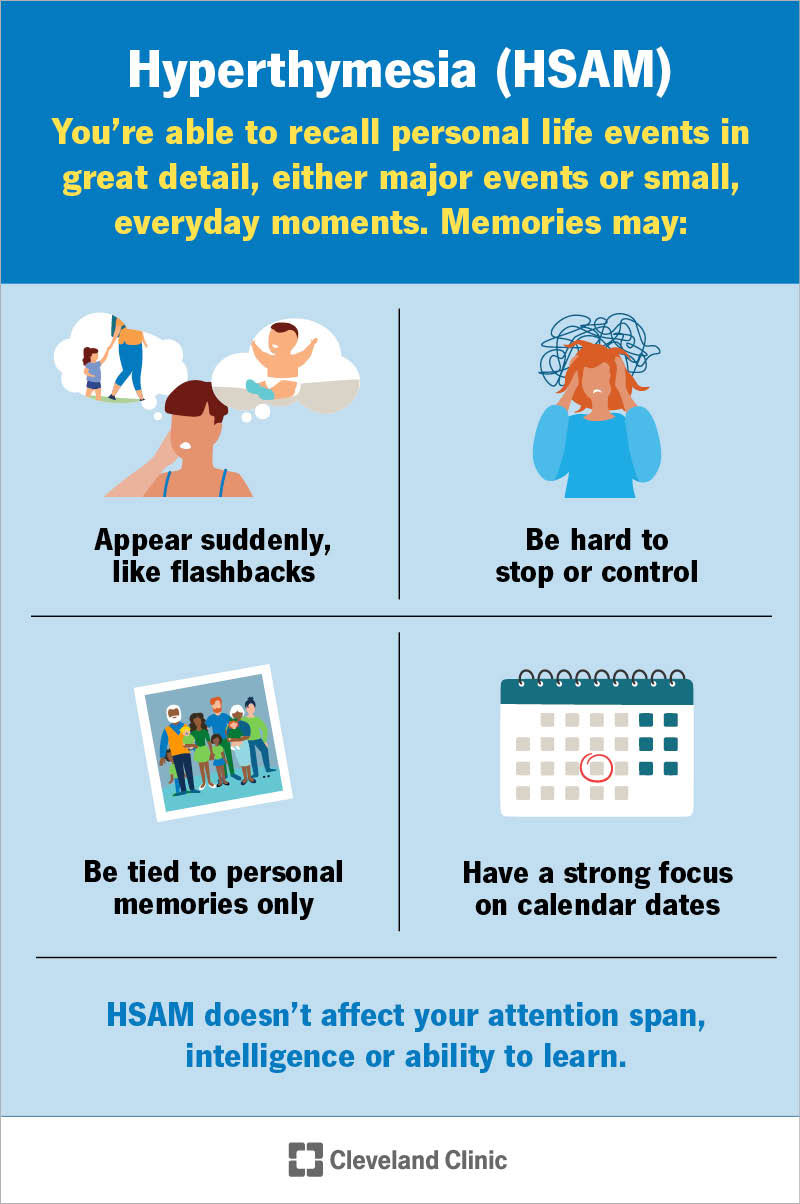
Image content: This image is available to view online.
View image online (https://my.clevelandclinic.org/-/scassets/images/org/health/articles/hyperthymesia)
The main feature is that you have a very strong autobiographical memory. This means you’re able to recall personal life events in great detail. These memories can be about your major events or your small, everyday moments.
The memories may:
It’s important to note that if you have this condition, you don’t necessarily remember everything. Instead, you have difficulty forgetting your personal life experiences.
The exact cause of HSAM isn’t known. But researchers have a few ideas about what might play a role:
Advertisement
There may be some benefits to having a highly superior autobiographical memory, including:
This trait can be challenging because you forget so little. You may not be able to control when memories appear. This can lead to:
Even though your memories may feel very vivid, you can still have false memories. HSAM doesn’t make memories perfect.
These difficulties may also be associated with:
Since this condition is very rare, it may take some time to get an official and accurate diagnosis. A healthcare provider will review your medical history and do a neurological exam. They may run tests to rule out other conditions and help confirm the diagnosis. These tests may include:
HSAM isn’t a disorder that needs medical treatment, so there’s no cure or medication to change it. But, if it affects your daily life and you want help coping with bothersome vivid memories, your provider may recommend:
Your provider may offer guidance tailored to your needs, since each person’s experience with HSAM is different.
You should see a healthcare provider if HSAM starts to affect your emotional health or daily life. Seek help if you:
If hyperthymesia isn’t causing problems, you usually don’t need medical care.
Even if you don’t have HSAM but have strong memories that seem overwhelming or disruptive, it’s OK to reach out to a provider. They can help manage them so you can feel better.
Advertisement
Having a near-perfect memory for your life’s events can seem like a superpower. You might recall what you ate or what you wore years ago with ease. But remembering everything can be a double-edged sword. Some memories, especially painful ones, may stick around longer than you’d like.
It’s OK if that feels overwhelming sometimes. Your brain is working hard. That kind of mental replay can take an emotional toll. If old memories are getting in the way of your present-day life or your peace of mind, talking with a provider may help. Therapy, stress management and other supports can help you carry those memories more gently.
Advertisement



Sign up for our Health Essentials emails for expert guidance on nutrition, fitness, sleep, skin care and more.
Learn more about the Health Library and our editorial process.
Cleveland Clinic’s health articles are based on evidence-backed information and review by medical professionals to ensure accuracy, reliability and up-to-date clinical standards.
Cleveland Clinic’s health articles are based on evidence-backed information and review by medical professionals to ensure accuracy, reliability and up-to-date clinical standards.
If you have a neurological condition, you want expert advice. At Cleveland Clinic, we’ll work to create a treatment plan that’s right for you.