



Facet hypertrophy happens when the small joints in your spine thicken due to arthritis or wear and tear. It can cause back pain, stiffness and, in some cases, nerve pressure. While it can’t be reversed, treatments like physical therapy, medications and injections can help you feel better.
Advertisement
Cleveland Clinic is a non-profit academic medical center. Advertising on our site helps support our mission. We do not endorse non-Cleveland Clinic products or services. Policy
Facet hypertrophy, or facet joint hypertrophy, happens when the small joints called facets between your spine bones (vertebrae) enlarge and inflame. It’s often due to wear and tear. These joints help stabilize your spine and guide movement. Cartilage is the smooth tissue covering the ends of your facet joints. Aging or overuse can wear it down. This lets bone rub on bone and triggers joint overgrowth.
Advertisement
Cleveland Clinic is a non-profit academic medical center. Advertising on our site helps support our mission. We do not endorse non-Cleveland Clinic products or services. Policy
Facet hypertrophy can cause pain, stiffness or spasms. A healthcare provider can help you manage these issues so they interfere less with your daily routine.
Facet joints run all along your spine. They’re found in each segment, including your:
Each level of your spine has two facet joints, one on each side. Your provider may describe the location as:
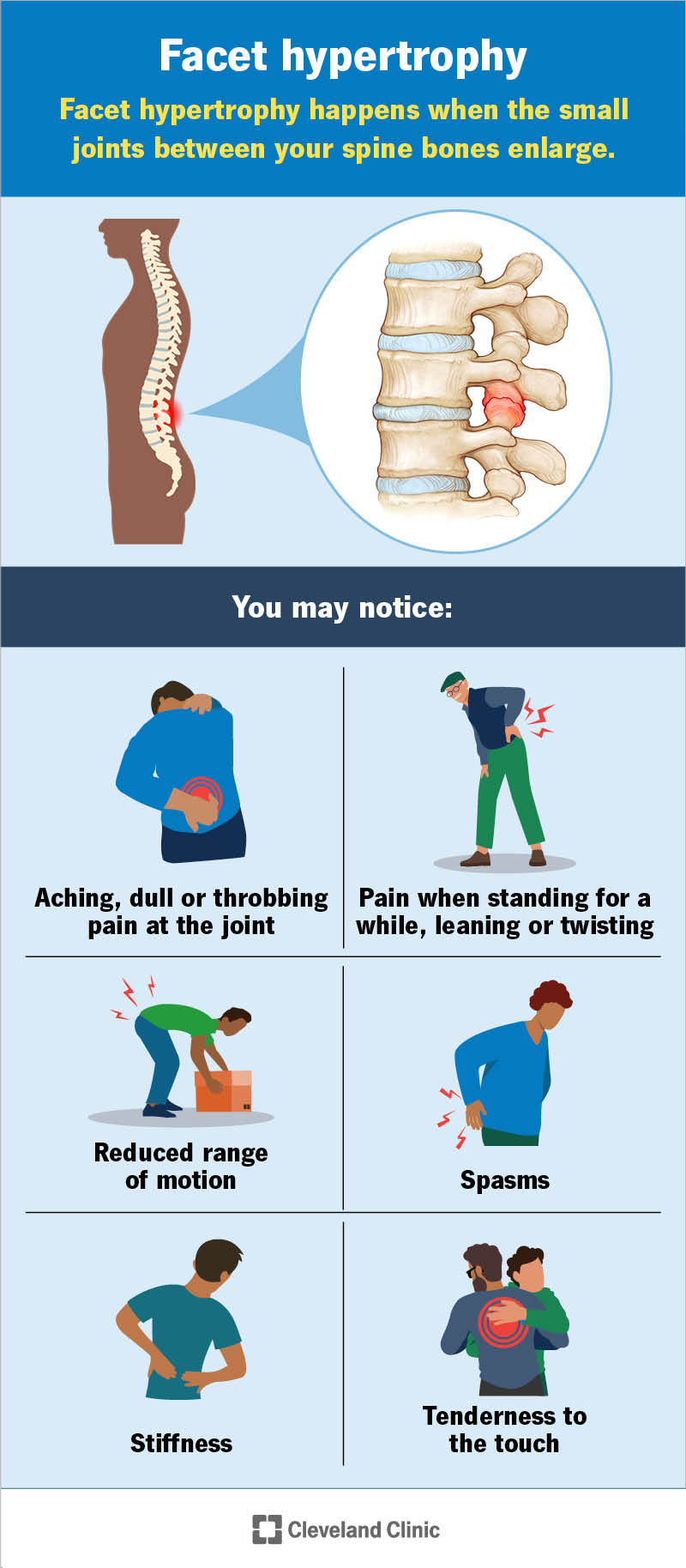
Image content: This image is available to view online.
View image online (https://my.clevelandclinic.org/-/scassets/images/org/health/articles/facet-hypertrophy)
Not all cases of facet joint hypertrophy cause symptoms, but facet joint hypertrophy from wear and tear can be a source of pain. You may notice:
Pain from these joints may also appear in other areas of your body. This is called referred pain. It means you feel it somewhere different from where the pain starts. Pain can also radiate, or spread, from the joint itself. Pain from the facet joints can radiate to your butt and thighs. Keep in mind, this pain won’t radiate below your knee.
Many people find the pain feels worse after rest, like first thing in the morning. But it may improve with gentle movement.
Advertisement
Facet hypertrophy happens when a facet joint breaks down. This occurs as the cartilage that lines and cushions your spinal bones wears away over time. Everyone’s spine changes with age, but other factors can also play a role, including:
Your spinal canal (the bony tunnel that holds your spinal cord) has limited space. If a facet joint grows too large, it may cause your spinal canal to narrow, and it can press on nearby nerves or your spinal cord. Fluid-filled cysts can also form near your joint. In some cases, joint degeneration can cause slippage of one vertebra over another (spondylolisthesis).
These changes can affect both movement and feeling. You may notice trouble walking, numbness or weakness in your arms and legs. In severe cases, it may also cause bowel or bladder problems. These symptoms are important to watch for, so let your provider know if they happen.
A healthcare provider usually starts with a physical exam and a review of your medical history. They’ll ask about your symptoms. They may gently press on your spine to check where the pain comes from or have you do different movements to see what creates the pain.
To get a better look at your joints, your provider may order imaging tests like x-rays, a CT scan or MRI. The imaging test helps your provider see the enlarged joint to confirm the diagnosis.
Imaging tests can show how much a facet joint thickens. Your provider may grade it as mild, moderate or severe. This grading helps guide treatment and track changes over time. Keep in mind that a worse grade doesn’t always mean worse pain. It’s just describing how it looks in the images.
Treatment depends on how severe the condition is. Options may include:
Advertisement
See a healthcare provider if you have ongoing back or neck pain. Let them know if it doesn’t improve or gets worse after home care, like rest or over-the-counter pain relievers.
Get medical help right away if you notice sudden weakness or numbness in your arms or legs, or if you have changes in bowel or bladder function.
There isn’t a single experience that fits everyone. You might not have any symptoms, only have mild symptoms or have severe ones that affect your daily routine.
Joint changes from arthritis are usually permanent. The condition may slowly get worse. Even though treatment can’t reverse the damage, it can help manage symptoms if you have them. You may need small lifestyle adjustments and occasional treatments throughout the year to manage your symptoms.
A healthcare provider can help you find the treatment plan that works best for you.
You can’t fully prevent facet joint hypertrophy because your facet joints naturally wear down over time. But you can lower your risk by:
Facet hypertrophy is one of those conditions that tends to sneak up on you. These joints aren’t visible, so it’s hard to notice the years of wear and tear that happen to them. But if you’re constantly waking up stiff and uncomfortable when standing, it’s time to talk to a healthcare provider.
Advertisement
Even though changes from this condition can’t be undone, there are ways to manage the pain and improve your movement. With the right support — from lifestyle changes and medications to a procedure — you can take steps to feel more comfortable.
Advertisement



Sign up for our Health Essentials emails for expert guidance on nutrition, fitness, sleep, skin care and more.
Learn more about the Health Library and our editorial process.
Cleveland Clinic’s health articles are based on evidence-backed information and review by medical professionals to ensure accuracy, reliability and up-to-date clinical standards.
Cleveland Clinic’s health articles are based on evidence-backed information and review by medical professionals to ensure accuracy, reliability and up-to-date clinical standards.
Back pain can stop you in your tracks. But you don’t have to live like that. Cleveland Clinic is here to help you get moving again.
