



Cluster A personality disorders (PDs) involve odd and unusual behavior. There are three types, including paranoid PD, schizotypal PD and schizoid PD. People with these personality disorders often don’t realize there’s an issue with how they think or behave.
Advertisement
Cleveland Clinic is a non-profit academic medical center. Advertising on our site helps support our mission. We do not endorse non-Cleveland Clinic products or services. Policy
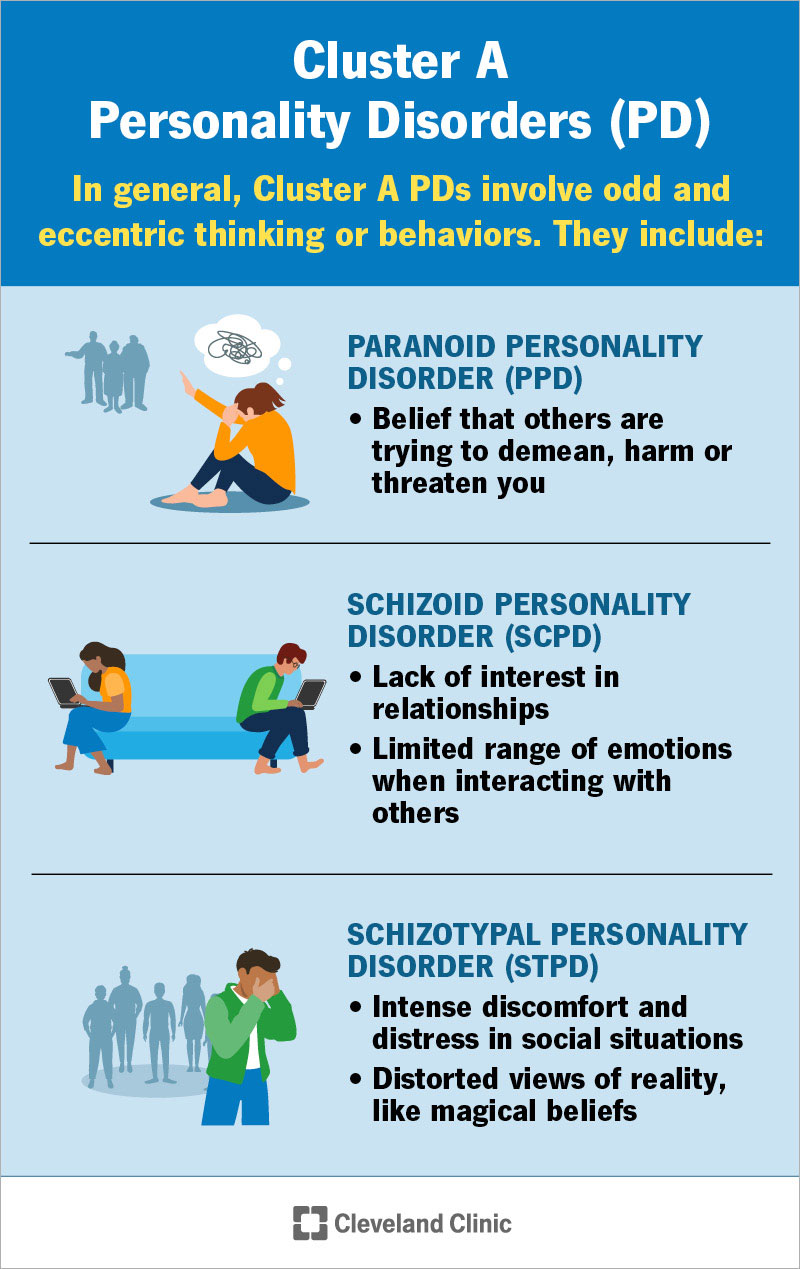
Image content: This image is available to view online.
View image online (https://my.clevelandclinic.org/-/scassets/images/org/health/articles/cluster-a-personality-disorders)
Cluster A personality disorders (PDs) are three mental health conditions that involve odd and eccentric thinking or behaviors. They include:
Advertisement
Cleveland Clinic is a non-profit academic medical center. Advertising on our site helps support our mission. We do not endorse non-Cleveland Clinic products or services. Policy
It’s possible to have more than one of these conditions. For example, people with schizoid personality disorder tend to have paranoid personality disorder, as well.
These lifelong behaviors and thinking patterns can cause distress in many areas of your life, like work and relationships. Talk therapy can help manage the symptoms. But you may not think there’s an issue with how you relate to others.
Each Cluster A personality disorder has its own symptoms. But these PDs share certain personality traits, which begin by early adulthood. To others, people with personality disorders in this cluster generally appear:
Advertisement
If you have one of these conditions, you may feel social distrust or disinterest. You may have difficulty forming close relationships.
Healthcare providers don’t know the exact cause of Cluster A personality disorders. Research suggests that it’s complex and may involve many factors, like genetics and childhood experiences.
Compared to other clusters, Cluster A PDs may have stronger genetic ties. People with Cluster A personality disorders are more likely to have a biological relative with schizophrenia.
Experiencing emotional extremes in childhood may play a role, too. For example, you may have had caregivers who had frequent emotional outbursts or a lack of emotions.
Healthcare providers use criteria in the DSM-5 to diagnose Cluster A personality disorders. Each PD has specific criteria. Providers ask questions about your medical, personal and social history to guide the diagnosis.
This can be difficult. Most people living with personality disorders may not seek help. Mental health professionals may work with loved ones to gather more information.
Talk therapy can help manage Cluster A personality disorders. You’ll work with a mental health professional, like a psychologist. They can provide support and education to you and your family. They’ll help you learn healthier ways of working through emotions and relationships.
There are several types of talk therapy. Some types may work better than others for certain Cluster A PDs.
Currently, the U.S. Food and Drug Administration (FDA) doesn’t approve any medications to treat personality disorders directly. But medications such as low-dose antipsychotics may be helpful if you have schizotypal personality disorder. You may also take medications for other conditions you have, like depression and anxiety.
The outlook for Cluster A personality disorders varies. It depends on symptom severity and your willingness to get treatment.
If you have a Cluster A personality disorder, you may:
But with treatment, it’s possible to improve your quality of life.
If you think a family member has a Cluster A personality disorder, encourage them to get help. It’s important to take care of yourself, too. Reach out to a mental health specialist if you’re feeling isolated or frustrated.
Advertisement



Sign up for our Health Essentials emails for expert guidance on nutrition, fitness, sleep, skin care and more.
Learn more about the Health Library and our editorial process.
Cleveland Clinic’s health articles are based on evidence-backed information and review by medical professionals to ensure accuracy, reliability and up-to-date clinical standards.
Cleveland Clinic’s health articles are based on evidence-backed information and review by medical professionals to ensure accuracy, reliability and up-to-date clinical standards.
Your mental well-being is just as important as your physical well-being. Cleveland Clinic’s mental health experts can help you live life to the fullest.
