Spots on your tongue are often harmless. But in some cases, they can indicate serious health conditions. The spots come in different colors and sizes. They may be raised, flat or have odd borders. Some common spots, like canker sores and cold sores, may be easy to identify. For other spots, you may need a healthcare provider to take a look.
Advertisement
Cleveland Clinic is a non-profit academic medical center. Advertising on our site helps support our mission. We do not endorse non-Cleveland Clinic products or services. Policy
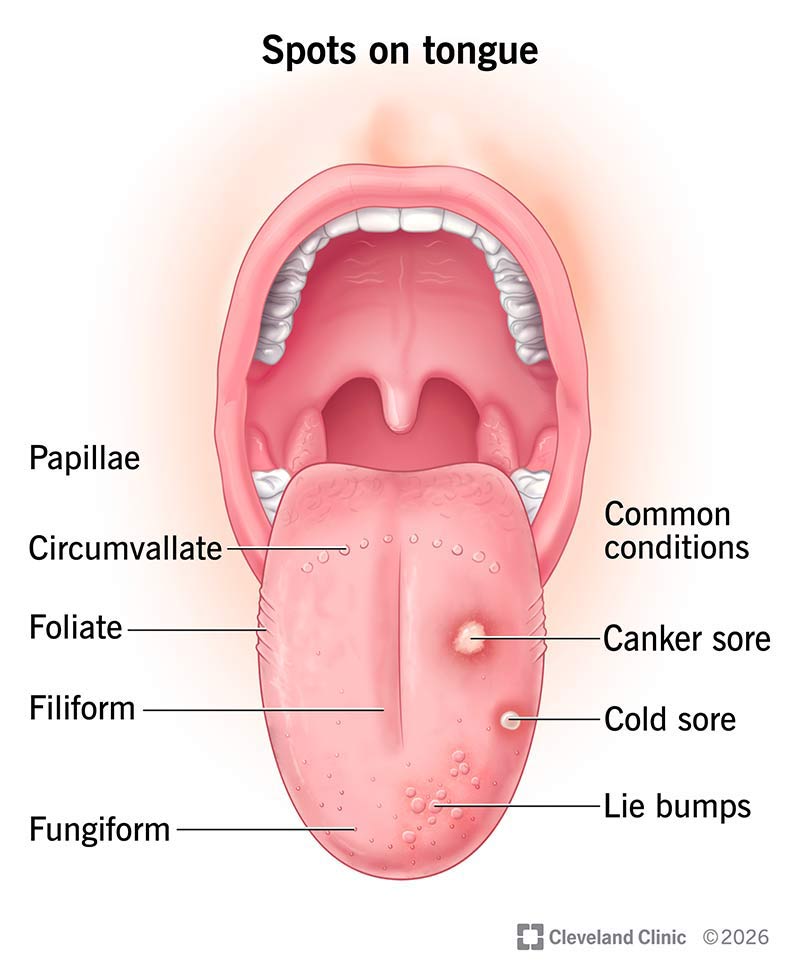
Image content: This image is available to view online.
View image online (https://my.clevelandclinic.org/-/scassets/Images/org/health/articles/spots-on-tongue)
Tongue spots range from bumps that are just part of a healthy tongue to lesions that mean you have a health condition. In most cases, these spots are harmless. But certain spots on your tongue can signal health issues, like a food allergy, autoimmune disease or infection. Less commonly, the spots can mean tongue cancer.
Advertisement
Cleveland Clinic is a non-profit academic medical center. Advertising on our site helps support our mission. We do not endorse non-Cleveland Clinic products or services. Policy
If you’re unsure about what’s causing spots on your tongue and they aren’t going away, see your dentist or primary care physician for help.
Your tongue is covered with papillae — tiny bumps and projections that help with sensory things like speaking, chewing food and detecting temperature. Some contain taste buds. There are four kinds of papillae:
You don’t need to worry about these “spots.”
Most tongue spots aren’t dangerous, and they usually get better without treatment. But with some, you may need medicine or a procedure to get rid of them. Here are some of the most common spots you can get on your tongue and what they look like:
Advertisement
| Condition | What it looks like |
|---|---|
| Canker sores | Yellow or white spots with borders |
| Cold sores | Blisters or fluid-filled bumps, sometimes in clusters |
| Geographic tongue | Discolored, map-like spots that may have a light-colored border |
| Lie bumps (transient lingual papillitis) | Small red or white bumps |
| Oral thrush | Raised, white areas that resemble cottage cheese |
| Lichen planus | White, lacy patches with possible redness and swelling |
| Leukoplakia | White patches that won’t scrape off |
| Erythroplakia | Red patches that won’t scrape off |
| Tongue cancer | Red or white patches, ulcers or open sores |
| Condition | |
| Canker sores | |
| What it looks like | |
| Yellow or white spots with borders | |
| Cold sores | |
| What it looks like | |
| Blisters or fluid-filled bumps, sometimes in clusters | |
| Geographic tongue | |
| What it looks like | |
| Discolored, map-like spots that may have a light-colored border | |
| Lie bumps (transient lingual papillitis) | |
| What it looks like | |
| Small red or white bumps | |
| Oral thrush | |
| What it looks like | |
| Raised, white areas that resemble cottage cheese | |
| Lichen planus | |
| What it looks like | |
| White, lacy patches with possible redness and swelling | |
| Leukoplakia | |
| What it looks like | |
| White patches that won’t scrape off | |
| Erythroplakia | |
| What it looks like | |
| Red patches that won’t scrape off | |
| Tongue cancer | |
| What it looks like | |
| Red or white patches, ulcers or open sores |
Canker sores
Canker sores are small ulcers that develop in the lining of your mouth. They look white or yellowish and usually have a red border. Canker sores can appear on your tongue, lips, inner cheeks or even the roof of your mouth. Healthcare providers don’t know what causes them. But minor injuries to the inside of your mouth and stress are possible triggers.
Most canker sores go away on their own within a few weeks. In the meantime, there are medicines and mouthwashes that can help ease the symptoms.
Cold sores
Also called fever blisters, cold sores look like fluid-filled blisters. Sometimes, they appear in clusters. They often appear on your lips, but you can also get them on your tongue. The herpes simplex virus (HSV-1) causes cold sores. HSV-1 easily spreads through saliva or close contact.
There are over-the-counter and prescription options for treating cold sores. Your healthcare provider can help you find a product that works for you.
Geographic tongue
Geographic tongue gets its name because of its “map-like” appearance. People with the condition develop smooth patches of redness or discoloration on their tongues. These areas are often surrounded by a white or light-colored border.
Geographic tongue is totally harmless, and it’s not contagious. Treatment usually isn’t necessary unless it’s causing symptoms.
Lie bumps (transient lingual papillitis)
Lie bumps are very common. They happen when the papillae on your tongue enlarge or become inflamed. They usually appear as small red or white bumps. They get their name from a myth that a person could develop them after telling a lie. In reality, they happen when you injure your tongue or something irritates it.
They usually go away on their own within a few days. They’re not dangerous and typically don’t require treatment.
Oral thrush
Oral thrush is a fungal infection. It’s not highly contagious, but it can spread to people with weakened immune systems. People with thrush develop raised, white spots on their tongues and inner cheeks. These irritated areas may look like cottage cheese.
You can scrape these lesions off, but doing so will cause bleeding. Your healthcare provider can prescribe an antifungal medicine to clear up the infection.
Lichen planus
Oral lichen planus is a condition that irritates the skin lining your mouth. It occurs when your immune system attacks cells in your body for unknown reasons. Oral lichen planus can look like white, lacy patches. It can also result in open sores or swollen tissues.
Advertisement
Your healthcare provider can prescribe medications to help manage symptoms.
Leukoplakia
Leukoplakia lesions look like white or gray patches or spots inside your mouth. These spots can develop on or under your tongue or on your inner cheeks. You can’t scrape or rub them off.
Experts don’t know what causes them, but using tobacco products and drinking too much alcohol may increase your risk. Related, people who develop leukoplakia have an increased risk of oral cancer. But most people who get leukoplakia don’t go on to develop oral cancer.
In most cases, healthcare providers recommend removing leukoplakia lesions with surgery.
Erythroplakia
Erythroplakia causes red spots to develop inside your mouth. You can get these lesions on your tongue or the floor of your mouth. Like leukoplakia lesions, areas of erythroplakia don’t come off when scraped.
It’s also linked to tobacco and alcohol, and it may increase your oral cancer risk.
Healthcare providers treat erythroplakia with radiation, surgery or by eliminating relevant risk factors.
Tongue cancer
Tongue cancer is a head and neck cancer that starts in the cells that line your tongue. Cancerous lesions may look like red or white patches. Sometimes, they’re open sores that won’t go away.
Advertisement
The treatment you’ll need depends on the cancer stage, your overall health and your preferences.
You should call a healthcare provider any time you notice a new sore spot or ulcer on your tongue or in your mouth — especially if it doesn’t go away within two weeks.
Schedule an appointment if the spot seems to be growing or happens alongside other symptoms, like:
Most of the time, spots on your tongue are harmless and go away rather quickly. But some spots, ulcers or lesions can indicate a more serious condition.
If you have spots on your tongue that won’t go away, schedule an appointment with your healthcare provider. They can help find out what the spots are and what they mean. They can tell you whether they’re related to any other health conditions and provide treatment that can help.
Advertisement



Sign up for our Health Essentials emails for expert guidance on nutrition, fitness, sleep, skin care and more.
Learn more about the Health Library and our editorial process.
Cleveland Clinic’s health articles are based on evidence-backed information and review by medical professionals to ensure accuracy, reliability and up-to-date clinical standards.
Cleveland Clinic’s health articles are based on evidence-backed information and review by medical professionals to ensure accuracy, reliability and up-to-date clinical standards.
Need care fast? Cleveland Clinic’s Express Care and Urgent Care locations treat everything from sprains to sinus infections — no appointment needed.