



With hyperacusis, everyday sounds may seem unbearably loud, painful and even frightening. It often accompanies tinnitus, a condition that involves hearing a ringing in your ears. There isn’t a single cause or cure that works for everyone. But there are therapies that can help treat symptoms.
Advertisement
Cleveland Clinic is a non-profit academic medical center. Advertising on our site helps support our mission. We do not endorse non-Cleveland Clinic products or services. Policy
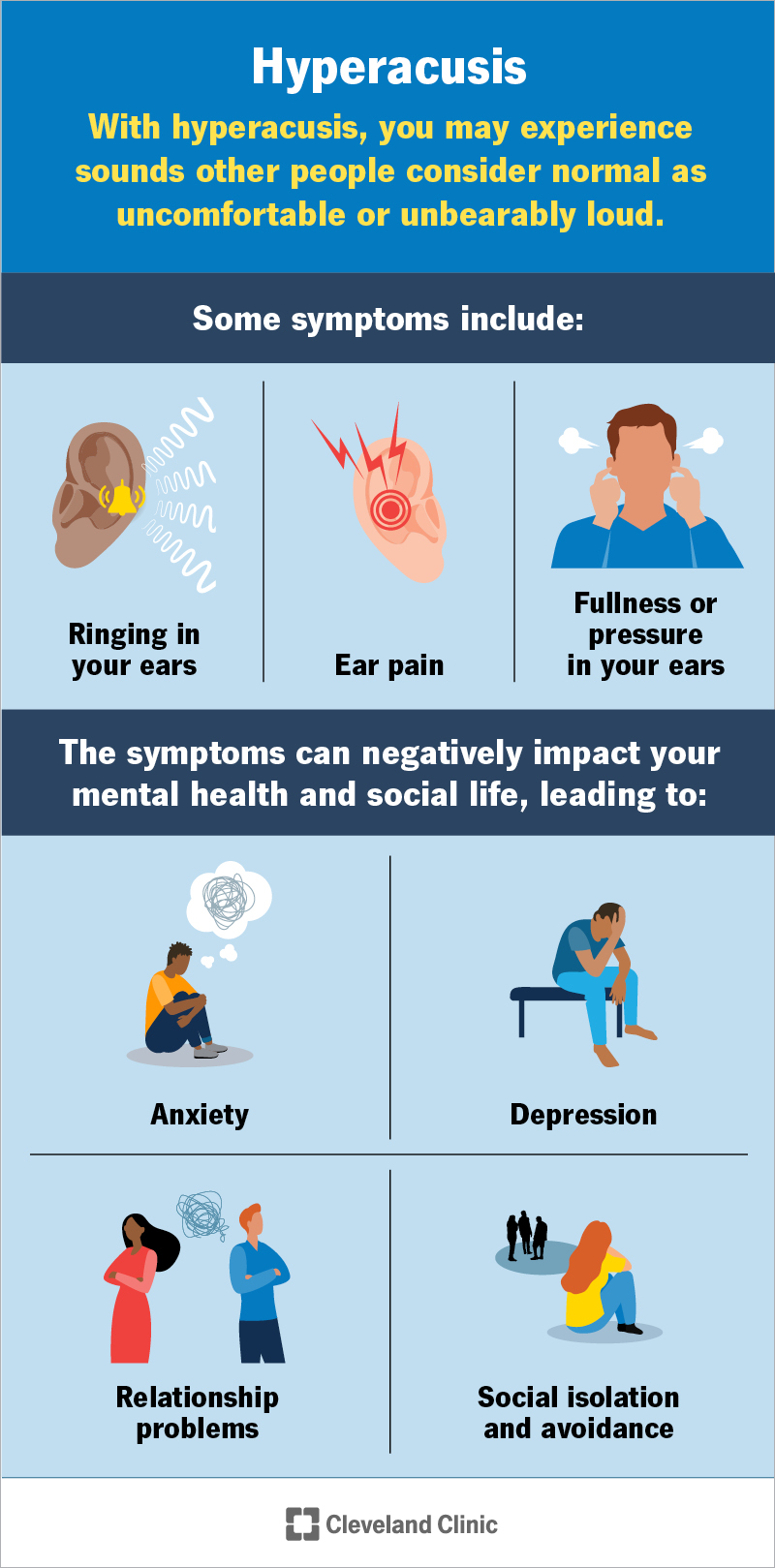
Image content: This image is available to view online.
View image online (https://my.clevelandclinic.org/-/scassets/Images/org/health/articles/hyperacusis-infographic)
Hyperacusis is a rare hearing disorder where sounds others perceive as normal seem uncomfortably — and often unbearably — loud. It’s also called decreased sound tolerance, or DST.
Advertisement
Cleveland Clinic is a non-profit academic medical center. Advertising on our site helps support our mission. We do not endorse non-Cleveland Clinic products or services. Policy
People with typical hearing experience a range of sounds with varying degrees of loudness. But people with hyperacusis experience sound, in general, with the volume turned too high.
Some examples of common sounds in everyday life that may feel intolerable to someone with this condition include:
The experience can take a toll on your mental health. It can make you feel irritable and anxious. This condition can impact your social life, too. Some people avoid social situations to reduce the risk of experiencing intense loudness.
Hyperacusis often accompanies tinnitus, a more common condition related to hearing loss that involves ringing, whistling, clicking or roaring sounds in your ears. Still, not all cases involve tinnitus or hearing loss.
This condition may cause you to experience regular sounds as uncomfortable, unbearably loud, painful or even frightening. The loudness may be mildly annoying. Or it may be so intense that it makes you struggle with your balance or even have seizures.
Other symptoms may include:
Advertisement
Symptoms may get worse if you’re stressed or tired. Even worrying about noise exposure may make things worse.
There isn’t a single cause that explains why it happens. But lots of theories exist.
It’s possible that auditory nerve damage causes hyperacusis. Your auditory nerve carries sound signals from your inner ear to your brain so you can hear. Another theory is that damage to your facial nerve causes it. Your facial nerve controls a muscle inside your ear that regulates loudness.
Experts have found that it’s linked to many conditions. It’s especially common in people with Williams syndrome and tinnitus. Nearly half of people with hyperacusis also have a behavioral health condition, like anxiety or depression.
Other conditions associated with it include:
Factors that increase your risk include:
The symptoms of hyperacusis can impact your mental health and social life. The constant experience of feeling overwhelmed with intense, unpleasant sounds can lead to:
You may need to see a specialist for this diagnosis, like an otolaryngologist (ENT), neurotologist or audiologist. They’ll consider your medical history and do an exam to check for structural issues in your ear.
Diagnosis may involve:
There isn’t a standard treatment for hyperacusis. Instead, your healthcare provider will suggest therapies that reduce symptoms. They’ll teach you coping strategies to manage it. Treatments include:
Advertisement
There isn’t a cure. But depending on the cause, your symptoms may improve in time.
For instance, hyperacusis after surgery may go away once you heal from the procedure. Switching medicines may help if noise sensitivity is a medication side effect. People with Ménière’s disease may notice an improvement if the disease goes into remission.
See a healthcare provider if everyday noises sound unbearably loud or painful. It may take a while to find what’s causing the issue. But there are therapies that can help.
Advertisement
Medical experts are still studying the long-term effects of hyperacusis. Some people have symptom relief once they get treatment for the condition causing it. But for many people, it’s a long-term condition they learn to manage with treatment.
Even when symptoms don’t go away for good, therapies can improve things. For instance, research shows that sound therapy often increases sound tolerance within six months to a year.
The best thing you can do is see a healthcare provider instead of trying to manage the condition on your own. This is because with hyperacusis, the obvious solutions can make things worse.
For example, you may want to drown out sounds with noise-canceling earplugs or headphones. You may avoid social settings. But wearing headphones or earplugs can make sounds even more intense once you remove them. Social isolation can lead to (or worsen) anxiety and depression.
You have the best chance of finding relief by working with a healthcare provider who has experience in treating this condition.
Many people with hyperacusis symptoms start by trying to drown out the sounds around them with earplugs or headphones. They may avoid social settings. But these options can make things worse. People who wear headphones or earplugs may experience sound even more intensely once they remove them, and social isolation can lead to (or worsen) behavioral health issues.
Advertisement
Don’t try to manage symptoms on your own. Instead, see a healthcare provider if you’re experiencing hyperacusis symptoms. It may take a while to identify the likely cause, but there are therapies that can help.
Some healthcare providers find it helpful to think of this condition as one of four types. The groupings describe it based on the symptom that seems to bother a person the most. They are:
Experts disagree, though, on whether these are different types of the same condition. It’s possible that people with hyperacusis just experience things like negative emotions or physical pain on a spectrum. Some experts see misophonia and phonophobia as entirely different conditions from hyperacusis.
Regardless of the labels, the important thing to know is that hyperacusis is a real condition that can impact your quality of life. No matter your experience, there are therapies that can help.
It often takes hard work and patience to find relief from hyperacusis symptoms. But it’s possible. Many people learn to increase their tolerance to sounds they once thought unbearable. The sooner you’re diagnosed, the sooner you can find treatments that turn the volume down, so you can start feeling like yourself again.



Sign up for our Health Essentials emails for expert guidance on nutrition, fitness, sleep, skin care and more.
Learn more about the Health Library and our editorial process.
Cleveland Clinic’s health articles are based on evidence-backed information and review by medical professionals to ensure accuracy, reliability and up-to-date clinical standards.
Cleveland Clinic’s health articles are based on evidence-backed information and review by medical professionals to ensure accuracy, reliability and up-to-date clinical standards.
If you have conditions affecting your ears, nose and throat, you want experts you can trust. Cleveland Clinic’s otolaryngology specialists can help.
