



Compulsive sexual behavior disorder (CSBD), or hypersexuality, is when sexual urges or actions feel out of control. They may cause stress, guilt, relationship issues or other challenges. It’s treatable with therapy, support and, in some cases, medication.
Advertisement
Cleveland Clinic is a non-profit academic medical center. Advertising on our site helps support our mission. We do not endorse non-Cleveland Clinic products or services. Policy
Compulsive sexual behavior disorder (CSBD), also called hypersexuality or sex addiction, involves strong sexual thoughts, urges or behaviors that feel hard to control. These happen a lot and can get in the way of your daily life. They may cause stress, shame or problems with relationships, work or finances.
Advertisement
Cleveland Clinic is a non-profit academic medical center. Advertising on our site helps support our mission. We do not endorse non-Cleveland Clinic products or services. Policy
You might use these behaviors to cope with anxiety, depression or past trauma. You may try to stop or cut back, but find it difficult. And you may keep doing them even if they cause guilt or regret.
Treatment often includes therapy to understand your patterns and triggers. Care may also focus on treating related mental health conditions and building healthier ways to handle stress and emotions.
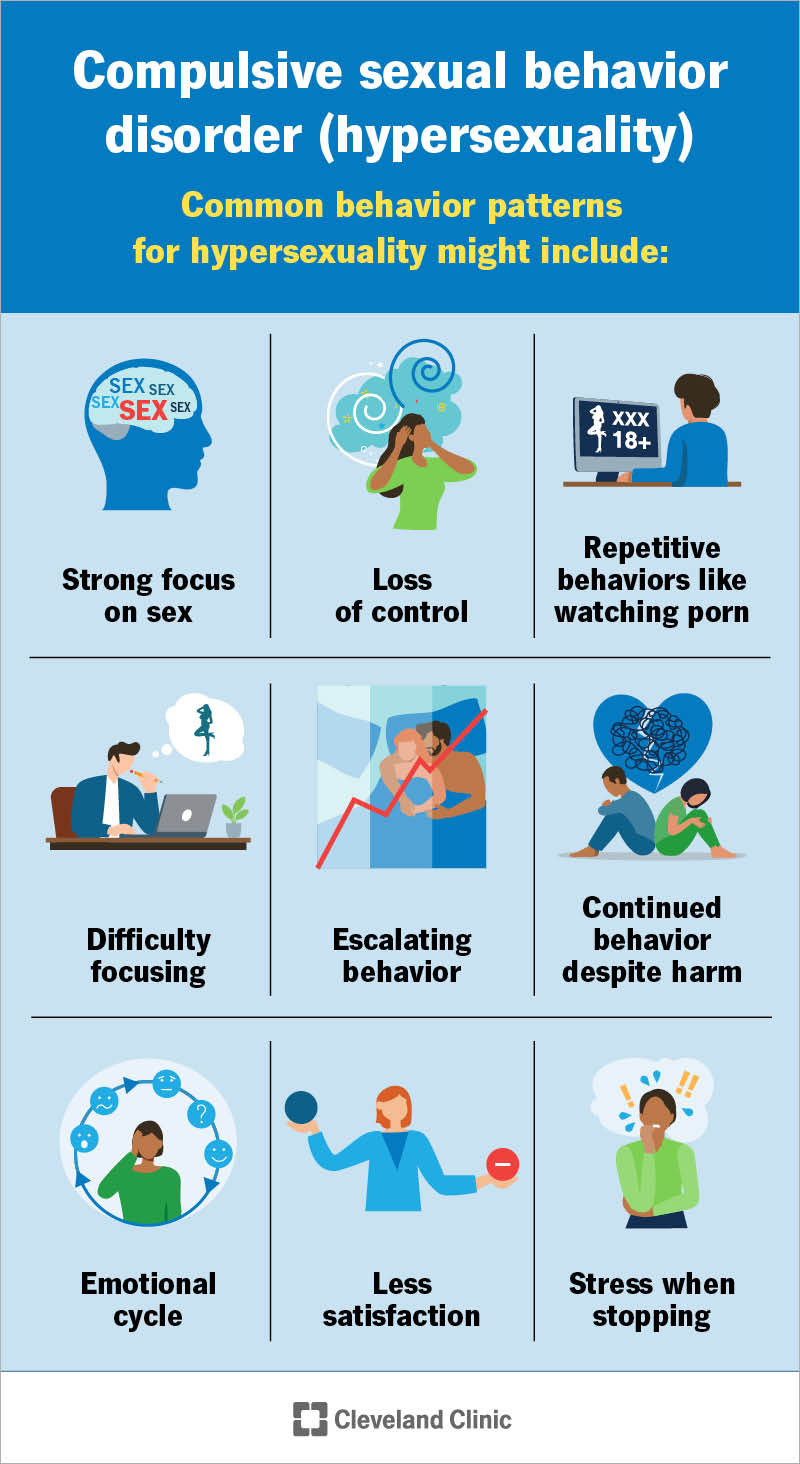
Image content: This image is available to view online.
View image online (https://my.clevelandclinic.org/-/scassets/images/org/health/articles/hypersexuality)
There isn’t a list of symptoms all providers use to diagnose compulsive sexual behavior disorder. But there are common behavior patterns. These might include:
Advertisement
Healthcare providers don’t know the exact cause of CSBD. It likely develops from a mix of brain changes and learned behavior patterns.
Possible factors include:
Triggers are things that can set off symptoms. They vary from person to person. Common triggers may include:
This condition can affect anyone. You may be at higher risk if you have one or more of the following:
Compulsive sexual behavior disorder can affect many parts of your life. Possible complications include:
If you’re having thoughts of suicide or self-harm, seek help right away. You can call or text 988 (U.S.). This is the Suicide and Crisis Lifeline. Someone is available to talk to you 24/7.
There’s no single test for hypersexuality. A healthcare provider makes the diagnosis through conversation and evaluation.
Your provider will ask about sexual thoughts, urges and behaviors. They’ll focus on whether these feel hard to control and whether they affect daily life, relationships, work or emotional health. They’ll also ask how long you’ve had symptoms.
Advertisement
Just having a strong sex drive doesn’t mean you have CSBD. Providers look for loss of control and negative impact, not just how often sexual activity happens. They also consider your personal values and cultural background.
Your provider will check whether something else is causing it, like a medicine, substance use or a health issue.
Throughout the process, providers aim to be respectful and nonjudgmental. The goal is to learn what’s going on and find the right kind of help.
Compulsive sexual behavior disorder is recognized as a mental health condition by major health organizations. It involves ongoing sexual urges or behaviors that feel hard to control and cause problems in daily life. Not all medical systems use the same name, and experts still discuss how best to classify it.
It isn’t currently listed in the updated version of the DSM-5 (Diagnostic and Statistical Manual of Mental Disorders, fifth edition). Even so, healthcare providers widely agree that this is a real and treatable mental health condition. Many people find relief and stability with the right support and care.
Treatment focuses on helping you feel more in control, reducing stress and improving daily life. The goal isn’t to take away your sex drive — just to help it feel more balanced.
Advertisement
Treatment often takes time. Your provider may adjust your care as symptoms change.
Therapy is the main treatment for CSBD. In therapy, you may work on:
Therapy might be just you, with your partner or in a group — whatever works best for you.
You may benefit from medication. A medication is usually added to therapy, not used alone.
Medications may help:
There’s no single medication made just for this condition. Your provider will help decide if medication makes sense for you.
You should talk to a healthcare provider if sexual thoughts or behaviors feel hard to control or start causing problems in your life.
It may be time to seek help if:
Advertisement
You don’t need to wait for a crisis to reach out. If you’re worried about your sexual behavior, a provider can help you sort through what’s going on and discuss next steps.
Living with CSBD may feel difficult, and it often takes ongoing effort to manage. There’s no cure for CSBD, but treatment may help you feel more in control.
With therapy and support, many people learn skills to manage triggers and respond to urges in healthier ways. Over time, sexual thoughts may feel less intense, and behaviors may happen less often.
Progress takes time. You may have days when urges get stronger, especially when you’re stressed. That doesn’t mean you failed. These moments are part of your journey.
You may feel better, think more clearly and have better relationships as you gain more stability. With continued support and self-care, managing CSBD often becomes a regular part of life, like managing any long-term health condition.
This condition can have many causes. Some factors, like brain chemistry or other health conditions, aren’t something you can control. Because of this, prevention isn’t always possible.
But there are steps that may reduce triggers and support healthier patterns. These include:
Some studies suggest that attention-deficit/hyperactivity disorder (ADHD) and compulsive sexual behavior disorder may be related.
If you have ADHD, you may have a harder time pausing, slowing down or controlling impulses. This can make sexual urges feel stronger or harder to manage. Because of this, hypersexual behavior shows up more often in people with ADHD than in the general population.
Not everyone with ADHD has CSBD. And not everyone with CSBD has ADHD. But the two may occur together. When they do, treating ADHD can sometimes help with impulse control and reduce sexual behavior problems.
If you have ADHD and struggle with sexual urges, or if you have CSBD and trouble with focus or impulsivity, it may help to talk with a healthcare provider about both.
Compulsive sexual behavior disorder may feel overwhelming, confusing or even isolating — especially when urges feel out of your control and leave you with regret, shame or stress. But the truth is, you’re not alone, and you’re not without options.
This condition isn’t about weakness. It’s a pattern in how your brain deals with stress and urges. Understanding that is the first step. With the right mix of therapy, tools and support, many people find steadier ground. You can learn to handle urges, avoid triggers and focus on what matters most.
Progress takes time. Setbacks may happen. But small steps forward still count.



Sign up for our Health Essentials emails for expert guidance on nutrition, fitness, sleep, skin care and more.
Learn more about the Health Library and our editorial process.
Cleveland Clinic’s health articles are based on evidence-backed information and review by medical professionals to ensure accuracy, reliability and up-to-date clinical standards.
Cleveland Clinic’s health articles are based on evidence-backed information and review by medical professionals to ensure accuracy, reliability and up-to-date clinical standards.
Your mental well-being is just as important as your physical well-being. Cleveland Clinic’s mental health experts can help you live life to the fullest.
