



A septate hymen is one type of hymen variant that has two holes instead of one larger hole. It can interfere with vaginal sex and tampon use. A septate hymen sometimes goes away on its own. A minor surgery called hymenotomy can resolve it.
Advertisement
Cleveland Clinic is a non-profit academic medical center. Advertising on our site helps support our mission. We do not endorse non-Cleveland Clinic products or services. Policy
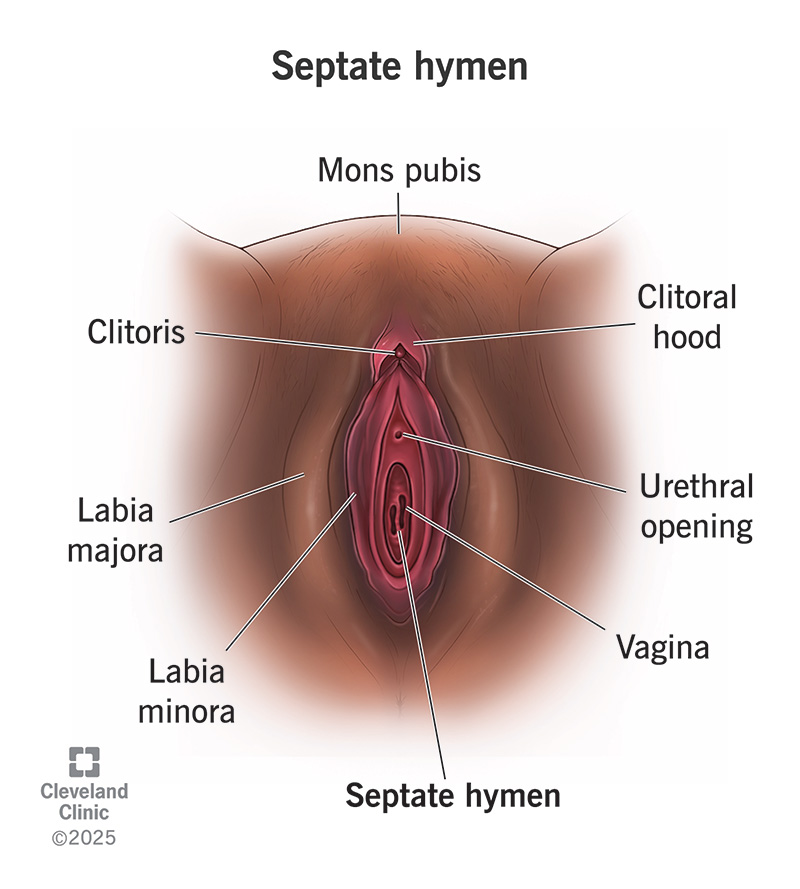
Image content: This image is available to view online.
View image online (https://my.clevelandclinic.org/-/scassets/images/org/health/articles/22257-septate-hymen)
A septate hymen is a hymen with two holes instead of one. This happens because of an extra piece of skin or tissue down the middle of it.
Advertisement
Cleveland Clinic is a non-profit academic medical center. Advertising on our site helps support our mission. We do not endorse non-Cleveland Clinic products or services. Policy
Your hymen is a thin, fleshy membrane that surrounds the opening of your vagina. If you have a septate hymen, extra hymenal tissue creates two small vaginal openings instead of one.
A septate hymen is a hymenal anomaly. Hymenal anomalies (conditions you’re born with) are rare. Between 1 and 1,000 and 1 in 10,000 females are born with atypical hymens.
Learning your genital anatomy is different from what’s expected may leave you with questions or concerns. Know that a septate hymen is just that — a difference. It may go away on its own, or a simple surgery can treat it.
Signs of a septate hymen include:
A septate hymen may not cause any symptoms at all. But if you have any pain or abnormal bleeding near your vagina, talk to your healthcare provider.
A septate hymen happens when the hymen forms differently during fetal development. But scientists don’t know what causes the difference. There’s nothing you can do to prevent it.
A healthcare provider may detect a septate hymen at birth during a newborn’s physical exam. But providers most commonly diagnose it in teenagers when symptoms appear due to difficulties with using period products or sex.
Advertisement
A healthcare provider (usually a gynecologist) can diagnose a septate hymen while looking at your vagina. This is usually part of a pelvic exam.
Your first pelvic exam may bring up some anxiety simply because you don’t know what to expect. Make sure your provider is someone you feel comfortable with. If you feel uncomfortable at any point, say so. You have control over your body.
A septate hymen may go away on its own, or you can get surgery to treat it.
The extra band of tissue in a septate hymen can stretch and tear on its own with certain body movements. If your hymen rips or expands on its own, there may be no treatment necessary. If you try to push a tampon into your vagina or try sexual intercourse, the hymenal tear could be more painful and start to bleed.
You may choose to have surgery to open up or remove your hymen if it gets in the way of:
The surgery is called a hymenotomy or hymenectomy. Your healthcare provider cuts away the extra tissue, leaving only one opening that’s a typical size. It’s a minor outpatient procedure, which means you can go home the same day.
Your provider will talk to you about options for anesthesia to manage pain during the procedure. You may need stitches afterward, which usually dissolve on their own.
A septate hymen may cause pain and limit sexual activity, but it’s not a dangerous condition.
Sometimes, it goes away on its own as a child grows. Your hymen may tear or wear down from everyday activities, like riding a bike or doing gymnastics. This may naturally open it up.
Yes, you can still have a period if you have a septate hymen. This is because the two openings are large enough for blood to flow out of your vagina during your period.
You might experience issues when you use tampons to catch menstrual blood. A tampon may not go in at all. Or it might not come out because the band of extra tissue acts as a barrier to removing the tampon. Sometimes, using tampons isn’t a problem because both openings are large enough.
Contact your healthcare provider if you have difficulty using tampons or painful sexual intercourse.
If you want to know more about your hymen, consider asking a healthcare provider the following questions:
Advertisement
If you’ve had surgery to repair a septate hymen and have signs of infection, like fever or pus, call your provider.
There’s nothing you can do to control the shape of your hymen. And everyone’s hymen is different. If you have a septate hymen, it may not cause any symptoms. But if you’re having issues with tampon use or penetrative sex, it’s a good idea to see your healthcare provider.
Talking about your genital anatomy or sex life can be difficult. But it’s nothing to be ashamed of. It’s an important part of your health. And your provider is there to help you, not judge you.
Advertisement



Sign up for our Health Essentials emails for expert guidance on nutrition, fitness, sleep, skin care and more.
Learn more about the Health Library and our editorial process.
Cleveland Clinic’s health articles are based on evidence-backed information and review by medical professionals to ensure accuracy, reliability and up-to-date clinical standards.
Cleveland Clinic’s health articles are based on evidence-backed information and review by medical professionals to ensure accuracy, reliability and up-to-date clinical standards.
From routine pelvic exams to high-risk pregnancies, Cleveland Clinic’s Ob/Gyns are here for you at any point in life.
