The tibial tuberosity, a bony bump below the kneecap, anchors muscles and tendons that help straighten the leg. It’s vital for movements like squatting and jumping. It also plays a role in kids’ bone growth. Common issues include Osgood-Schlatter disease, avulsion fractures and direct fractures. Seek medical care for pain, swelling or weakness in your knee.
Advertisement
Cleveland Clinic is a non-profit academic medical center. Advertising on our site helps support our mission. We do not endorse non-Cleveland Clinic products or services. Policy
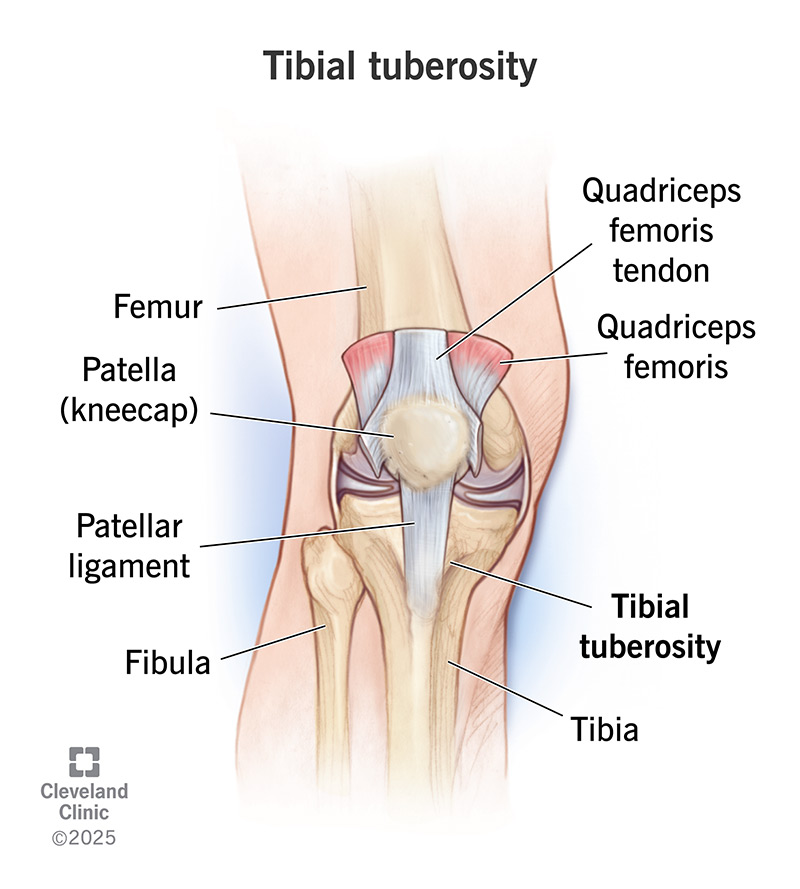
Image content: This image is available to view online.
View image online (https://my.clevelandclinic.org/-/scassets/images/org/health/articles/tibial-tuberosity)
Your tibial tuberosity, or tibial tubercle, is a rounded bony bump on the front of your shin bone, just below your kneecap. Your patellar tendon, which is a continuation of the quadriceps tendon after the patella, also connects to your tibial tuberosity.
Advertisement
Cleveland Clinic is a non-profit academic medical center. Advertising on our site helps support our mission. We do not endorse non-Cleveland Clinic products or services. Policy
This connection is why this bony bump is a key player on the team of tendons, ligaments and muscles that support your knees and let you straighten your lower leg.
Your tibial tuberosity acts like an anchor for the muscles and tendons that let you squat, jump or simply get up from sitting down. Here’s how this happens:
Your tibial tuberosity also factors into how kids’ bones change as they grow up. It covers the growth plates at the top of kids’ shinbones.
Your tibial tubercle is on the front of your shin bone. You can feel it if you run your fingers straight down from your kneecap. There’s a soft section right below your kneecap. Next, you’ll feel a raised section of bone. This is your tibial tuberosity. Your patellar tendon connects to the smooth upper half of the bony section. The lower half is rough.
Advertisement
Inflammation and injury are the most common issues that can affect it.
Contact a healthcare provider if your knee hurts and you have swelling just below your kneecap. These may be symptoms of Osgood-Schlatter disease that can affect your tibial tuberosity. Get medical care right away if you have symptoms like:
Tibial tuberosity is the tongue-twister of a name for a part of your shinbone. It supports the complicated process that lets you straighten your leg to do things like kick a ball, jump up or run. Overdoing activities like running or jumping may affect it. Don’t hesitate to talk to a healthcare provider if your knees hurt. Finding the cause and getting treatment is the first step toward getting well and back to your active life.
Advertisement



Sign up for our Health Essentials emails for expert guidance on nutrition, fitness, sleep, skin care and more.
Learn more about the Health Library and our editorial process.
Cleveland Clinic’s health articles are based on evidence-backed information and review by medical professionals to ensure accuracy, reliability and up-to-date clinical standards.
Cleveland Clinic’s health articles are based on evidence-backed information and review by medical professionals to ensure accuracy, reliability and up-to-date clinical standards.
From sudden injuries to chronic conditions, Cleveland Clinic’s orthopaedic providers can guide you through testing, treatment and beyond.