



The pectineus is a short, flat muscle in your thigh. You have one on either side of your pelvis. These muscles help you move your legs in, toward your body. They also help flex your hips to let you lift your knees.
Advertisement
Cleveland Clinic is a non-profit academic medical center. Advertising on our site helps support our mission. We do not endorse non-Cleveland Clinic products or services. Policy
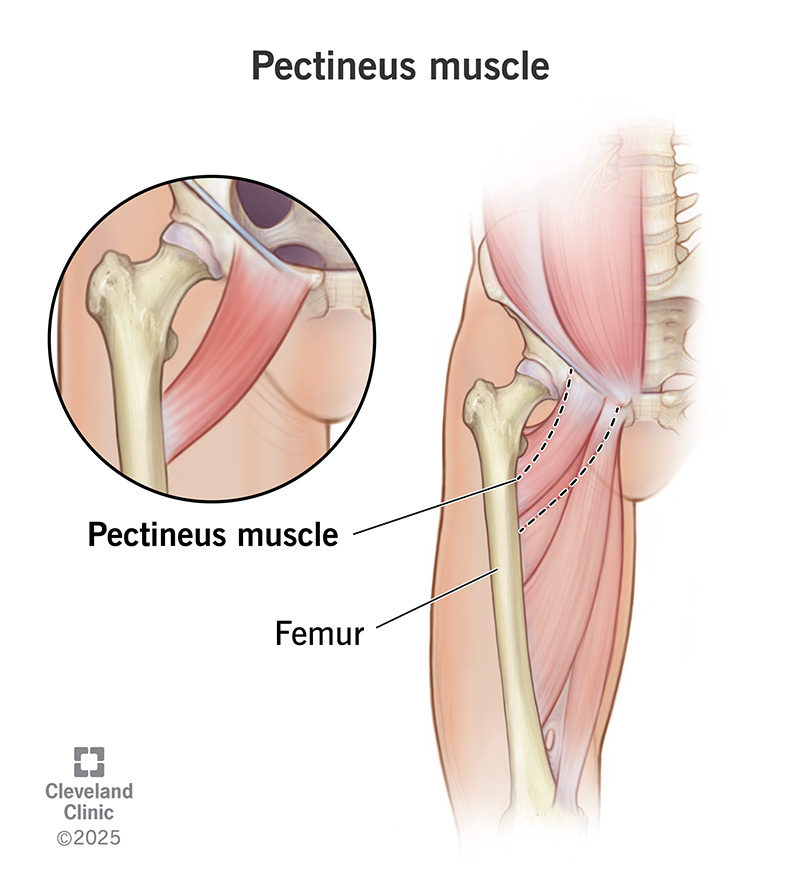
Image content: This image is available to view online.
View image online (https://my.clevelandclinic.org/-/scassets/images/org/health/articles/pectineus-muscle)
The pectineus is a muscle in your thigh that helps you move your hips and knees. You have one on either side of your pelvis. They’re in the group of muscles called your hip flexors. These are the muscles where your thigh meets your hip.
Advertisement
Cleveland Clinic is a non-profit academic medical center. Advertising on our site helps support our mission. We do not endorse non-Cleveland Clinic products or services. Policy
The pectineus is small compared to bigger thigh muscles, like your hamstrings or quads. But it still plays a big role in helping you move and use your legs.
Thigh muscle injuries (including your pectineus) are common. Visit a healthcare provider if you have pain in your thigh or groin that lasts for more than a few days.
The pectineus works with your other hip flexors to move and rotate your hips. It helps with two main actions:
Your other hip flexors help with multiple motions, too. But only the pectineus works on both of these movements.
The pectineus is at the front of your thigh, right by your pelvis. The top connects to your pelvis near your pubic bone. It runs at an angle away from the center of your body to the top of your thigh bone (femur). It wraps behind your femur and connects on the back side.
Healthcare providers group muscles together in sets called compartments. Because they’re right on the border of two compartments, the pectineus muscles are sometimes put in both groups. Some group them in the medial (inner) compartment of thigh muscles. Others put them in the anterior (front) compartment. You’ll probably never need to know or worry about this unless you’re studying muscles. Your healthcare provider will walk you through all these terms if you have an issue with your pectineus muscles.
Advertisement
The pectineus muscle is flat. It has four sides and is shaped sort of like a rectangle with rounded corners.
Strains are by far the most common pectineus muscle issue. A muscle strain happens when a sudden force stretches a muscle farther than its limit. The thousands of tiny fibers that make up the muscle can be stretched apart or torn.
Hip flexor strains are common sports injuries. Any sudden movement that overstretches your pectineus can cause one. Strains can happen if you kick, twist or jerk your leg suddenly.
Injuries are more common if your muscles are tight. Or if you do a lot of physical activity suddenly. You can protect your pectineus muscles with a few simple steps:
Pain in your hip, thigh or groin is the most common sign of a strained pectineus. You might also notice:
Visit a healthcare provider if you have pain or other symptoms that last for more than a few days. See a provider if symptoms make it hard to move or use your hips. Don’t push through pain or other symptoms. This can make a minor strain into a more serious issue.
The pectineus muscles in your thighs aren’t the biggest ones in your legs. But they’re very important. You’re using them all the time, whether or not you know they’re there. When you’re going for a run, chasing your kids around the yard or moving your legs to adjust your posture at your desk, your pectineus muscles help you get around each day.
They shouldn’t need much maintenance, other than some stretching here and there. But visit a healthcare provider if you feel any pain or stiffness that lasts long enough to affect your daily routine. It’s always a good idea to get muscle injuries diagnosed before they can become bigger problems.
Advertisement



Sign up for our Health Essentials emails for expert guidance on nutrition, fitness, sleep, skin care and more.
Learn more about the Health Library and our editorial process.
Cleveland Clinic’s health articles are based on evidence-backed information and review by medical professionals to ensure accuracy, reliability and up-to-date clinical standards.
Cleveland Clinic’s health articles are based on evidence-backed information and review by medical professionals to ensure accuracy, reliability and up-to-date clinical standards.
Cleveland Clinic’s primary care providers offer lifelong medical care. From sinus infections and high blood pressure to preventive screening, we’re here for you.
