



Montgomery glands can appear as tiny, skin-colored bumps on your areolas, the darker circles around your nipples. They grow larger during pregnancy to prepare for breastfeeding, where they’ll play an important role. These specialized sebaceous glands release an oil that protects your nipples from chafing and infection. It also attracts your baby.
Advertisement
Cleveland Clinic is a non-profit academic medical center. Advertising on our site helps support our mission. We do not endorse non-Cleveland Clinic products or services. Policy
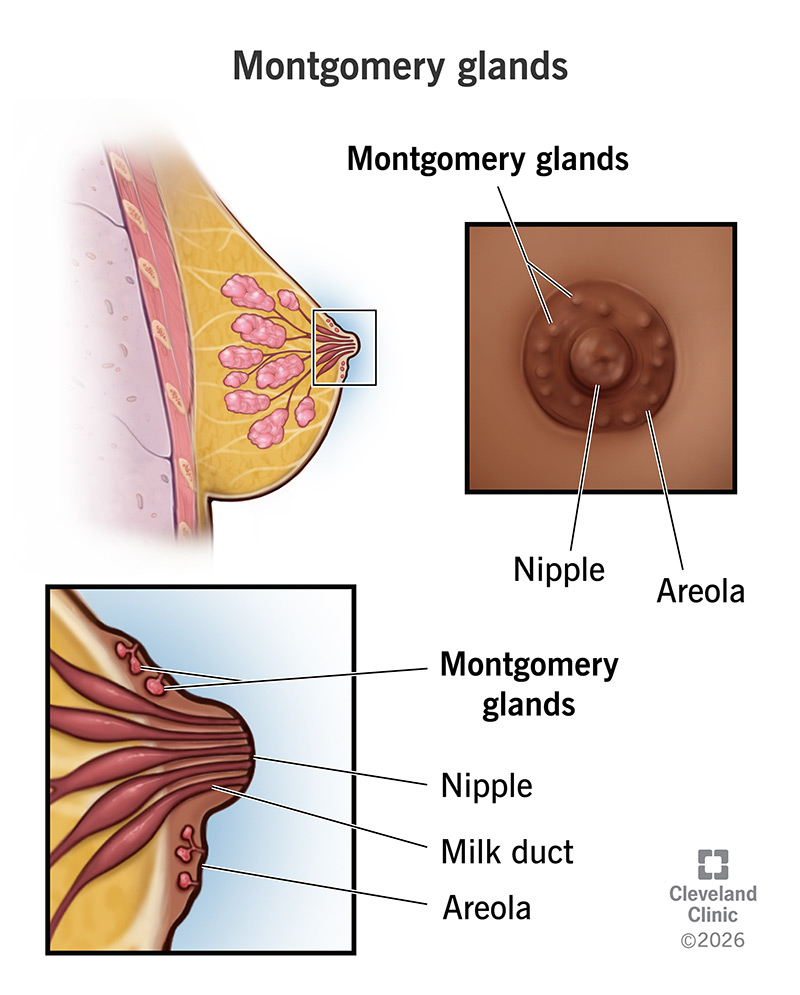
Image content: This image is available to view online.
View image online (https://my.clevelandclinic.org/-/scassets/images/org/health/articles/montgomery-glands.jpg)
Montgomery glands are sebaceous glands in your areolas, the circles of darker skin around your nipples. Sebaceous glands release oils that lubricate and protect your skin. Montgomery glands help nourish and protect the skin of your areolas and nipples, especially during breastfeeding. That’s why they may become more visible when you’re pregnant or producing milk (lactating). You might notice tiny, raised bumps on your areolas.
Advertisement
Cleveland Clinic is a non-profit academic medical center. Advertising on our site helps support our mission. We do not endorse non-Cleveland Clinic products or services. Policy
Montgomery glands (also called areolar glands) are different from the mammary glands in your breasts. Mammary glands release milk. Montgomery glands release a clear, lubricating substance. They do this all the time, in both male and female breasts — not just when you’re pregnant or breastfeeding. But they do grow during pregnancy, and they play a special role during lactation and breastfeeding.
Montgomery glands release an oily substance that’s like a special type of sebum for your areolas and nipples. It’s a little different from the sebum that your other sebaceous glands in your skin release. It:
Montgomery glands also connect to mammary glands, and they can release small amounts of milk. Some believe they might serve as backup mammary glands when you need more to feed your baby.
Advertisement
You’ll find Montgomery glands (areolar glands) inside the darker skin around your nipples. They circle your nipples just under your skin, often at the base of hair follicles.
They release oil through tiny skin openings called tubercles. Your healthcare provider might refer to them as Montgomery tubercles, or sometimes, tubercles of Morgagni.
The number, size and appearance of Montgomery glands vary widely from person to person. Some people have only a few that are barely noticeable. Others have many that are more visible. These differences are normal.
You might not see them all the time. But sometimes, Montgomery glands appear as little bumps on your areolas that look like goosebumps. You may notice them for the first time during pregnancy. In some people, they can be an early sign of pregnancy, since they start to grow in the first trimester. They’ll continue to grow during pregnancy and stay enlarged while you’re breastfeeding, and sometimes even afterward.
You may also see them when:
Like other skin glands, Montgomery tubercles can get clogged or infected. A clogged tubercle might become swollen and firm, like a pimple. It often clears up on its own. But you can help it along by applying a warm cloth. Don’t squeeze it — this can cause infection. Your healthcare provider may recommend a topical antibiotic if needed to prevent infection. If your gland is sore and inflamed, see your provider.
Rarely, benign (noncancerous) growths or cysts can develop in Montgomery glands. This can happen if the ducts that drain the glands on the inside get clogged. Your healthcare provider may call this a retroareolar cyst, or cyst of Montgomery. It shows up as a swollen mass behind your areola, which may or may not be painful. Although these cysts are usually benign, they can become infected. Your provider will treat them with antibiotics and anti-inflammatory medicine if there’s an infection or inflammation.
Clogged Montgomery glands aren’t common. But you may be more at risk if you use heavy nipple balms on your nipples and areolas. Balms and creams can help soothe sore or cracked nipples during breastfeeding. If you use them, just make sure to wipe them off for a short time each day to let your skin breathe. If you use breast pads, changing them regularly can help prevent infections.
Among the many changes that you’ll go through during pregnancy, you may notice tiny Montgomery glands on your areolas for the first time. Like your breasts themselves, these little bumps grow as your body gets ready for breastfeeding.
Montgomery glands play an important role in protecting your areolas and nipples, especially during breastfeeding. As a bonus, they also help attract your baby to your nipples.
Advertisement



Sign up for our Health Essentials emails for expert guidance on nutrition, fitness, sleep, skin care and more.
Learn more about the Health Library and our editorial process.
Cleveland Clinic’s health articles are based on evidence-backed information and review by medical professionals to ensure accuracy, reliability and up-to-date clinical standards.
Cleveland Clinic’s health articles are based on evidence-backed information and review by medical professionals to ensure accuracy, reliability and up-to-date clinical standards.
Breastfeeding is natural and rewarding, but it’s not without challenges. Get the support you need at Cleveland Clinic.
