



Your lips are a key part of so many everyday activities. They help you talk and eat, and they’re a key part of your facial appearance. But your lips are prone to many medical conditions. And they can show symptoms that mean you should talk to a healthcare provider.
Advertisement
Cleveland Clinic is a non-profit academic medical center. Advertising on our site helps support our mission. We do not endorse non-Cleveland Clinic products or services. Policy
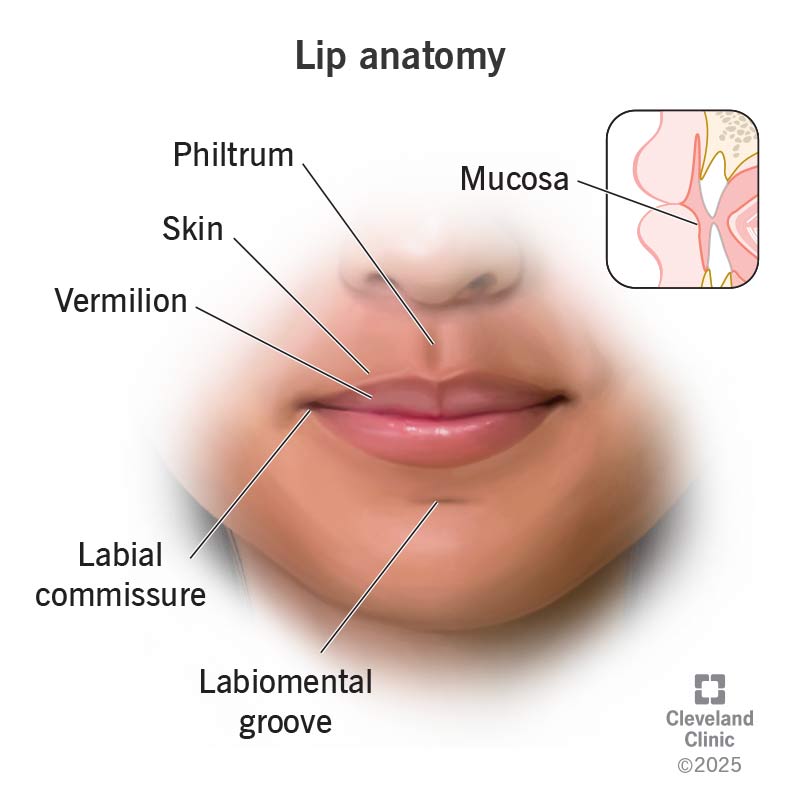
Image content: This image is available to view online.
View image online (https://my.clevelandclinic.org/-/scassets/images/org/health/articles/lip-anatomy.jpg)
Your lips are two folds of tissue that make up the external structures around your mouth. While you might just be thinking about the softer, hairless skin right around your mouth, your lips actually include a lot more.
Advertisement
Cleveland Clinic is a non-profit academic medical center. Advertising on our site helps support our mission. We do not endorse non-Cleveland Clinic products or services. Policy
The medical term for your lips is “labia oris” or just “labia.” Your upper lip is the labium superior, and your bottom lip is the labium inferior. Here, superior means upper and inferior means bottom (as opposed to better or worse).
Your lips have several different purposes, including:
Your upper lip technically starts at the bottom edge of where your nose extends outward from your face. Your bottom lip ends just as your chin starts to extend forward, about even with where your lower gumline connects to the inside of your lip.
Advertisement
Your lips have the following parts:
The main muscles that control your lips are the orbicularis oris muscles. They form an oval under the skin around your mouth. They don’t attach to your skull directly. Instead, they attach to other muscles of your face, especially muscles that attach around your cheekbones and chin.
Your lips also rely on specific nerve connections to your brain. Your facial nerve carries signals that control lip movement. But your trigeminal nerve carries signals to your brain related to your lips’ sense of touch.
Your lips are prone to many conditions, ranging from those that are lip-specific to those that affect your skin in general. Possible lip conditions include:
Lip conditions often cause changes you can see or feel. They include:
Your dentist is often the main person to help you manage the health of your lips. But your primary care provider may also be able to help, especially with conditions on the lips’ skin area.
Your dentist will usually examine your lips during routine visits like cleanings. A primary care provider is most likely to use a physical exam to check for lip-related skin issues.
Advertisement
Primary care providers can also use lab tests like swab cultures or tissue biopsies. The tests that can help, depending on your symptoms or if they suspect certain issues. Your dentist or primary care provider is the best one to tell you more about possible tests and why they might help.
There are a few treatments that might specifically affect your lips. They include:
Because lips are such a key part of your facial appearance, there are several types of cosmetic procedures specifically for your lips. Examples include:
Other types of cosmetic procedures are possible, too. If you have questions about options, your primary care provider can refer you to a specialist who can tell you more.
There are several things you can do to help your lips stay healthy and looking their best, including:
Advertisement
Even though they’re front and center on your face, it can still be easy to take your lips for granted. Understanding how they work and how to care for them can help you keep them looking their best. And knowing the conditions and symptoms that can affect your lips can help you get care sooner.
If you have questions about your lips’ health, talk to your dentist or primary care provider. They can guide you on the best ways to keep your lips healthy and looking their best.
Advertisement



Sign up for our Health Essentials emails for expert guidance on nutrition, fitness, sleep, skin care and more.
Learn more about the Health Library and our editorial process.
Cleveland Clinic’s health articles are based on evidence-backed information and review by medical professionals to ensure accuracy, reliability and up-to-date clinical standards.
Cleveland Clinic’s health articles are based on evidence-backed information and review by medical professionals to ensure accuracy, reliability and up-to-date clinical standards.
Cleveland Clinic’s primary care providers offer lifelong medical care. From sinus infections and high blood pressure to preventive screening, we’re here for you.
