Your ileum is the last section of your small intestine. It’s where digestion finishes and nutrients, like vitamin B12 and bile salts, are absorbed. Your ileum plays a vital role in helping your body get energy from food and protecting your gut from harmful bacteria. You can take care of it by eating nutritiously and staying physically active.
Advertisement
Cleveland Clinic is a non-profit academic medical center. Advertising on our site helps support our mission. We do not endorse non-Cleveland Clinic products or services. Policy
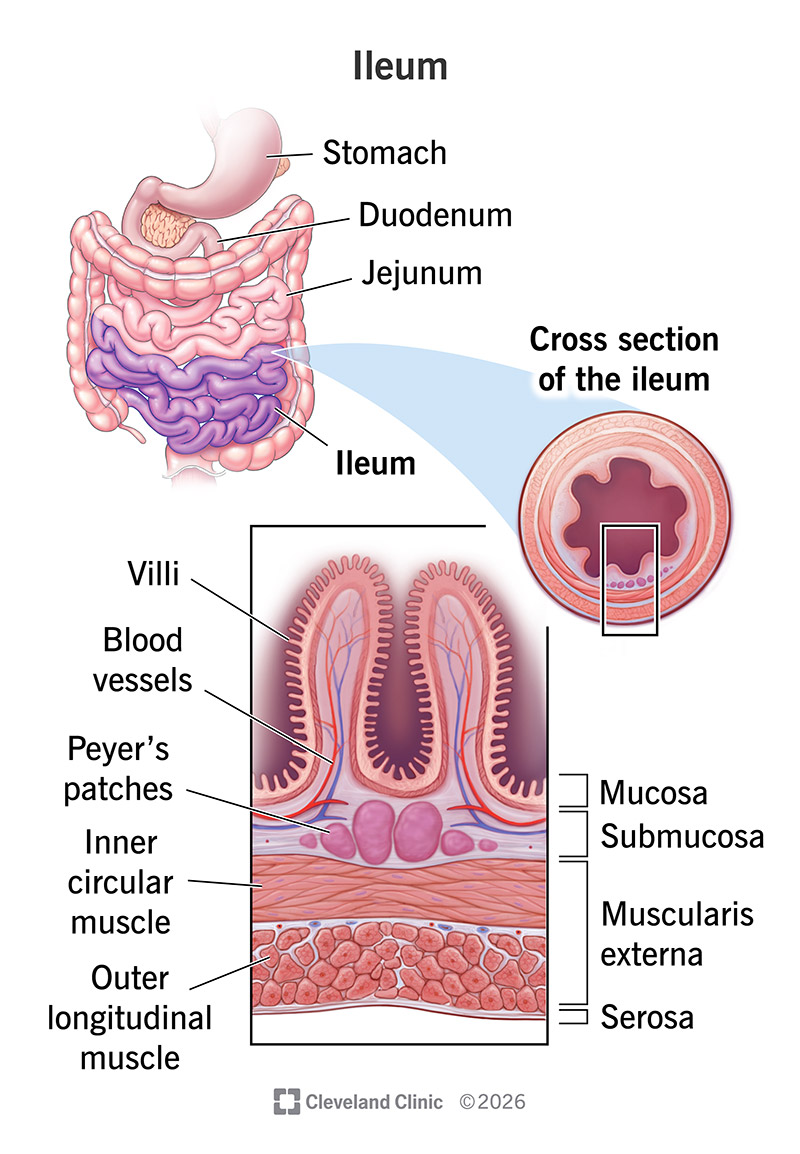
Image content: This image is available to view online.
View image online (https://my.clevelandclinic.org/-/scassets/Images/org/health/articles/ileum.jpg)
Your ileum (pronounced “IH-lee-um”) is the final part of your small intestine. It connects the middle part of your small intestine (jejunum) to your large intestine.
Advertisement
Cleveland Clinic is a non-profit academic medical center. Advertising on our site helps support our mission. We do not endorse non-Cleveland Clinic products or services. Policy
Your ileum’s main job is to absorb certain nutrients from the food you eat. These nutrients include vitamin B12, fats and bile salts. They help your body further digest food and make energy.
Health conditions related to your ileum can lead to malabsorption of these nutrients. So, it’s important to keep this part of your small intestine healthy.
Your ileum has a few important functions. These include:
Your ileum is located in the lower right part of your abdominal cavity. It sits between the middle part of your small intestine (jejunum) and the ileocecal valve.
The ileocecal (pronunced “il-ee-oh-SEE-kuhl”) valve connects the end of your small intestine (distal ileum) to the first part of your large intestine (cecum). It helps control the flow of digested food. It also prevents bacteria in the large intestine from moving backward.
Advertisement
A fold of tissue called the mesentery attaches your ileum to the back of your belly (abdomen). This tissue holds your ileum in place. It carries the ileum’s blood vessels, nerves and lymphatic tissue.
There are a couple of distinct features along your ileum. The proximal ileum is closer to your jejunum. It has large folds and fewer lymphoid follicles.
The terminal ileum is at the very end of the distal ileum. It’s the closest part to your large intestine. It has smaller folds but more lymphoid tissue than the proximal ileum.
The terminal ileum plays a key role in absorbing vitamin B12 and bile salts. Problems here can affect how well your body digests food and absorbs nutrients.
Like the rest of your small intestine, your ileum has four layers. From the inside out, these layers are:
Your ileum is a coiled, flexible, narrow tube. It looks like a loosely curled rope. Its diameter (width) is smaller than your jejunum (the middle part of your small intestine).
Your ileum is also lined with small circular folds. The folds are less noticeable than they are in your jejunum. So, they make the inner surface appear smoother.
Your ileum is usually a light pink color. That’s because it has a slightly lower blood supply than your jejunum (which is bright red). It also has a thinner wall.
Your ileum is about 11.5 feet (3.5 meters) long. It makes up about 3/5 of the total length of your small intestine.
Several health conditions can affect the ileum, including:
Advertisement
If your ileum is inflamed, it can’t absorb nutrients properly. Because of this, you may feel weakness or discomfort. Signs that something may be going on in your ileum include:
To help keep your ileum healthy:
Your ileum quietly supports your body every day. It finishes digestion, absorbs vital nutrients and defends against infection. If you have symptoms that won’t go away — like bloating, pain or diarrhea — don’t ignore them. Your digestive health plays an important role in how you feel overall. And a healthcare provider can help you keep your gut strong and healthy.
Advertisement



Sign up for our Health Essentials emails for expert guidance on nutrition, fitness, sleep, skin care and more.
Learn more about the Health Library and our editorial process.
Cleveland Clinic’s health articles are based on evidence-backed information and review by medical professionals to ensure accuracy, reliability and up-to-date clinical standards.
Cleveland Clinic’s health articles are based on evidence-backed information and review by medical professionals to ensure accuracy, reliability and up-to-date clinical standards.
If you have issues with your digestive system, you need a team of experts you can trust. Our gastroenterology specialists at Cleveland Clinic can help.