Your jejunum is the middle part of your small intestine. It breaks down food and absorbs nutrients your body needs for energy and growth. Eating nutritious foods, drinking plenty of water and staying active can help keep your jejunum healthy and working its best.
Advertisement
Cleveland Clinic is a non-profit academic medical center. Advertising on our site helps support our mission. We do not endorse non-Cleveland Clinic products or services. Policy
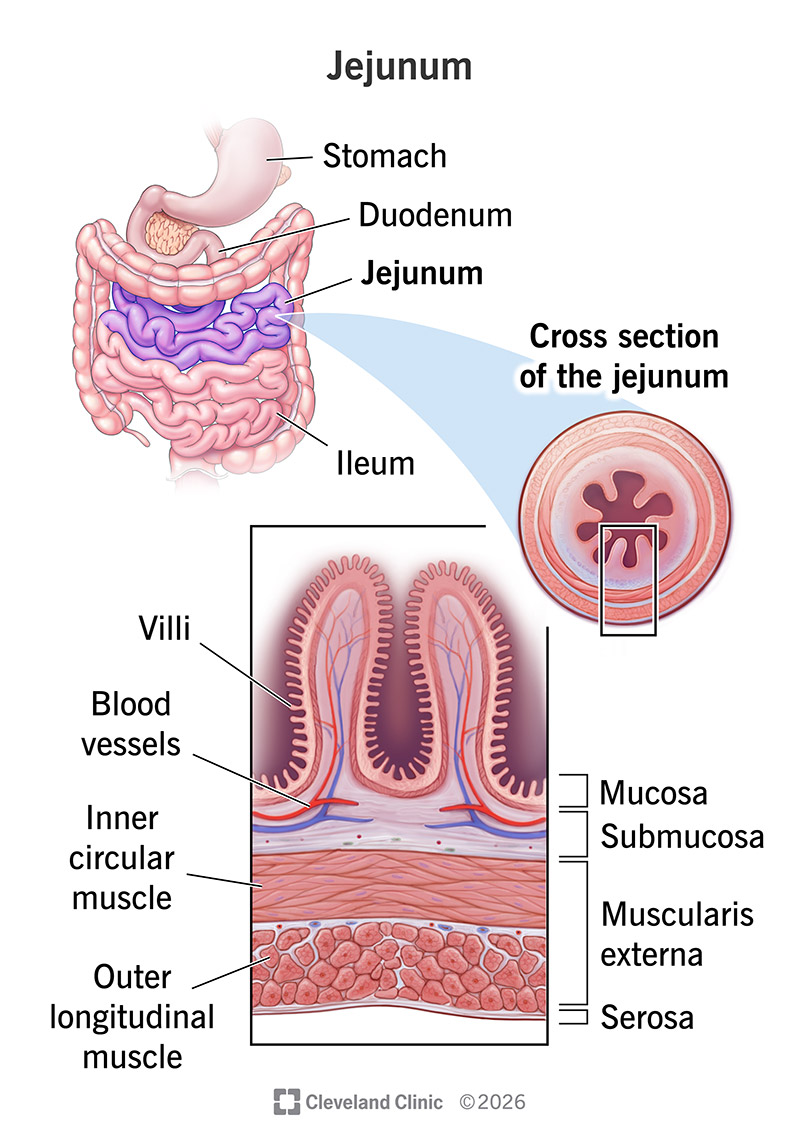
Image content: This image is available to view online.
View image online (https://my.clevelandclinic.org/-/scassets/images/org/health/articles/jejunum.jpg)
Your jejunum (pronounced “jeh-JYOO-num”) is the middle section of your small intestine. It’s located between the other parts of your small intestine — the duodenum and the ileum. The main function of your jejunum is to help with digestion. It also absorbs nutrients from foods into your bloodstream. These include carbohydrates, proteins, fats, vitamins and minerals.
Advertisement
Cleveland Clinic is a non-profit academic medical center. Advertising on our site helps support our mission. We do not endorse non-Cleveland Clinic products or services. Policy
Maintaining a healthy jejunum is important for overall digestion and nutrient absorption. Consuming healthy foods, staying hydrated and getting regular physical activity can help keep this part of your small intestine working properly.
Your jejunum has several key functions. These include:
Your jejunum is located in the upper left part of your abdominal cavity. It sits between the first part (duodenum) and the last part (ileum) of your small intestine.
Your jejunum is attached to the back of your belly (abdomen) by a fold of tissue called the mesentery. This tissue holds your jejunum in place and carries blood vessels, nerves and lymph.
From the inside to the outside, your jejunum has four main layers:
Advertisement
Your jejunum is shaped like a tube. Its internal diameter (width) is about 1 inch (2.5 centimeters). That’s why it’s called your “small” intestine.
Your jejunum is flexible and coiled in loops. It has large circular folds that make it look delicate and feathery on imaging or under a microscope.
Your jejunum is a deep red color. That’s because of its rich blood supply and thick wall. Your ileum, on the other hand, is generally pink and has a thinner wall.
Your jejunum is about 8 feet (2.5 meters) long. It makes up about two-fifths of the total length of your small intestine.
Several health conditions can affect your jejunum. These include:
If your jejunum can’t absorb nutrients properly, your body may feel weak, ill or uncomfortable. Symptoms you may notice include:
To help keep your jejunum healthy:
Your jejunum works quietly every day to keep you nourished and energized. And your digestive health plays a big role in how you feel overall. The way you treat your body every day affects how well your jejunum works. Taking care of it starts with simple habits. Eat mindfully, stay active and listen to your body. These practices will go a long way toward keeping your digestive system strong and healthy.
Advertisement



Sign up for our Health Essentials emails for expert guidance on nutrition, fitness, sleep, skin care and more.
Learn more about the Health Library and our editorial process.
Cleveland Clinic’s health articles are based on evidence-backed information and review by medical professionals to ensure accuracy, reliability and up-to-date clinical standards.
Cleveland Clinic’s health articles are based on evidence-backed information and review by medical professionals to ensure accuracy, reliability and up-to-date clinical standards.
If you have issues with your digestive system, you need a team of experts you can trust. Our gastroenterology specialists at Cleveland Clinic can help.